
Product Planning and Design Management (Product Development, Design Procedure, DR, VE)
製品企画と設計管理(製品開発・設計手順・DR・VE)
Production Management Planning Grade 3 生産管理プランニング (BC検定) · ビジネス・キャリア検定 生産管理プランニング3級 · Written by Tokutei Pass based on the official study texts; not copied verbatim.
1. 製品企画とマーケティング(マーケットイン・SWOT分析・4P・消費財と生産財)
1. Product Planning and Marketing (Market-In, SWOT Analysis, 4Ps, Consumer Goods vs Industrial Goods)
新製品を企画する考え方には、自社の技術力や製造設備を起点に「造れるものを造って売る」という「プロダクトアウト」と、顧客や市場が求めるニーズを起点に「売れるものを企画して造る」という「マーケットイン」があり、現代はマーケットインが基本です。
Approaches to planning new products include Product-Out, which starts from a company's own technology and manufacturing equipment (making what can be made and selling it), and Market-In, which starts from customer and market needs (planning and making what will sell); today, Market-In is fundamental.
製品企画の環境分析では「SWOT分析」を用います。自社の「内部環境」である強み(Strengths)・弱み(Weaknesses)と、市場や競合などの「外部環境」である機会(Opportunities)・脅威(Threats)の4つを整理して戦略を立てます。
Environmental analysis in product planning uses SWOT Analysis. Strategies are formulated by organizing four elements: the company's Internal Environment—Strengths and Weaknesses—and the External Environment such as markets and competitors—Opportunities and Threats.
また市場へ展開する具体策(マーケティングミックス)は、製品(Product)・価格(Price)・流通経路(Place)・販売促進(Promotion)の頭文字をとった「4P」で構成されます。
Specific market deployment tactics (the Marketing Mix) consist of the 4Ps named after their initials: Product, Price, Place (distribution channels), and Promotion (sales promotion).
なお製品は用途により、個人や家庭が消費する「消費財(日常すぐ買う最寄品・品質価格を比較する買回品・指名買いする専門品)」と、企業が生産活動に使う「生産財(原材料・部品・工作機械等)」に分類されます。
By use, products are classified into Consumer goods consumed by individuals or households (divided by buying behavior into Convenience goods bought daily, Shopping goods compared for quality and price, and Specialty goods bought by brand specification) and Industrial (producer) goods used by businesses for production (raw materials, parts, machine tools, etc.).
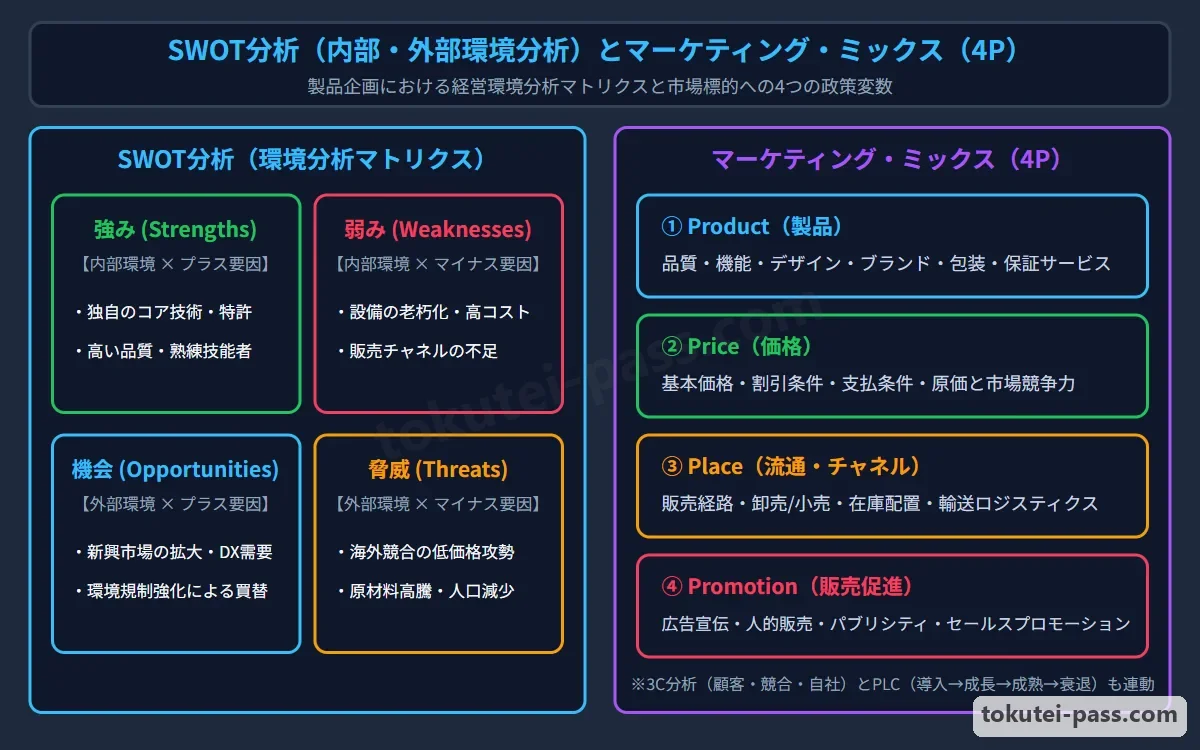
Key points
- マーケットイン=顧客ニーズ起点の製品開発/プロダクトアウト=自社技術・製造起点の製品開発。
Market-In = Customer-need-driven product development / Product-Out = Company-technology- and manufacturing-driven product development. - SWOT分析=内部環境(強みS・弱みW)と外部環境(機会O・脅威T)の4要素分析。
SWOT Analysis = Four-element analysis of Internal environment (Strengths S, Weaknesses W) and External environment (Opportunities O, Threats T). - マーケティングの4P=Product(製品)・Price(価格)・Place(流通・チャネル)・Promotion(販売促進)。
Marketing 4Ps = Product, Price, Place (distribution channels), and Promotion (sales promotion). - 消費財は購買行動により「最寄品・買回品・専門品」に分かれ、企業向けの原材料や設備は「生産財」と呼ぶ。
Consumer goods are divided by purchasing behavior into Convenience, Shopping, and Specialty goods, while raw materials and equipment for businesses are called Industrial (producer) goods.
| Word | Meaning |
|---|---|
| マーケットインとプロダクトアウト | Market-In and Product-Out |
| SWOT分析(強み・弱み・機会・脅威) | SWOT Analysis (Strengths, Weaknesses, Opportunities, Threats) |
| マーケティングの4P(製品・価格・流通・販促) | 4Ps of Marketing (Product, Price, Place, Promotion) |
| 消費財(最寄品・買回品・専門品)と生産財 | Consumer goods (Convenience, Shopping, Specialty goods) and Industrial goods |
2. 設計管理の重要性(原価の80%決定)とフロントローディング・標準化
2. Importance of Design Management (80% of Cost Determined at Design), Front-Loading, and Standardization
製品開発において「製品の品質や製造原価の約80%は設計段階で決まる」と言われます。どのような材質・形状・部品構成・加工精度にするかが図面で決まると、量産開始後の現場改善だけでは原価低減に限界があるためです。
In product development, it is said that approximately 80% of a product's quality and manufacturing cost is determined at the design stage. Once materials, shapes, part structures, and machining tolerances are fixed on drawings, shop-floor kaizen after mass production begins has limited room to reduce costs.
また開発の後工程(試作や量産立ち上げ)になってから設計不良が見つかると、金型の作り直しなどの膨大な「手戻りコスト」と納期遅れが発生します。
Moreover, if design defects are discovered in downstream development stages (prototyping or mass-production ramp-up), massive rework costs (such as remaking molds/dies) and delivery delays occur.
そこで、開発初期の上流工程(構想・基本設計段階)に人員や3次元シミュレーション(CAE)などの経営資源を前倒しで集中投入し、初期段階で問題を解決する「フロントローディング」が重視されます。
Therefore, companies emphasize Front-Loading: shifting and concentrating management resources—such as personnel and 3D computer simulations (CAE)—forward into upstream stages of early development (conceptual and basic design) to solve problems early.
さらに設計の効率化のため、既存の標準部品の活用(部品共通化)や、複数部品を機能単位のブロックにまとめる「モジュール化」を進めることで、設計期間の短縮と品質安定・コストダウンを同時に達成します。
Furthermore, to improve design efficiency, utilizing existing standard parts (parts commonality) and Modularization (grouping multiple parts into functional blocks) simultaneously shortens design lead times, stabilizes quality, and reduces costs.
Key points
- 製品原価の約80%は「設計段階」で決定されるため、上流での原価・品質の造り込みが最も効果的である。
About 80% of product cost is determined at the design stage, making upstream building-in of cost and quality most effective. - フロントローディング=設計初期(上流工程)に作業負荷や検証を前倒しし、後工程での設計変更・手戻りを防ぐ手法。
Front-Loading = Shifting workload and verification forward to early design (upstream processes) to prevent downstream design changes and rework. - 設計の標準化・部品共通化・モジュール化により、新規図面作成や金型費用を削減し開発期間を短縮する。
Design standardization, parts commonality, and modularization reduce new drawing creation and die expenses while shortening development time.
| Word | Meaning |
|---|---|
| 設計段階での原価造り込み(原価の80%) | Building cost in at the design stage (80% of cost) |
| フロントローディングと手戻り防止 | Front-loading and Rework prevention |
| 部品共通化とモジュール設計 | Parts commonality and Modular design |
3. 設計のステップ(製品企画→設計企画→構想設計→詳細設計→生産準備)
3. Steps of Design (Product Planning → Design Planning → Conceptual Design → Detail Design → Production Preparation)
製品開発から量産までの設計手順は、概念的な設計から実体的な設計へと段階的に進みます。まず「①製品企画」で市場ニーズを調査して新製品のコンセプトを定め、続く「②設計企画」で目標とする性能・品質・原価・開発日程の計画書をまとめる段階に入ります。
The design procedure from product development to mass production progresses step by step from conceptual design to substantive (physical) design. First, (1) Product planning surveys market needs to define the new product concept, followed by (2) Design planning, which compiles a plan specifying target performance, quality, cost, and development schedule.
次の「③構想設計(基本設計・機能設計)」では、要求される機能を実現するための基本構造・原理・システム全体のレイアウトや主要ユニットの配置(組立構想図)を決定します。
Next, in (3) Conceptual design (basic design / functional design), engineers determine the basic structure, operating principles, overall system layout, and arrangement of major units (assembly concept drawings) to realize the required functions.
続く「④詳細設計(生産設計・実施設計)」では、構想設計を基に、実際に工場で経済的かつ容易に製造できるよう、個々の部品の具体的な形状・寸法・公差・材質・表面粗さを決め、部品図・組立図・部品表(BOM)を完成させます。
Subsequently, in (4) Detail design (production design / working design), based on the conceptual design and considering economical and easy manufacturing at the plant, engineers determine the specific shapes, dimensions, tolerances, materials, and surface roughness of each individual part, completing detail drawings, assembly drawings, and Bills of Materials (BOM).
その後「⑤試作・評価」で性能や信頼性を検証し、「⑥生産準備(工程設計・設備や金型・治工具の手配・作業標準書の作成)」を経て量産へ移行します。試験では「構想設計(概念)→詳細設計(実体)」の順序が頻出です。
Thereafter, performance and reliability are verified in (5) Prototyping and evaluation, followed by (6) Production preparation (process design, procuring equipment, dies, and jigs/tools, and creating work standards) before transitioning to mass production. Exams frequently test the sequence: Conceptual design (conceptual) → Detail design (substantive).
Key points
- 設計の基本順序:製品企画→設計企画→構想設計(基本設計)→詳細設計(生産設計)→生産準備→量産。
Basic design sequence: Product planning → Design planning → Conceptual design (basic design) → Detail design (production design) → Production preparation → Mass production. - 構想設計=要求機能を満たす原理・基本構造・全体配置を決める「概念的な設計」。
Conceptual design = Conceptual design phase that determines principles, basic structure, and overall layout to satisfy required functions. - 詳細設計(生産設計)=製造のしやすさ(加工性・組立性)やコストを考慮し、全部品の寸法・公差・材質(部品図)を決める「実体的な設計」。
Detail design (production design) = Substantive design phase that considers manufacturability (machinability, assemblability) and cost to fix dimensions, tolerances, and materials for all parts (part drawings).
| Word | Meaning |
|---|---|
| 設計企画・構想設計・詳細設計(生産設計) | Design planning, Conceptual design, Detail design (Production design) |
| 概念的な設計から実体的な設計への展開 | Deployment from conceptual design to substantive (physical) design |
| 組立図・部品図・部品表(BOM) | Assembly drawings, Part drawings, Bill of Materials (BOM) |
4. デザインレビュー(DR:インスペクションとウォークスルー)とコンカレントエンジニアリング
4. Design Review (DR: Inspection vs Walkthrough) and Concurrent Engineering
「デザインレビュー(DR:設計審査)」とは、製品企画・構想設計・詳細設計・試作などの各段階の節目において、設計部門だけでなく製造・生産技術・品質保証・購買・営業などの専門家が集まり、設計内容を多面的に審査して次の段階へ進む可否を判定する仕組みです。
Design Review (DR) is a mechanism at key milestones of each stage—product planning, conceptual design, detail design, and prototyping—where specialists not only from design but also from manufacturing, production engineering, quality assurance, purchasing, and sales gather to review design contents multi-dimensionally and judge whether to proceed to the next stage.
レビューの手法には、定められた役割分担とチェックリストに基づき公式かつ厳格に欠陥を摘出・判定する「インスペクション」と、設計担当者がメンバーに設計手順を説明しながら一緒に誤りや改善点を確認する「ウォークスルー」があります。
Review methods include Inspection—which formally and rigorously detects defects and makes pass/fail judgments based on defined roles and checklists—and Walkthrough—where the designer explains the design steps to team members to jointly confirm errors and improvement points.
また従来の「リレー方式(コンベンショナル方式)」では、設計がすべて終わってから生産準備(工程設計や金型手配)を始めていたため、開発期間が長く後工程からの設計変更が多発していました。
In the traditional relay method (conventional sequential method), production preparation (process design and die procurement) began only after all design work finished, causing long development periods and frequent design changes from downstream processes.
これを改め、製品設計の初期段階から生産技術・製造・購買部門が参画し、情報を共有しながら製品設計と生産準備を「同時並行(コンカレント)」で進める手法を「コンカレントエンジニアリング」と呼び、開発リードタイムの大幅短縮を実現します。
To reform this, Concurrent Engineering involves production engineering, manufacturing, and purchasing departments from the early stages of product design, sharing information and advancing product design and production preparation simultaneously in parallel—achieving dramatic reductions in development lead time.
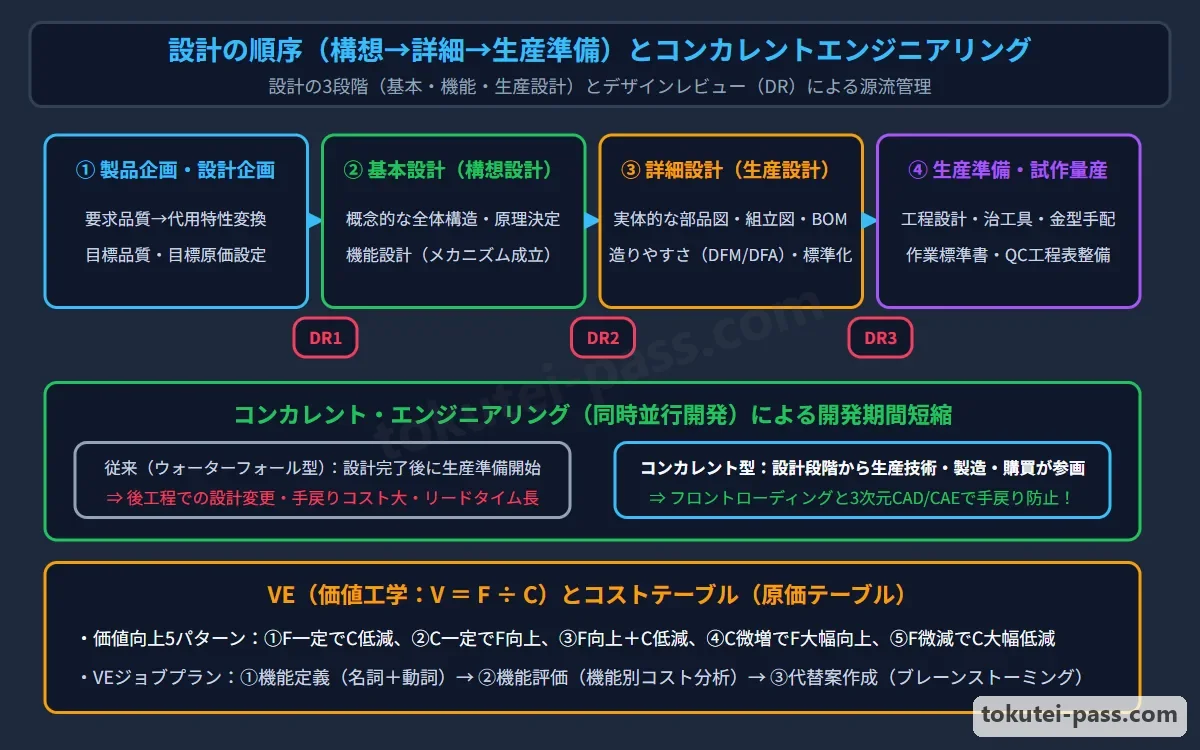
Key points
- デザインレビュー(DR)=設計の各節目で関連部門の専門家がQ・C・Dや造りやすさ・安全性を客観的に審査する活動。
Design Review (DR) = Activity at each design milestone where specialists from related departments objectively review Q, C, D, manufacturability, and safety. - インスペクション=公式な役割と基準による厳格な審査/ウォークスルー=作成者主導で設計内容を説明し誤りを発見するレビュー。
Inspection = Rigorous formal review using defined roles and criteria / Walkthrough = Designer-led review explaining design contents to discover errors. - コンカレントエンジニアリング=製品設計と生産準備(工程設計・金型製作)を同時並行で進め、開発期間短縮と手戻り削減を図る手法。
Concurrent Engineering = Advancing product design and production preparation (process design, die making) simultaneously in parallel to shorten development time and reduce rework.
| Word | Meaning |
|---|---|
| デザインレビュー(DR:設計審査) | Design Review (DR) |
| インスペクションとウォークスルー | Inspection and Walkthrough |
| コンカレントエンジニアリング(同時並行開発) | Concurrent Engineering (Simultaneous parallel development) |
5. 設計におけるQCDの造り込み(代用特性・原価テーブル・設計基準日程と手配番数・3次元CAD)
5. Building QCD into Design (Substitute Characteristics, Cost Tables, Standard Design Schedule & Lead-Time Numbers, 3D CAD)
設計での「品質(Q)」の確保では、顧客が言葉で求める抽象的な「要求品質(例:軽くて壊れにくい・静かに動く)」を、設計者が図面上で計測や制御ができる技術的な数値特性(質量kg・引張強さMPa・騒音レベルdB等)へ置き換えます。これを「代用特性(品質特性)」と呼びます。
To secure Quality (Q) in design, abstract Required qualities expressed in customers' words (e.g., light and durable, runs quietly) are translated into technical numerical characteristics that designers can measure and control on drawings (mass in kg, tensile strength in MPa, noise level in dB, etc.). These are called Substitute characteristics (quality characteristics).
「原価(C)」の確保では、予定販売価格から目標利益を引いて「目標原価(企画原価)」を定めます。設計者が材質や加工方法・寸法を選んだ段階で即座に概算原価を見積もれる一覧表を「原価テーブル(コストテーブル)」と呼び、設計中の原価造り込みに活用します。
To secure Cost (C), Target cost (planned cost) is set by subtracting target profit from the planned selling price. A reference table allowing designers to immediately estimate approximate costs as soon as they select materials, processing methods, and dimensions is called a Cost Table, used to build cost in during design.
「納期(D)」の確保では、出図(図面発行)の遅れが後工程の金型手配や部品調達を直撃するため、製品完成日から逆算した「手配番数(リードタイムの日数番数)」に基づく「設計基準日程」を設定し、リードタイムの長い部品から優先して出図します。
To secure Delivery (D), because delays in drawing release directly hit downstream die ordering and parts procurement, a Standard design schedule based on Lead-time numbers (days counted backward from product completion) is set, prioritizing early drawing release for long-lead-time parts.
またコンピュータ支援技術として、図面や立体モデルを作成する「3次元CAD」、CADデータからNC加工プログラムを作成する「CAM」、強度や熱・流動を事前解析する「CAE」を連携させ、試作回数の削減と設計品質の向上を図ります。
As computer-aided technologies, 3D CAD (creating drawings and solid models), CAM (generating NC machining programs from CAD data), and CAE (pre-analyzing strength, heat, and fluid flow) are linked to reduce prototype iterations and improve design quality.
Key points
- 代用特性=顧客の「要求品質(使い勝手等)」を、設計・製造で測定可能な物理的・技術的数値(寸法・強度・重量等)に翻訳した特性。
Substitute characteristics = Characteristics that translate customer Required quality (usability, etc.) into physical, technical values measurable in design and manufacturing (dimensions, strength, weight, etc.). - 原価テーブル=設計者が材質・形状・加工法ごとの原価を容易に比較・算出できるようにしたデータ表。
Cost Table = Data table enabling designers to easily compare and calculate costs by material, shape, and processing method. - 設計基準日程と手配番数=調達・加工リードタイムの長い部品(長納期品)から順次先行して出図する日程基準。
Standard design schedule & Lead-time numbers = Scheduling criteria that release drawings sequentially starting from parts with long procurement and processing lead times. - 【例】予想販売価格10,000円・目標売上利益率20%・現状の成行き見積原価8,600円 → 目標原価=10,000×(1-0.20)=8,000円、設計段階での要原価低減額=8,600-8,000=600円
Example: Expected selling price 10,000 yen, target profit margin on sales 20%, current estimated drifting cost 8,600 yen → Target cost = 10,000 × (1 - 0.20) = 8,000 yen, required cost reduction at design stage = 8,600 - 8,000 = 600 yen
| Word | Meaning |
|---|---|
| 要求品質と代用特性(品質機能展開:QFD) | Required quality and Substitute characteristics (Quality Function Deployment: QFD) |
| 原価企画と原価テーブル(コストテーブル) | Target costing and Cost Table |
| 設計基準日程・手配番数・出図管理 | Standard design schedule, Lead-time numbers, Drawing release control |
| 3次元CAD・CAM・CAE | 3D CAD, CAM, CAE |
6. VE(バリューエンジニアリング:価値工学)の基礎理論と価値の定義式(V=F÷C)
6. Fundamental Theory of VE (Value Engineering) and the Value Formula (V = F ÷ C)
「VE(Value Engineering:価値工学)」とは、「最低のライフサイクルコスト(LCC:製造原価だけでなく使用・保守・廃棄までの総コスト)で、必要な機能を確実に達成するために、製品やサービスの機能的研究に注力する組織的な努力」と定義されます。
VE (Value Engineering) is defined as an organized effort directed at analyzing the functions of products and services to reliably achieve the required functions at the lowest Life Cycle Cost (LCC: total cost covering not only manufacturing cost but also usage, maintenance, and disposal).
単なるコストカットが「今ある部品の形状のまま安く作る(品質低下を招きやすい)」というモノ中心の考え方であるのに対し、VEは「その部品は何の働き(機能)をするのか」という「機能中心・顧客重視」で考える点が最大の特徴です。
Whereas simple cost-cutting is an object-centered approach (making an existing part's shape cheaper, which easily degrades quality), VE's greatest feature is its function-centered and customer-oriented thinking: asking what work (function) that part performs.
VEにおいて、製品の「価値(Value:V)」は、その製品が果たす「機能の大きさ・機能評価値(Function:F)」と、それを得るために費やす「コスト(Cost:C)」の比、すなわち「V = F ÷ C」の式で表されます。
In VE, the Value (V) of a product is expressed as the ratio of the magnitude of function or functional worth (Function: F) performed by the product to the Cost (C) expended to obtain it: the formula V = F ÷ C.
したがって価値Vを高める方法には、①機能Fを維持してコストCを下げる(F→、C↓)、②コストCを維持して機能Fを高める(F↑、C→)、③機能Fを高めつつコストCを下げる(F↑、C↓)、④コストCがわずかに増えても機能Fを大幅に高める(F↑↑、C↑)の4パターンがあります。
Accordingly, there are four patterns to increase Value V: (1) Maintain Function F and reduce Cost C (F→, C↓); (2) Maintain Cost C and improve Function F (F↑, C→); (3) Improve Function F while reducing Cost C (F↑, C↓); and (4) Slightly increase Cost C while dramatically improving Function F (F↑↑, C↑).
Key points
- VEの定義=最低のライフサイクルコスト(LCC)で、顧客が必要とする機能を確実に達成するための機能的・組織的研究。
Definition of VE = Organized functional study to reliably achieve the functions required by customers at the lowest Life Cycle Cost (LCC). - 価値の算定式:「価値(V)= 機能(F)÷ コスト(C)」。単なる品質切り下げによるコストダウンはVEではない。
Value formula: Value (V) = Function (F) ÷ Cost (C). Simple cost reduction by degrading quality is not VE. - 価値向上の4形態:①F維持・C低減、②F向上・C維持、③F向上・C低減、④C微増・F大幅向上。
Four forms of value improvement: (1) Maintain F & lower C, (2) Raise F & maintain C, (3) Raise F & lower C, (4) Slightly raise C & greatly raise F. - 【例】現行品の機能評価値F=800円・実際コストC=1,000円から、改善案で機能F=960円・コストC=800円へ改善 → 現行価値V=800÷1,000=0.80、改善後価値V=960÷800=1.20(価値は1.20÷0.80=1.5倍に向上)
Example: From a current item with functional worth F = 800 yen and actual cost C = 1,000 yen, an improvement plan achieves function F = 960 yen and cost C = 800 yen → Current value V = 800 ÷ 1,000 = 0.80, improved value V = 960 ÷ 800 = 1.20 (value improves by 1.20 ÷ 0.80 = 1.5 times)
| Word | Meaning |
|---|---|
| VE(バリューエンジニアリング:価値工学) | VE (Value Engineering) |
| 価値(V)=機能(F)÷コスト(C) | Value (V) = Function (F) ÷ Cost (C) |
| ライフサイクルコスト(LCC)と顧客重視 | Life Cycle Cost (LCC) and Customer orientation |
7. VEにおける機能の分類(使用価値と貴重価値・基本機能と二次機能)
7. Classification of Functions in VE (Use Value vs Esteem Value, Basic Function vs Secondary Function)
VEで分析する「機能(製品や部品が果たすべき働き)」は、顧客にどのような価値を与えるかという性質によって「使用機能(使用価値)」と「魅力機能(貴重価値)」の2つに分けられます。
Functions analyzed in VE (the work a product or part should perform) are divided into two types by the nature of value they provide to customers: Use Function (Use Value) and Aesthetic/Attractive Function (Esteem Value).
「使用価値(Use Value)」は、製品を実際に使う上で実用的な働きをする価値(例:時計の「時刻を知らせる」、ペンキの「錆を防ぐ」)です。「貴重価値(Esteem Value)」は、外観の美しさや高級感など所有する喜びを与える価値(例:宝飾時計の「気品を高める」)です。
Use Value is the value of practical utility when actually using a product (e.g., a watch's 'indicate time' or paint's 'prevent rust'). Esteem Value is the value giving pride of ownership through exterior beauty or luxury (e.g., a jewelry watch's 'enhance prestige').
また機能は、役割の重要度(目的と手段の関係)によって「基本機能」と「二次機能」に分けられます。「基本機能」とは、その製品が存在する本来の直接的な目的となる機能(例:白熱電球の「光を出す」)です。
Functions are also classified by role importance (purpose-means relationship) into Basic Function and Secondary Function. A Basic Function is the primary, direct purpose for which the product exists (e.g., an incandescent bulb's 'emit light').
「二次機能」とは、基本機能を実現するための手段として付随する補助的機能(例:電球の「フィラメントに通電する」「空気を遮断する」)です。なお機能を定義する際は、誰が見ても本質がわかるよう「名詞+動詞(例:電流を流す・トルクを伝える)」の簡潔な2語で表現します。
A Secondary Function is an auxiliary function accompanying as a means to realize the basic function (e.g., a bulb's 'conduct electricity to filament' or 'block air'). When defining a function, it is expressed concisely in two words—Noun + Verb (e.g., 'conduct current', 'transmit torque')—so anyone can grasp its essence.
Key points
- 使用価値=実用的な効用・働きを生む価値/貴重価値=美観・デザイン・ステータスなど購買欲や満足感を高める価値。
Use Value = Value producing practical utility and work / Esteem Value = Value enhancing buying desire and satisfaction through aesthetics, design, or status. - 基本機能=その製品・部品が存在する本来の目的機能/二次機能=基本機能を達成するための手段・補助となる機能。
Basic Function = Primary purpose function for which the product/part exists / Secondary Function = Auxiliary or means function to achieve the basic function. - 機能定義の表現ルール:抽象度を高めて代替案を発想しやすくするため、「名詞+動詞」の2語で記述する。
Function definition rule: Express in two words as 'Noun + Verb' to raise the level of abstraction and facilitate brainstorming alternatives.
| Word | Meaning |
|---|---|
| 使用価値(使用機能)と貴重価値(魅力機能) | Use Value (Use function) and Esteem Value (Attractive function) |
| 基本機能と二次機能(必要機能と不必要機能) | Basic function and Secondary function (Required vs Unnecessary function) |
| 「名詞+動詞」による機能定義 | Function definition using 'Noun + Verb' |
8. VEの実施手順(機能定義→機能評価→代替案作成)と購買VE
8. VE Implementation Steps (Function Definition → Function Evaluation → Alternative Creation) and Purchasing VE
VEのジョブプラン(実施手順)は、大きく「①機能定義」→「②機能評価」→「③代替案作成」の3つの基本ステップ(詳細には10〜12ステップ)に従って順序よく進められます。
The VE Job Plan (implementation procedure) proceeds sequentially through three major basic steps: (1) Function Definition → (2) Function Evaluation → (3) Alternative Creation (10 to 12 detailed steps).
第1の「①機能定義」では、VE対象を選定して情報を収集し、構成部品の機能を「名詞+動詞」で定義した上で、「目的―手段」の論理関係(上位機能←下位機能)で体系的に整理した「機能系統図」を作成します。
In the first step, (1) Function Definition, the team selects a VE subject, gathers information, defines component functions as 'Noun + Verb', and creates a Function Family Tree (FAST diagram) systematically organized by logical Purpose–Means relationships (higher-order function ← lower-order function).
第2の「②機能評価」では、機能系統図の各機能に現在いくらのコストCがかかっているか(機能別コスト分析)を調べ、その機能を達成する最低コストである「機能評価値F」と比較して、価値が低い(Cが高すぎる)改善対象機能を選定します。
In the second step, (2) Function Evaluation, the team analyzes how much current cost C each function on the tree incurs (cost analysis by function) and compares it with the Functional Worth F (minimum cost to achieve that function) to select low-value functions (where C is too high) for improvement.
第3の「③代替案作成」では、「その機能を他に果たす方法はないか」とブレーンストーミング等で多くのアイデアを発想し、概略評価・具体化・詳細評価(技術性と経済性の検証)を経て提案します。なお、外注・購入部品についてサプライヤーの専門技術を活かして共同で行うVEを「購買VE(サプライヤーVE)」と呼びます。
In the third step, (3) Alternative Creation, the team brainstorms many ideas asking 'how else can this function be performed?', then conducts preliminary evaluation, concretization, and detailed evaluation (verifying technical and economic feasibility) before submitting proposals. Joint VE conducted with suppliers utilizing their specialized technology for outsourced/purchased parts is called Purchasing VE (Supplier VE).
Key points
- VEの基本3ステップの順序:①機能定義(機能系統図の作成)→②機能評価(機能別コストと機能評価値の比較)→③代替案作成(発想・具体化・詳細評価)。
Order of the 3 basic VE steps: (1) Function Definition (creating the function family tree) → (2) Function Evaluation (comparing cost by function vs functional worth) → (3) Alternative Creation (ideation, concretization, detailed evaluation). - 機能系統図=定義した機能を「目的(左側:なぜ?)―手段(右側:どうやって?)」の論理で並べた図。
Function Family Tree = Diagram arranging defined functions by the logic of Purpose (left side: Why?) — Means (right side: How?). - 購買VE=購入品・外注品を対象に、取引先(サプライヤー)の固有技術や提案を取り入れて行うVE活動。
Purchasing VE = VE activity targeting purchased and outsourced parts by incorporating suppliers' proprietary technologies and proposals. - 【例】ある機能分野の現状コストC=450円・その機能を達成できる目標最低コスト(機能評価値F)=360円 → 価値指数V=360÷450=0.80(1.0未満のため改善対象)、理論コスト低減余地=450-360=90円
Example: Current cost C of a functional area = 450 yen, target minimum cost to achieve that function (functional worth F) = 360 yen → Value index V = 360 ÷ 450 = 0.80 (target for improvement since < 1.0), theoretical cost reduction potential = 450 - 360 = 90 yen
| Word | Meaning |
|---|---|
| VE基本ステップ(機能定義→機能評価→代替案作成) | Basic VE steps (Function Definition → Function Evaluation → Alternative Creation) |
| 機能系統図(目的と手段の体系化) | Function Family Tree (Systematizing purpose and means) |
| 購買VE(サプライヤーVE・マイルズの第2世代VE) | Purchasing VE (Supplier VE / Second-generation VE) |
試験によく出るポイントと覚え方
Frequent Exam Points and How to Remember Them
第2章(問5〜問8)では、まず「マーケットイン(顧客ニーズ起点)とプロダクトアウト」「SWOT分析の内部環境(強み・弱み)と外部環境(機会・脅威)」「4P」が問5で出題されます。
In Chapter 2 (Questions 5 to 8), Question 5 first tests Market-In (customer-need-driven) vs Product-Out, SWOT Analysis's Internal environment (Strengths, Weaknesses) vs External environment (Opportunities, Threats), and the 4Ps.
問6〜問7の設計管理では、「製品企画→設計企画→構想設計(概念)→詳細設計(実体)→生産準備」の順序問題と、以下のキーワード定義が鉄板です。「代用特性=要求品質を設計上の技術特性に変換したもの」「原価テーブル=設計者が材質や加工法からすぐ原価を見積もれる表」「コンカレントエンジニアリング=設計と生産準備の同時並行化」。
In Questions 6 to 7 on design management, sequence questions on Product planning → Design planning → Conceptual design (conceptual) → Detail design (substantive) → Production preparation and the following keyword definitions are exam staples: Substitute characteristics = translating required quality into technical design characteristics; Cost table = table allowing designers to immediately estimate costs from materials and processing methods; Concurrent Engineering = parallelizing design and production preparation.
また「デザインレビュー(DR)」における公式で厳格な「インスペクション」と作成者主導の「ウォークスルー」の区別もよく狙われます。
Also, distinguishing between formal, rigorous Inspection and designer-led Walkthrough in Design Review (DR) is frequently tested.
問8のVEでは、①価値の式「V=F÷C」、②「使用価値(実用の働き)と貴重価値(美観・魅力)」および「基本機能(本来の目的)と二次機能(手段)」の区別、③基本手順「機能定義→機能評価→代替案作成」の順序を確実に暗記してください。
In Question 8 on VE, memorize: (1) Value formula V = F ÷ C; (2) Use Value (practical work) vs Esteem Value (aesthetics/appeal) and Basic Function (primary purpose) vs Secondary Function (means); and (3) the basic step sequence: Function Definition → Function Evaluation → Alternative Creation.
Key points
- 設計順序:製品企画→設計企画→構想設計(基本・概念)→詳細設計(生産・実体)→生産準備。
Design sequence: Product planning → Design planning → Conceptual design (basic / conceptual) → Detail design (production / substantive) → Production preparation. - 設計キーワード:代用特性(要求品質の数値変換)・原価テーブル(設計時のコスト見積表)・フロントローディング・コンカレントエンジニアリング。
Design keywords: Substitute characteristics (numerical translation of required quality), Cost table (design-stage cost estimation table), Front-loading, Concurrent Engineering. - VEの鉄則:V=F÷C、機能は「名詞+動詞」で定義、手順は「①機能定義(機能系統図)→②機能評価→③代替案作成」。
Iron rules of VE: V = F ÷ C, define functions as 'Noun + Verb', sequence is (1) Function Definition (function family tree) → (2) Function Evaluation → (3) Alternative Creation.
| Word | Meaning |
|---|---|
| 構想設計と詳細設計・代用特性 | Conceptual design, Detail design, and Substitute characteristics |
| コンカレントエンジニアリングとDR | Concurrent Engineering and Design Review (DR) |
| VEの3ステップと機能分類 | Three steps of VE and Function classification |
Product Planning & Design Management (DR, VE)
Practice this chapter in the appOfficial references
- 中央職業能力開発協会(JAVADA) ビジネス・キャリア検定試験 3級 生産管理プランニング 試験範囲 — https://www.javada.or.jp/jigyou/gino/business/subject.html
- 中央職業能力開発協会 編『ビジネス・キャリア検定試験 標準テキスト【専門知識】生産管理プランニング 3級〔第4版〕』 — https://www.javada.or.jp/jigyou/gino/business/text.html