
Materials, Inventory, Purchasing & Logistics Management Fundamentals
資材・在庫・購買・物流管理基礎
Production Management Operations Grade 3 生産管理オペレーション (BC検定) · ビジネス・キャリア検定 生産管理オペレーション3級 · Written by Tokutei Pass based on the official study texts; not copied verbatim.
1. 資材管理の5原則、資材分類、部品表(BOM)と純所要量計算
1. Five Principles of Material Management, Material Classification, BOM, and Net Requirements
「資材管理(および購買管理)の5原則」とは、①適正な品質の資材を、②適正な数量だけ、③適正な時期(納期)に、④適正な価格で、⑤適正な取引先(供給源)から調達・供給することです。
The "Five Principles of Material Management (and Purchasing Management)" are to procure and supply materials of: ① the right quality, ② the right quantity, ③ at the right time (delivery date), ④ at the right price, and ⑤ from the right supplier (source).
工場の資材は、製品の主体となる「主要材料(鋼板・樹脂等)」、外部から買ってそのまま組み付ける「買入部品(ネジ・モーター等)」、製品に付随する「補助材料(塗料・接着剤等)」、製造で消費される「工場消耗品(切削油・ウエス等)」に分かれます。
Factory materials are classified into "Main Materials (steel sheets, resin, etc.)" forming the core of the product, "Purchased Parts (screws, motors, etc.)" bought externally and assembled as-is, "Auxiliary Materials (paint, adhesive, etc.)" accompanying the product, and "Factory Consumables (cutting oil, wiping cloths, etc.)" consumed during manufacturing.
製品1単位を造るのに必要な構成部品と員数を示す「部品表(BOM)」には、組立の親子階層構造をそのまま段階的に表す「ストラクチャ型部品表(設計変更や工程管理向き)」と、製品1個あたりの各部品の合計使用数を一覧にした「サマリ型部品表」があります。
A "Bill of Materials (BOM)," which lists the component parts and quantities required to build one unit of a product, comes in two main types: a "Structure BOM (hierarchical BOM—suited for engineering changes and process control)" that displays parent-child assembly levels step by step, and a "Summary BOM" that lists the total usage quantity of each part per product unit.
資材所要量計画(MRP)では、生産計画数に部品員数を掛けて「総所要量」を求め、そこから自由に使える「有効在庫量=手持在庫量-引当量(他用途への予約分)+発注残(注文済み未入荷分)」を差し引いて「純所要量(正味手配量)」を算出します。
In Material Requirements Planning (MRP), multiplying planned production quantity by part usage gives "Gross Requirements"; subtracting "Available Inventory = On-Hand Inventory - Allocated Quantity (reserved for other uses) + On-Order Quantity (ordered but not yet received)" yields the "Net Requirements (actual quantity to arrange)."
Key points
- 資材・購買の5原則=適正な「品質・数量・時期(納期)・価格・取引先」。
Five Principles of Material & Purchasing Management = Right "Quality, Quantity, Time (delivery), Price, and Supplier." - ストラクチャ型部品表=組立の親子階層構造を段階表示/サマリ型部品表=製品1個に必要な各部品の総数を集計表示。
Structure BOM = displays multi-level parent-child assembly hierarchy / Summary BOM = lists the total aggregated quantity of each part needed per unit of product. - 有効在庫量=手持在庫量-引当量+発注残/純所要量=総所要量-有効在庫量。
Available Inventory = On-Hand Inventory - Allocated Quantity + On-Order Quantity / Net Requirements = Gross Requirements - Available Inventory. - 【例】製品200個を生産(1個に部品3個使用)、手持在庫150個・引当量40個・発注残90個 → 総所要量=200×3=600個、有効在庫量=150-40+90=200個、純所要量=600-200=400個
Example: Producing 200 products (3 parts per product), on-hand inventory 150 units, allocated quantity 40 units, on-order quantity 90 units → Gross requirement = 200 × 3 = 600 units, Available inventory = 150 − 40 + 90 = 200 units, Net requirement = 600 − 200 = 400 units
| Word | Meaning |
|---|---|
| 資材・購買管理の5原則 | Five Principles of Material and Purchasing Management |
| ストラクチャ型部品表とサマリ型部品表 | Structure BOM and Summary BOM |
| 有効在庫量(手持-引当+発注残) | Available Inventory (On-Hand - Allocated + On-Order) |
| 純所要量(正味所要量) | Net Requirements |
2. 在庫費用のトレードオフと経済的発注量(EOQ)の計算
2. Inventory Cost Trade-Off and Calculating Economic Order Quantity (EOQ)
在庫には、需要変動や納期遅れに対する緩衝(バッファ)となり品切れを防ぐ効用がある一方、持ちすぎると資金の固定化・金利負担・保管場所の圧迫・品質劣化や陳腐化を招く弊害があります。
While inventory serves as a buffer against demand fluctuations and delivery delays to prevent stockouts, holding too much inventory causes harmful effects such as tied-up capital, interest burdens, cramped storage space, quality deterioration, and obsolescence.
在庫に関わる総費用のうち、1回あたりの発注量を大きくして発注回数を減らせば「年間発注費用」は減りますが、平均在庫量が増えるため「年間在庫保管費用」が増大するという「トレードオフ(二律背反)の関係」にあります。
Among total inventory-related costs, increasing the order quantity per order to reduce order frequency lowers "Annual Ordering Cost," but because average inventory rises, "Annual Inventory Holding (Carrying) Cost" increases—creating a "trade-off relationship."
この「年間発注費用」と「年間保管費用」がちょうど等しくなり、両者の合計(総在庫関連費用)が最小となる1回あたりの最適な発注量を「経済的発注量(EOQ)」と呼びます。
The optimal order quantity per order at the point where "Annual Ordering Cost" exactly equals "Annual Holding Cost," minimizing the sum of both (total inventory-related cost), is called the "Economic Order Quantity (EOQ)."
経済的発注量の公式は「EOQ=√((2×年間需要量×1回の発注費用)÷(単価×年間保管費率))」です。分母の「単価×年間保管費率」は「1個あたり年間保管費用」を表します。
The formula for Economic Order Quantity is "EOQ = √((2 × Annual Demand × Ordering Cost per Order) ÷ (Unit Price × Annual Holding Cost Rate))." The denominator "Unit Price × Annual Holding Cost Rate" represents the "Annual Holding Cost per Unit."
Key points
- 1回の発注量を増やすと「年間発注費用は減少」し、「年間保管費用は増加」するトレードオフの関係にある。
Increasing order size per order "decreases annual ordering cost" while "increasing annual holding cost" (a trade-off relationship). - 年間発注費用と年間保管費用が一致する点で、総費用が最小となり、そのときの発注量が経済的発注量(EOQ)。
Total cost is minimized at the point where annual ordering cost equals annual holding cost, and the order quantity at that point is the Economic Order Quantity (EOQ). - EOQ=√((2×年間需要量×1回あたり発注費)÷1個あたり年間保管費)。
EOQ = √((2 × Annual Demand × Cost per Order) ÷ Annual Holding Cost per Unit). - 【例】年間需要量4,000個・1回発注費1,000円・単価800円・年間保管費率25% → 1個あたり年間保管費=800×0.25=200円、EOQ=√((2×4,000×1,000)÷200)=√40,000=200個
Example: Annual demand 4,000 units, ordering cost 1,000 yen/order, unit price 800 yen, annual holding cost rate 25% → Annual holding cost per unit = 800 × 0.25 = 200 yen, EOQ = √((2 × 4,000 × 1,000) ÷ 200) = √40,000 = 200 units
| Word | Meaning |
|---|---|
| 発注費用と保管費用のトレードオフ | trade-off between ordering cost and holding cost |
| 経済的発注量(EOQ) | Economic Order Quantity (EOQ) |
| 在庫保管費率 | inventory holding cost rate |
| 品切れ(欠品)コスト | stockout (shortage) cost |
3. 定量発注方式(発注点・ダブルビン法)と定期発注方式、ABC分析
3. Fixed-Order-Quantity System (Reorder Point, Double-Bin), Periodic Ordering, and ABC Analysis
在庫補充の2大方式が「定量発注方式」と「定期発注方式」です。「定量発注方式(発注点方式)」は、在庫残高があらかじめ定めた「発注点」まで減った時点で、毎回「一定量(EOQなど)」を発注する方式(発注時期は不定期・発注量は一定)です。
The two major inventory replenishment methods are the "Fixed-Order-Quantity System" and the "Periodic-Order System." In the "Fixed-Order-Quantity System (Reorder Point System)," whenever inventory drops to a predetermined "Reorder Point," a "fixed quantity (such as EOQ)" is ordered each time (ordering timing is irregular; order quantity is constant).
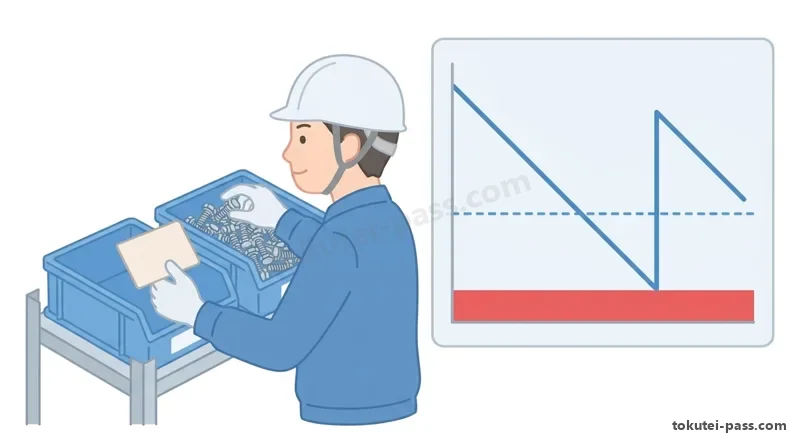
発注点は「発注点=1日平均需要量×調達リードタイム(日数)+安全在庫」で計算します。なお、同じ部品を2つの箱に入れ、1箱目が空になった時点を発注点とみなして補充注文する簡便な定量発注法を「ダブルビン法(2箱法)」と呼びます。
The reorder point is calculated as "Reorder Point = Average Daily Demand × Procurement Lead Time (days) + Safety Stock." A simplified fixed-order-quantity method that places identical parts in two bins and treats the emptying of the first bin as the reorder point to trigger replenishment is called the "Double-Bin (Two-Bin) System."
一方「定期発注方式」は、毎月1日や毎週月曜日など「一定の発注サイクル(発注間隔)」ごとに、その都度必要な量を計算して発注する方式(発注時期は一定・発注量は毎回変動)です。
Conversely, the "Periodic-Order System" calculates and orders the required quantity at "fixed ordering intervals (order cycles)," such as the 1st of every month or every Monday (ordering timing is fixed; order quantity varies each time).
定期発注の発注量は「発注量=(発注サイクル+調達リードタイム)×1日平均需要量+安全在庫-現在の手持在庫-発注残」で求めます。
The order quantity in periodic ordering is calculated as "Order Quantity = (Order Cycle + Procurement Lead Time) × Average Daily Demand + Safety Stock - Current On-Hand Inventory - On-Order Quantity."
これらを「ABC分析(パレート図による取扱金額順の重点管理)」と組み合わせ、高価・重要な「A品目」にはきめ細かい「定期発注方式」、中程度の「B品目」には「定量発注方式」、安価・大量の「C品目」には「ダブルビン法」を適用します。
Combining these with "ABC Analysis (Pareto priority management by annual usage value)," expensive and critical "Class A items" use tightly controlled "Periodic Ordering," moderate "Class B items" use "Fixed-Order-Quantity Ordering," and inexpensive high-volume "Class C items" use the "Double-Bin System."
Key points
- 定量発注方式(B・C品目向き)=発注時期は不定期・発注量は一定/発注点=1日平均需要×調達期間+安全在庫。
Fixed-Order-Quantity System (suited for B/C items) = irregular order timing, fixed order size / Reorder Point = Average Daily Demand × Lead Time + Safety Stock. - 定期発注方式(高価なA品目向き)=発注時期は一定・発注量は毎回変動/発注量=(発注間隔+調達期間)×1日平均需要+安全在庫-有効在庫。
Periodic-Order System (suited for expensive A items) = fixed order timing, variable order size / Order Quantity = (Order Cycle + Lead Time) × Average Daily Demand + Safety Stock - Available Inventory. - ダブルビン法(2箱法)=1箱目が空になったら発注する定量発注方式の一種で、単価の安いC品目(ネジ・小物)に適する。
Double-Bin (Two-Bin) System = a type of fixed-order-quantity method where an order is placed when the first bin becomes empty, ideal for low-cost Class C items (screws, small parts). - 【例】1日平均需要40個・調達期間5日・安全在庫80個 → 発注点=40×5+80=280個(発注点280個なら安全在庫=280-40×5=80個)
Example: Average daily demand 40 units, lead time 5 days, safety stock 80 units → Reorder point = 40 × 5 + 80 = 280 units (given reorder point 280 units, safety stock = 280 − 40 × 5 = 80 units) - 【例】発注間隔20日・調達期間5日・1日平均需要30個・安全在庫100個・手持在庫180個・発注残70個 → 発注量=(20+5)×30+100-180-70=600個
Example: Order cycle 20 days, lead time 5 days, average daily demand 30 units, safety stock 100 units, on-hand inventory 180 units, on-order quantity 70 units → Order quantity = (20 + 5) × 30 + 100 − 180 − 70 = 600 units
| Word | Meaning |
|---|---|
| 定量発注方式と発注点 | Fixed-Order-Quantity System and Reorder Point |
| ダブルビン法(2箱法) | Double-Bin (Two-Bin) System |
| 定期発注方式 | Periodic-Order System |
| ABC分析(重点在庫管理) | ABC Analysis (priority inventory control) |
| 安全在庫 | Safety Stock |
4. 入出庫・検収、棚卸(一斉・循環)と在庫評価(先入れ先出し法・移動平均法)
4. Receiving & Acceptance Inspection, Physical Inventory (Simultaneous / Cycle), and Valuation (FIFO / Moving Average)
注文した資材が届いた際、納品書と照合して数量と品質(受入検査)を確認し、合格品を正式に企業の資産として受け入れる業務を「検収」と呼びます。検収完了によって買掛金(代金支払義務)が確定します。
When ordered materials arrive, checking their quantity and quality (receiving inspection) against the delivery slip and formally accepting conforming goods as company assets is called "Acceptance (Kenshuu)." Completion of acceptance finalizes accounts payable (the obligation to pay).
保管中の在庫について、帳簿上の記録(帳簿棚卸)と実際の現品数を照合する作業が「実地棚卸」です。期末などに業務を止めて全品目を一度に数える「一斉棚卸」と、営業を止めずに品目や場所を順番に回って数える「循環棚卸」があります。
Verifying book inventory records against actual physical counts of stored stock is called "Physical Inventory Taking." It includes "Simultaneous (Wall-to-Wall) Inventory," which halts operations at period-end to count all items at once, and "Cycle Counting," which counts items or locations in rotation without stopping daily operations.
実地棚卸の結果、紛失・破損・記帳ミス等で実在数が帳簿数より少ない差額を「棚卸減耗(減耗損)」と呼びます。
When physical inventory reveals that actual stock is less than book stock due to loss, damage, or recording errors, the shortage is called "Inventory Shrinkage (inventory loss)."
また購入単価が変動する場合の払出単価・期末在庫評価額の計算には、先に入庫した古い単価の在庫から順番に払い出されたとみなす「先入れ先出し法(FIFO)」と、入庫のつど在庫総額を総数量で割って平均単価を改定する「移動平均法」が代表的です。
When purchase unit prices fluctuate, the two standard methods for calculating issue unit cost and ending inventory value are "First-In, First-Out (FIFO)," which assumes older stock received first is issued first in order, and the "Moving Average Method," which recalculates the average unit cost upon each new receipt by dividing total inventory value by total quantity.
Key points
- 検収=納入された資材の数量・品質を検査し、合格品を正式に受け入れて支払債務を確定させる業務。
Acceptance (Kenshuu) = inspecting the quantity and quality of delivered materials, formally accepting conforming items, and confirming payment obligation. - 一斉棚卸(期末に全品目を一斉カウント)vs 循環棚卸(日常業務を止めず計画的に順番にカウント)。
Simultaneous Inventory (counting all items at once at period-end) vs. Cycle Counting (counting systematically in rotation without halting daily operations). - 先入れ先出し法=古い入庫分の単価から順に払い出す/移動平均法=新規入庫のつど(残高金額+入庫金額)÷合計数量で平均単価を計算し直す。
FIFO (First-In, First-Out) = issuing stock starting from the oldest receipt's unit price / Moving Average = recalculating average unit price as (Remaining Value + New Receipt Value) ÷ Total Quantity upon each receipt. - 【例】月初在庫100個(単価100円=10,000円)・入庫100個(単価140円=14,000円)から120個払出 → 先入れ先出し法の払出額=100×100+20×140=12,800円(期末在庫80×140=11,200円)
Example: Beginning inventory 100 units (@100 yen = 10,000 yen), received 100 units (@140 yen = 14,000 yen), issued 120 units → FIFO issue cost = 100 × 100 + 20 × 140 = 12,800 yen (ending inventory 80 × 140 = 11,200 yen) - 【例】同条件で移動平均法 → 平均単価=(10,000+14,000)÷(100+100)=120円/個、払出額=120×120=14,400円(期末在庫80×120=9,600円)
Example: Under the same conditions using the moving average method → Average unit cost = (10,000 + 14,000) ÷ (100 + 100) = 120 yen/unit, Issue cost = 120 × 120 = 14,400 yen (ending inventory 80 × 120 = 9,600 yen)
| Word | Meaning |
|---|---|
| 検収(数量・品質の受入確認) | acceptance inspection (Kenshuu: verifying quantity and quality) |
| 実地棚卸(一斉棚卸と循環棚卸) | physical inventory (simultaneous inventory and cycle counting) |
| 棚卸減耗 | inventory shrinkage (loss) |
| 先入れ先出し法と移動平均法 | First-In, First-Out (FIFO) and Moving Average methods |
5. 購買・外注管理(集中購買・有償無償支給)と下請法
5. Purchasing & Subcontract Management (Centralized Purchasing, Paid/Free Supply) and the Subcontract Act
複数工場の所要量を本社購買部門でまとめて買う「集中購買」は、大口割引による価格交渉力強化や共通資材の標準化に有利です。逆に各工場が個別に買う「分散購買(現地購買)」は、緊急対応や輸送費削減に優れます。
"Centralized Purchasing," in which headquarters consolidates requirements from multiple plants to buy in bulk, strengthens price bargaining power through volume discounts and aids material standardization. Conversely, "Decentralized (Local) Purchasing," where each plant buys independently, excels in emergency responsiveness and lower transport costs.
外注加工先へ親企業が材料を支給する際、材料代を一度外注先に売却する形をとり完成品を「材料代+加工賃」で買い戻す「有償支給(外注先が材料歩留まり向上に責任を持つ)」と、所有権を親企業に残したままタダで預け「加工賃のみ」を支払う「無償支給」があります。
When a parent company supplies raw materials to a subcontractor for processing, "Paid Supply (Chargeable Supply)" sells the material to the subcontractor and buys back the finished part at "Material Cost + Processing Fee" (giving the subcontractor responsibility for improving material yield), whereas "Free Supply (Non-Chargeable Supply)" retains ownership with the parent company, consigns the material free of charge, and pays only the "Processing Fee."
また外注取引の公正を守り下請事業者の利益を保護するため、「下請代金支払遅延等防止法(下請法)」が定められています。製造委託等では、親事業者と下請事業者の「資本金区分(3億円超→3億円以下、または1千万円超3億円以下→1千万円以下)」で適用が決まります。
To ensure fair subcontracting transactions and protect subcontractors' interests, Japan enforces the "Act against Delay in Payment of Subcontract Proceeds, etc. to Subcontractors (Subcontract Act)." In manufacturing commission, applicability is determined by "Capital Size Tiers" between the Parent Enterprise and Subcontractor (over 300M yen → 300M yen or less; or over 10M–300M yen → 10M yen or less).
下請法では親事業者に対し、①発注書面(3条書面)の直ちの交付、②支払期日を「物品等を受領した日(検査完了日ではない)から60日以内」のできる限り短い期間内に定めること、③書類の作成・2年間保存、④遅延利息(年率14.6%)の支払という「4つの義務」を課しています。
The Subcontract Act imposes "4 Obligations" on the parent enterprise: ① Immediate issuance of a written purchase order (Article 3 document), ② Setting the payment due date as short as possible and "within 60 days from the date the goods are received (not the date inspection is completed)," ③ Creating and retaining records for 2 years, and ④ Paying overdue interest (14.6% per annum).
さらに同法では、下請事業者に責任がないのに受取を拒む「受領拒否」をはじめ、「下請代金の支払遅延」「下請代金の不当減額」「不当な返品」「買いたたき(通常の対価より著しく低い代金の決定)」「購入・利用強制」など「11の禁止事項」を厳しく定めています。
Furthermore, the Act strictly prohibits "11 Prohibited Acts," including "Refusal to Receive Goods" without fault on the subcontractor's part, "Delay in Payment of Subcontract Proceeds," "Unjust Reduction of Subcontract Proceeds," "Unjust Return of Goods," "Beating Down Prices (setting prices markedly below normal market rates)," and "Forced Purchase or Usage."
Key points
- 集中購買(大量一括購入によるコスト低減)vs 分散購買(工場ごとの迅速・小回りの利く調達)。
Centralized purchasing (cost reduction via bulk buying) vs. Decentralized purchasing (fast, flexible local procurement by each plant). - 有償支給=材料を外注先に売り、完成後に材料代+加工費で買い戻す(歩留まり意識が高まる)/無償支給=材料を無償で預け加工賃のみ支払う。
Paid supply = selling materials to the subcontractor and buying back finished goods at material + processing cost (raises yield awareness) / Free supply = providing materials free and paying only the processing fee. - 下請法=発注書面の交付義務、および下請代金は「検査合格日ではなく、物品を受領した日から60日以内」に支払う義務がある。
Subcontract Act = mandatory written purchase order issuance, and subcontract payment must be made "within 60 days from the date of receiving the goods (not the inspection pass date)."
| Word | Meaning |
|---|---|
| 集中購買と分散購買 | centralized purchasing and decentralized purchasing |
| 有償支給と無償支給 | paid material supply and free material supply |
| 下請代金支払遅延等防止法(下請法) | Subcontract Act (Act against Delay in Payment of Subcontract Proceeds) |
| 受領後60日以内の支払義務 | obligation to pay within 60 days of receiving goods |
6. 物流の5大機能・倉庫(DC・TC)・ロケーションとピッキング方式
6. Five Major Functions of Logistics, Warehouses (DC / TC), Location Control, and Picking Methods
物流(ロジスティクス)の「5大機能(これに情報機能を加えて6大機能)」は、①輸送・配送、②保管、③荷役(積卸し・入出庫・ピッキング)、④包装、⑤流通加工(値札付け・詰合わせ等)です。領域別には調達・生産・販売・回収(静脈)物流に分かれます。
The "Five Major Functions" of logistics (six when information is added) are: ① Transportation & Delivery, ② Storage, ③ Material Handling (loading/unloading, warehousing, picking), ④ Packaging, and ⑤ Distribution Processing (price tagging, assorting, etc.). By domain, logistics is divided into procurement, production, sales, and recovery (reverse/venous) logistics.
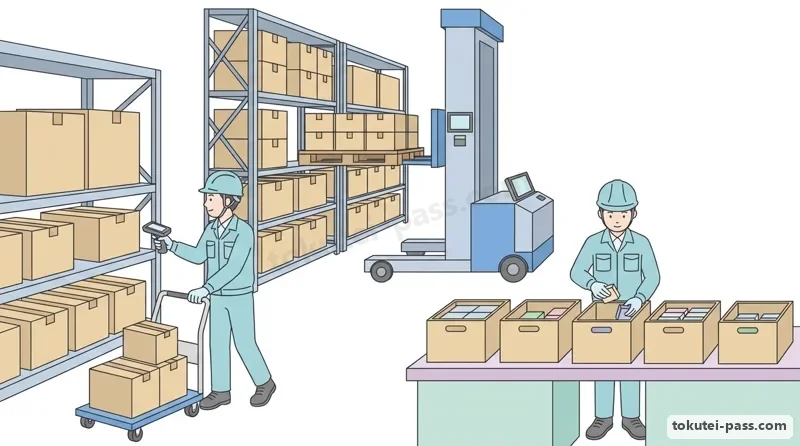
物流センター(倉庫)には、在庫を保管して受注に応じ出荷する「DC(ディストリビューションセンター:在庫保管型)」と、在庫を持たず入荷した荷物を即座に配送先別に仕分け・積み替えて出荷する「TC(トランスファーセンター:通過型・クロスドッキング)」があります。
Logistics centers (warehouses) include "DCs (Distribution Centers: storage type)," which hold inventory and ship upon receiving orders, and "TCs (Transfer Centers: pass-through / cross-docking type)," which hold no inventory and immediately sort and transship incoming goods by destination.
倉庫内の保管場所管理には、品目ごとに置き場を固定する「固定ロケーション(覚えやすいがスペース効率が低い)」と、WMS(倉庫管理システム)等で空いている棚に自在に格納する「フリーロケーション(保管スペース効率が高い)」があります。
Warehouse storage location control includes "Fixed Location (easy to remember, but lower space efficiency)," which assigns a permanent shelf to each item, and "Free (Random) Location (high storage space efficiency)," which uses a Warehouse Management System (WMS) to store goods flexibly in any open rack.
また出庫の「ピッキング方式」には、1件の注文(伝票)ごとに棚を回って集品する「摘み取り方式(シングルピッキング:多品種・迅速出荷向き)」と、複数注文分の品目をまとめて一括集品したあと配送先別に仕分ける「種蒔き方式(トータルピッキング:歩行距離短縮向き)」があります。
For outbound "Order Picking Methods," "Single Picking (Order Picking / discrete picking—suited for high variety and fast shipping)" walks the shelves to gather items for one order slip at a time, whereas "Total Picking (Batch Picking / seeding method—shortens walking distance)" gathers the combined item totals for multiple orders at once and then sorts them by destination.
Key points
- 物流の5大機能=輸送・保管・荷役・包装・流通加工(+情報)/DC=在庫保管型センター、TC=在庫を持たない通過・仕分け型センター。
Five Major Functions of Logistics = Transport, Storage, Material Handling, Packaging, and Distribution Processing (+ Information) / DC = inventory storage center, TC = non-stocking pass-through sorting center. - 固定ロケーション=品目ごとに保管棚を固定/フリーロケーション=空き棚へ流動的に保管しスペース効率を最大化。
Fixed Location = permanent shelf assigned per item / Free Location = flexible storage in any available rack to maximize space efficiency. - 摘み取り方式(シングルピッキング)=1伝票ずつ順番に棚から集める/種蒔き方式(トータルピッキング)=複数伝票分をまとめて集品後に仕分ける。
Single Picking (discrete picking) = gathering items from shelves one order slip at a time / Total Picking (batch/seeding method) = gathering items for multiple orders in bulk and sorting afterward.
| Word | Meaning |
|---|---|
| 物流の5大機能と静脈物流 | Five Major Functions of logistics and reverse (venous) logistics |
| DC(保管型)とTC(通過型) | DC (Distribution Center: storage) and TC (Transfer Center: pass-through) |
| 固定ロケーションとフリーロケーション | Fixed Location and Free Location |
| 摘み取り方式(シングル)と種蒔き方式(トータル) | Single Picking (discrete) and Total Picking (batch / seeding) |
7. 運搬管理の原則、ユニットロード(T11パレット)と運搬活性示数
7. Material Handling Principles, Unit Load System (T11 Pallet), and Material Handling Liveliness Index
運搬管理では、活性荷姿の原則・重力利用の原則・手待ち(空運搬)排除の原則などを重視します。特に貨物をパレットやコンテナで一定の単位(ユニット)にまとめ、発地から着地まで積み替えずに機械荷役・輸送する仕組みを「ユニットロードシステム(一貫パレチゼーション)」と呼びます。
Material handling management emphasizes principles such as keeping loads ready to move, utilizing gravity, and eliminating waiting or empty transport. Consolidating cargo onto pallets or containers into a standard unit to enable mechanized handling and transport from origin to destination without repacking is called the "Unit Load System (integrated palletization)."
日本のJIS規格で定められた一貫輸送用標準平パレットは「T11型パレット(縦1,100mm×横1,100mm:イチ・イチパレット)」であり、トラック荷台や自動倉庫・包装モジュール寸法の基準となっています。
The standard flat pallet specified by Japanese JIS standards for integrated transport is the "T11 Pallet (1,100 mm length × 1,100 mm width: the 'one-one pallet')," which serves as the dimensional standard for truck beds, automated warehouses, and packaging modules.
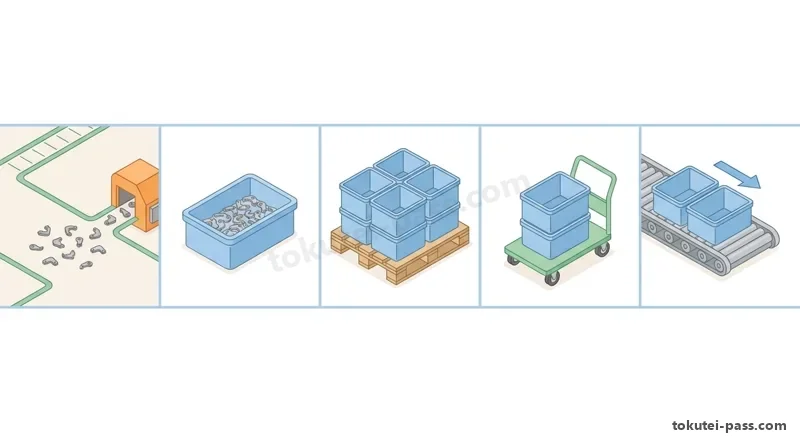
また、置かれている物品を「次に動かしやすい状態(活性度)」にするため、運搬に必要な4つの手間「集める(まとめる)・起こす(持ち上げる)・乗せる・運ぶ」のうち、すでに省かれている手間の数を0〜4で表した指標を「運搬活性示数」と呼びます。
To place goods in an "easily movable state (liveliness)," the "Material Handling Liveliness Index" rates from 0 to 4 how many of the four handling actions required to move an item—"Piling (gathering), Raising (lifting), Loading, and Conveying"—have already been eliminated.
具体的には、床にバラ置きは「示数0」、箱や袋に入れた状態(集めるが不要)は「示数1」、パレットに載せた状態(集める・起こすが不要)は「示数2」、車輪付き台車に載せた状態(運ぶだけ)は「示数3」、動いているコンベヤ・シュート上(手間ゼロ)は「示数4」です。
Specifically, items scattered loose on the floor have "Index 0"; items placed in a box or bag (piling eliminated) have "Index 1"; items stacked on a pallet (piling and raising eliminated) have "Index 2"; items placed on a wheeled cart (only conveying needed) have "Index 3"; and items on a moving conveyor or chute (zero effort required) have "Index 4."
Key points
- ユニットロードシステム(一貫パレチゼーション)=標準パレット(T11型:1,100mm×1,100mm)等にまとめて積み替えなしに機械荷役・輸送する方式。
Unit Load System (integrated palletization) = consolidating goods onto standard pallets (T11 type: 1,100 mm × 1,100 mm) for mechanized handling and transport without reloading. - 運搬活性示数=「集める・起こす・乗せる・運ぶ」の4動作のうち、すでに不要となっている動作の数(0〜4)。
Material Handling Liveliness Index = number of actions (0 to 4) already eliminated out of the 4 actions: "Piling, Raising, Loading, Conveying." - バラ置き=0、箱入り=1、パレット載せ=2、台車載せ=3、コンベヤ・スライダー上=4(数字が大きいほど動かしやすい)。
Loose on floor = 0, In a box = 1, On a pallet = 2, On a wheeled cart = 3, On a conveyor/chute = 4 (higher numbers mean easier to move).
| Word | Meaning |
|---|---|
| ユニットロードシステムと一貫パレチゼーション | Unit Load System and integrated palletization |
| T11型パレット(1,100mm×1,100mm) | T11 standard pallet (1,100 mm × 1,100 mm) |
| 運搬活性示数(0〜4) | Material Handling Liveliness Index (0 to 4) |
| 空運搬の排除 | eliminating empty transport |
8. 運搬・荷役機器の特徴と包装の分類(個装・内装・外装)
8. Material Handling Equipment Characteristics and Packaging Classification (Individual, Inner, Outer)
工場や倉庫で使われる主な運搬・荷役機器のうち、「フォークリフト」はパレット荷物の運搬と高所積付を1台でこなす最も汎用性の高い機器(カウンタバランス型・小回りの利くリーチ型など)です。
Among primary transport and material handling equipment in factories and warehouses, the "Forklift" is the most versatile machine, handling both horizontal pallet transport and high-rack stacking in a single unit (including counterbalance and compact reach types).
また、磁気テープやレーザー誘導などで無人走行する「AGV(無人搬送車)」、一定経路で大量の物品を連続輸送する「コンベヤ(ベルト・ローラー・トロリー等)」、重量物を吊り上げて立体的に移動させる「クレーン・ホイスト」を用途に応じて使い分けます。
Depending on application, plants also use "AGVs (Automated Guided Vehicles)" that travel unmanned via magnetic tape or laser guidance, "Conveyors (belt, roller, overhead trolley, etc.)" that continuously transport large volumes along fixed routes, and "Cranes & Hoists" that lift and move heavy loads three-dimensionally.
一方、物品の価値および状態を保護する「包装」は、JIS規格により「個装・内装・外装」の3つに分けられます。
Meanwhile, "Packaging," which protects the value and condition of goods, is classified by JIS standards into three levels: "Individual Packaging (Kosou), Inner Packaging (Naisou), and Outer Packaging (Gaisou)."
「個装」は商品1個ずつを包み購買意欲を高める「商業包装(消費者包装)」です。これに対し、水濡れ・衝撃・湿気を防ぐ「内装(緩衝材や防湿袋)」と、段ボール箱や木箱などに入れ荷扱いマーク(ケアマーク)を表示する「外装」は輸送・保管を目的とする「工業包装(輸送包装)」に分類されます。
"Individual Packaging (Kosou)" wraps each individual retail unit to enhance consumer appeal and is classified as "Commercial (Consumer) Packaging." In contrast, "Inner Packaging (cushioning materials, moisture-proof bags)" protecting against water, shock, and humidity, and "Outer Packaging" placing goods into corrugated cartons or wooden crates marked with handling symbols (Care Marks) serve transport and storage purposes and are classified as "Industrial (Transport) Packaging."
Key points
- フォークリフト=パレット荷役・運搬の主役/AGV=無人搬送車/コンベヤ=定経路の連続運搬/クレーン=重量物の吊り上げ運搬。
Forklift = mainstay of pallet handling and transport / AGV = unmanned guided vehicle / Conveyor = continuous fixed-route transport / Crane = overhead lifting of heavy loads. - 個装=商品の最小単位を包み美観・販売促進を重視する「商業包装」。
Individual Packaging (Kosou) = wraps the smallest product unit, emphasizing aesthetics and sales promotion → "Commercial Packaging." - 内装(防湿・緩衝)および外装(段ボール箱・木箱による保護)=輸送・保管の安全を重視する「工業包装」。
Inner Packaging (moisture/shock protection) and Outer Packaging (protection via cartons or wooden crates) = emphasize safe transport and storage → "Industrial Packaging."
| Word | Meaning |
|---|---|
| フォークリフトとAGV(無人搬送車) | Forklift and AGV (Automated Guided Vehicle) |
| 個装(商業包装) | Individual Packaging (Kosou: commercial packaging) |
| 内装・外装(工業包装・輸送包装) | Inner and Outer Packaging (industrial / transport packaging) |
| ケアマーク(取扱注意表示) | Care Marks (handling caution symbols) |
試験によく出るポイントと覚え方
High-Frequency Exam Points and Memory Aids
計算問題は4つが頻出です。①「有効在庫=手持在庫-引当量+発注残(引当は引き、発注残は足す!)」、②「EOQ=√((2×年間需要×1回発注費)÷1個あたり年間保管費)」です。
Four calculation problems appear frequently: ① "Available Inventory = On-Hand Inventory - Allocated Quantity + On-Order Quantity (subtract allocations, add on-order!)," and ② "EOQ = √((2 × Annual Demand × Cost per Order) ÷ Annual Holding Cost per Unit)."
③「発注点=1日平均需要×調達期間+安全在庫(定量発注)」と、④「先入れ先出し法・移動平均法による払出単価・期末在庫額計算」も確実に解けるようにしましょう。
Make sure you can also solve ③ "Reorder Point = Average Daily Demand × Procurement Lead Time + Safety Stock (fixed-order-quantity)" and ④ "Issue unit cost and ending inventory valuation using FIFO and Moving Average."
知識問題では、「A品目=定期発注、B品目=定量発注、C品目=ダブルビン法」「下請法の支払期日は検査日ではなく受領日から60日以内」「摘み取り方式(1注文ずつ=シングル)と種蒔き方式(一括集品後に仕分け=トータル)」が定番です。
For concept questions, classic exam favorites are: "Class A = Periodic Ordering, Class B = Fixed-Order-Quantity, Class C = Double-Bin," "Subcontract Act payment deadline is within 60 days from the date of receiving goods (not the inspection date)," and "Single Picking (one order at a time) vs. Total/Seeding Picking (bulk picking followed by sorting)."
さらに「運搬活性示数(バラ置き0・箱1・パレット2・台車3・コンベヤ4)」と「T11パレット=1,100mm×1,100mm」は数字までそのまま暗記しておけば即得点になります。
Finally, memorizing the exact numbers for the "Material Handling Liveliness Index (Floor 0, Box 1, Pallet 2, Cart 3, Conveyor 4)" and "T11 Pallet = 1,100 mm × 1,100 mm" guarantees instant points.
Key points
- 有効在庫=手持在庫-引当+発注残/発注点=1日需要×調達期間+安全在庫/EOQ=√(2×年間需要×発注費÷保管費)。
Available Inventory = On-Hand - Allocated + On-Order / Reorder Point = Daily Demand × Lead Time + Safety Stock / EOQ = √(2 × Annual Demand × Order Cost ÷ Holding Cost). - 下請法の支払期日は「物品受領後60日以内」/ピッキングは「摘み取り=1注文ずつ、種蒔き=まとめて集めて仕分け」。
Subcontract Act payment deadline is "within 60 days after receiving goods" / Picking: "Single (discrete) = one order at a time; Total (seeding) = bulk pick then sort." - 運搬活性示数:バラ0→箱1→パレット2→台車3→コンベヤ4(集める・起こす・乗せる・運ぶの省略数)。
Material Handling Liveliness Index: Loose 0 → Box 1 → Pallet 2 → Cart 3 → Conveyor 4 (number of steps eliminated out of Piling, Raising, Loading, Conveying).
| Word | Meaning |
|---|---|
| 有効在庫・発注点・EOQの公式 | formulas for Available Inventory, Reorder Point, and EOQ |
| 下請法(受領後60日以内支払) | Subcontract Act (payment within 60 days of receipt) |
| 摘み取り方式と種蒔き方式 | Single Picking vs. Total (Seeding) Picking |
| 運搬活性示数(0〜4) | Material Handling Liveliness Index (0 to 4) |
Materials, Inventory & Logistics
Practice this chapter in the appOfficial references
- 中央職業能力開発協会(JAVADA) ビジネス・キャリア検定試験 3級 生産管理オペレーション 試験範囲 — https://www.javada.or.jp/jigyou/gino/business/subject.html
- 中央職業能力開発協会 編『ビジネス・キャリア検定試験 標準テキスト【専門知識】生産管理オペレーション 3級〔第4版〕』 — https://www.javada.or.jp/jigyou/gino/business/text.html