
Equipment Management & Maintenance Fundamentals
設備管理・保全基礎
Production Management Operations Grade 3 生産管理オペレーション (BC検定) · ビジネス・キャリア検定 生産管理オペレーション3級 · Written by Tokutei Pass based on the official study texts; not copied verbatim.
1. 設備管理の目的・LCC・信頼性(MTBF・MTTR)とハインリッヒの法則
1. Purpose of Equipment Management, LCC, Reliability (MTBF / MTTR), and Heinrich's Law
「設備管理」とは、企業の生産性を高めるため、設備の調査・研究・設計・製作・据付から、運転・保全・更新・廃棄に至る「設備の一生(ライフサイクル)」全体を通じて最も経済的に活用する総合的な管理活動です。
"Equipment management" is a comprehensive management activity that utilizes equipment as economically as possible throughout the entire "equipment life cycle"—from research, design, fabrication, and installation to operation, maintenance, renewal, and disposal—in order to raise corporate productivity.
設備の企画・導入コスト(イニシャルコスト)だけでなく、稼働後の運転費・エネルギー費・修繕保全費・廃棄費(ランニングコスト)までを含めた生涯総費用を「ライフサイクルコスト(LCC)」と呼び、これを最小化することが設備管理の大きな目標です。
The total lifetime cost including not only initial planning and acquisition costs (Initial Cost) but also post-installation operating, energy, repair/maintenance, and disposal costs (Running Cost) is called "Life Cycle Cost (LCC)"; minimizing LCC is a primary goal of equipment management.
良い設備に求められる3つの特性は、①経済性(LCCが低く投資効果が高い)、②信頼性(故障しにくく安定稼働する)、③保全性(点検・修理がしやすい)です。
The three key characteristics required of good equipment are: ① Economy (low LCC and high return on investment), ② Reliability (rarely breaks down and operates stably), and ③ Maintainability (easy to inspect and repair).
信頼性の指標である「MTBF(平均故障間隔)」は「総稼働時間÷故障回数」で求め(長いほど良い)、保全性の指標である「MTTR(平均修復時間)」は「総修理時間÷故障回数」で求めます(短いほど良い)。
The indicator of reliability, "MTBF (Mean Time Between Failures)," is calculated as "Total Operating Time ÷ Number of Failures" (longer is better), while the indicator of maintainability, "MTTR (Mean Time To Repair)," is calculated as "Total Repair Time ÷ Number of Failures" (shorter is better).
また「ハインリッヒの法則(1:29:300の法則)」が示すとおり、1件の重大災害(大故障)の背後には29件の軽微な災害(小故障)と300件のヒヤリハット(微欠陥・異常の兆候)が隠れており、微欠陥の段階で摘み取ることが不可欠です。
Furthermore, as shown by "Heinrich's Law (the 1:29:300 rule)," behind 1 major accident (major breakdown) lie 29 minor accidents (minor breakdowns) and 300 near-misses / Hiyari-Hatto (micro-defects or signs of abnormality), making it essential to eliminate defects at the micro-defect stage.
Key points
- LCC(ライフサイクルコスト)=設備の企画・導入費(イニシャルコスト)+運転・保全・廃棄費(ランニングコスト)の生涯総費用。
LCC (Life Cycle Cost) = Equipment planning & acquisition cost (Initial Cost) + Operation, maintenance & disposal cost (Running Cost) over its entire lifetime. - MTBF(平均故障間隔=稼働時間÷故障回数)は信頼性の指標/MTTR(平均修復時間=修理時間÷故障回数)は保全性の指標。
MTBF (Mean Time Between Failures = Operating Time ÷ Failures) measures Reliability / MTTR (Mean Time To Repair = Repair Time ÷ Failures) measures Maintainability. - ハインリッヒの法則=1件の重大事故(大故障):29件の軽傷(小故障):300件のヒヤリハット(微欠陥)。
Heinrich's Law = 1 major accident (major breakdown) : 29 minor injuries (minor breakdowns) : 300 near-misses (micro-defects). - 【例】設備導入費1,500万円・10年間の運転保全費1,200万円・廃棄費100万円 → ライフサイクルコスト(LCC)=1,500+1,200+100=2,800万円
Example: Equipment acquisition cost 15M yen, 10-year operation & maintenance cost 12M yen, disposal cost 1M yen → Life Cycle Cost (LCC) = 15 + 12 + 1 = 28M yen - 【例】計画負荷時間315時間の間に故障5回・修理時間合計15時間 → 総稼働時間=315-15=300時間、MTBF=300÷5=60時間、MTTR=15÷5=3時間
Example: 5 failures and 15 hours total repair time during 315 planned loading hours → Total operating time = 315 − 15 = 300 hours, MTBF = 300 ÷ 5 = 60 hours, MTTR = 15 ÷ 5 = 3 hours
| Word | Meaning |
|---|---|
| ライフサイクルコスト(LCC:生涯総費用) | Life Cycle Cost (LCC: total lifetime cost) |
| MTBF(平均故障間隔:信頼性) | MTBF (Mean Time Between Failures: reliability) |
| MTTR(平均修復時間:保全性) | MTTR (Mean Time To Repair: maintainability) |
| ハインリッヒの法則(1:29:300) | Heinrich's Law (1 : 29 : 300 ratio) |
2. 保全方式の分類(予防保全PM・事後保全BM・改良保全CM・保全予防MP)
2. Classification of Maintenance Methods (Preventive PM, Breakdown BM, Corrective CM, Maintenance Prevention MP)
設備保全の方式は、維持活動と改善活動に大別されます。維持活動の代表である「予防保全(PM)」は、故障や停止が起きる前に計画的に点検・部品交換・修理を行う方式です。
Equipment maintenance methods are broadly divided into sustaining activities and improvement activities. Representing sustaining activities is "Preventive Maintenance (PM)," in which inspections, part replacements, and repairs are systematically carried out before breakdowns or stoppages occur.
予防保全はさらに、一定の稼働時間や周期ごとに無条件で部品交換・分解整備(オーバーホール)を行う「時間基準保全(TBM:定期保全)」と、振動・温度・異音などの劣化状態を診断し限界に達する前に処置する「状態基準保全(CBM:予知保全)」に分かれます。
Preventive maintenance is further divided into "Time-Based Maintenance (TBM: periodic maintenance)," which unconditionally replaces parts or performs overhauls at fixed operating-hour intervals, and "Condition-Based Maintenance (CBM: predictive maintenance)," which diagnoses deterioration via vibration, temperature, or abnormal noise and acts before limits are reached.
一方、故障や機能停止が発生してから修理・復旧を行う方式を「事後保全(BM)」と呼びます。影響が大きい突発故障に対処する緊急保全のほか、予備機がある設備や故障しても影響が小さい照明等では、コスト面からあえて計画的に事後保全を選ぶこともあります。
Conversely, repairing and restoring equipment only after a breakdown or functional stoppage has occurred is called "Breakdown Maintenance (BM)." Beyond emergency repairs for sudden failures, planned breakdown maintenance is sometimes deliberately chosen for cost reasons on non-critical items like lighting or machines with backup units.
また改善活動として、故障が再発しないよう(あるいは点検・修理がしやすいよう)設備自体の構造や材質を改良する「改良保全(CM:体質改善)」と、新設備の設計・導入段階から過去の故障データ等を反映して「そもそも故障せず保全も不要な設備(メンテナンスフリー)」を追求する「保全予防(MP)」があります。
As improvement activities, "Corrective Maintenance (CM)" modifies the structure or materials of existing equipment so failures do not recur (or to make inspection and repair easier), whereas "Maintenance Prevention (MP)" feeds past failure data into the design and procurement stage of new equipment to pursue "maintenance-free equipment that neither breaks down nor requires maintenance."
Key points
- 予防保全(PM)=時間基準保全(TBM:一定周期で交換・定期保全)+状態基準保全(CBM:劣化状態を監視・予知保全)。
Preventive Maintenance (PM) = Time-Based Maintenance (TBM: periodic replacement at fixed intervals) + Condition-Based Maintenance (CBM: monitoring deterioration / predictive maintenance). - 事後保全(BM)=故障が起きてから修理する方式(重要度が低い設備では経済的な場合もある)。
Breakdown Maintenance (BM) = repairing after a failure occurs (can be economical for low-criticality equipment). - 改良保全(CM)=既存設備を壊れにくく・直しやすく改造する/保全予防(MP)=新設設計段階から壊れない・保全不要な設備を造る。
Corrective Maintenance (CM) = modifying existing equipment to prevent recurrence and ease repair / Maintenance Prevention (MP) = designing new equipment from the start to be failure-free and maintenance-free.
| Word | Meaning |
|---|---|
| 予防保全(PM:TBMとCBM) | Preventive Maintenance (PM: TBM and CBM) |
| 事後保全(BM) | Breakdown Maintenance (BM) |
| 改良保全(CM) | Corrective Maintenance (CM) |
| 保全予防(MP) | Maintenance Prevention (MP) |
3. 日常保全(清掃・給油・増締め・点検)と自主保全のステップ
3. Daily Maintenance (Cleaning, Lubricating, Retightening, Inspection) and Autonomous Maintenance Steps
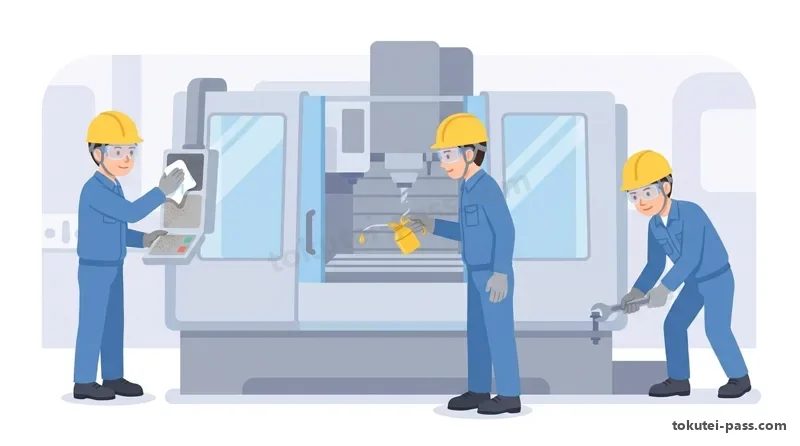
設備の劣化を防ぐ最前線の活動が、毎日の運転前・運転中・運転後に行う「日常保全(日常点検)」です。その基本3条件は「清掃・給油・増締め(ボルト・ナットの緩み止め)」であり、これに五感による「日常点検」を加えます。
The frontline activity preventing equipment deterioration is "Daily Maintenance (daily inspection)," performed before, during, and after daily operation. Its three basic conditions are "Cleaning, Lubricating, and Retightening (preventing loose bolts and nuts)," combined with "daily inspection" using the five senses.
製造部門のオペレーター(運転員)自身が「自分の設備は自分で守る」という意識を持ち、日常保全や小整備を行う活動を「自主保全」と呼びます(専門の保全部門が行う専門保全と対になります)。
The activity in which production operators themselves adopt the mindset "I protect my own machine" and perform daily maintenance and minor servicing is called "Autonomous Maintenance (Jishu Hozen)" (paired with specialized maintenance performed by the dedicated maintenance department).
自主保全において特に重要な考え方が「清掃は点検なり」です。設備の隅々まで自らの手で拭き上げることで、ボルトの緩み・亀裂・油漏れ・発熱・異音といった微欠陥(不工合)を五感(視覚・聴覚・触覚・嗅覚)で早期に発見できます。
A particularly vital principle in autonomous maintenance is "Cleaning is inspection." By wiping down every corner of the machine with their own hands, operators use their five senses (sight, hearing, touch, smell) to detect micro-defects early—such as loose bolts, cracks, oil leaks, overheating, and abnormal noises.
自主保全は7ステップで段階的に展開されます。第1ステップ「初期清掃(不工合の発見と復元)」から始まり、第2ステップ「発生源・困難個所対策」、第3ステップ「自主保全仮基準の作成」、第4ステップ「総点検」、第5ステップ「自主点検」、第6ステップ「標準化」、第7ステップ「自主管理の徹底」へと進みます。
Autonomous maintenance unfolds step by step across 7 steps: starting from Step 1 "Initial cleaning (discovering and restoring abnormalities)," advancing to Step 2 "Countermeasures against sources of contamination and hard-to-reach areas," Step 3 "Preparation of tentative autonomous maintenance standards," Step 4 "General inspection," Step 5 "Autonomous inspection," Step 6 "Standardization," and Step 7 "Full autonomous management."
Key points
- 設備の基本3条件(劣化防止の日常保全)=「清掃・給油・増締め」+五感による日常点検。
Three basic equipment conditions (daily maintenance to prevent deterioration) = "Cleaning, Lubricating, and Retightening" + daily inspection using the five senses. - 自主保全=オペレーターが「自分の設備は自分で守る」活動であり、「清掃は点検なり」を合言葉に微欠陥を発見・復元する。
Autonomous Maintenance = operators "protecting their own equipment," discovering and restoring micro-defects under the slogan "Cleaning is inspection." - 自主保全の第1ステップは「初期清掃」、第2ステップは「汚れの発生源・清掃困難個所対策」、第3ステップは「仮基準の作成」。
Step 1 of Autonomous Maintenance is "Initial cleaning," Step 2 is "Countermeasures for contamination sources and hard-to-clean areas," and Step 3 is "Creating tentative standards."
| Word | Meaning |
|---|---|
| 日常保全(清掃・給油・増締め) | daily maintenance (cleaning, lubricating, retightening) |
| 自主保全(自分の設備は自分で守る) | Autonomous Maintenance (protecting one's own equipment) |
| 清掃は点検なり | cleaning is inspection |
| 発生源・困難個所対策 | countermeasures for contamination sources and hard-to-reach spots |
4. TPM(全員参加の生産保全)の定義と8本柱
4. Definition of TPM (Total Productive Maintenance) and Its 8 Pillars
「TPM(Total Productive Maintenance:全員参加の生産保全)」とは、生産システム効率化の極限(総合的効率化)を追求する企業体質づくりを目標に、災害ゼロ・不良ゼロ・故障ゼロなどあらゆるロスを未然防止する全員参加の活動です。
"TPM (Total Productive Maintenance)" is a company-wide, all-employee participation activity that proactively prevents all losses—aiming for Zero Accidents, Zero Defects, and Zero Breakdowns—to build a corporate culture that pursues the ultimate limit of production system efficiency.
TPMには3つの大きな特徴があります。①生産部門だけでなく開発・営業・管理など「全社すべての部門」にわたること、②設備のライフサイクル「全段階」を対象とすること、③経営トップから第一線の作業員まで「全員参加」で重複小集団活動により推進することです。
TPM has three major characteristics: ① It spans "all departments company-wide," including development, sales, and administration as well as production; ② It covers "all stages" of the equipment life cycle; ③ It is promoted with "participation by everyone" from top management to frontline workers through overlapping small-group activities.
TPMは次の「8本柱」で展開されます。①個別改善(16大ロスの撲滅)、②自主保全(オペレーターによる日常保全)、③計画保全(保全部門による専門保全)、④教育訓練(運転・保全スキルの育成)が現場の4本柱です。
TPM is deployed across "8 Pillars." The four shop-floor pillars are: ① Focused Improvement / Kobetsu Kaizen (eliminating the 16 major losses), ② Autonomous Maintenance (daily maintenance by operators), ③ Planned Maintenance (specialized maintenance by the maintenance department), and ④ Education and Training (developing operation and maintenance skills).
さらに全社的な柱として、⑤初期管理(新製品・新設備の垂直立上げ・MP設計)、⑥品質保全(不良ゼロの設備条件設定・維持)、⑦管理・間接部門の効率化(事務TPM)、⑧安全・衛生・環境管理(災害ゼロ・環境負荷低減)の計8本柱で構成されます。
The four company-wide pillars are: ⑤ Initial Phase Management (vertical startup of new products/equipment and MP design), ⑥ Quality Maintenance (setting and maintaining equipment conditions for zero defects), ⑦ Administrative & Indirect Department Efficiency (Office TPM), and ⑧ Safety, Health, and Environment Management (zero accidents and reduced environmental impact).
Key points
- TPM=「災害ゼロ・不良ゼロ・故障ゼロ」を目指し、トップから第一線作業員まで「全員参加」の重複小集団活動で行う生産保全。
TPM = Productive maintenance aiming for "Zero Accidents, Zero Defects, Zero Breakdowns" through "all-employee participation" from top executives to frontline workers via overlapping small-group activities. - TPMの8本柱:①個別改善、②自主保全、③計画保全、④教育訓練、⑤初期管理、⑥品質保全、⑦管理・間接部門効率化、⑧安全・環境管理。
8 Pillars of TPM: ① Focused Improvement, ② Autonomous Maintenance, ③ Planned Maintenance, ④ Education & Training, ⑤ Initial Phase Management, ⑥ Quality Maintenance, ⑦ Office/Indirect Efficiency, ⑧ Safety & Environment. - 「垂直立上げ(設計から量産試運転までの期間短縮と初期トラブル防止)」は第5の柱「初期管理」の役割。
"Vertical startup (shortening the period from design to mass-production trial runs and preventing initial troubles)" is the role of the 5th pillar, "Initial Phase Management."
| Word | Meaning |
|---|---|
| TPM(全員参加の生産保全) | TPM (Total Productive Maintenance) |
| 重複小集団活動 | overlapping small-group activities |
| TPMの8本柱 | 8 Pillars of TPM |
| 初期管理(垂直立上げ) | Initial Phase Management (vertical startup) |
| 品質保全 | Quality Maintenance |
5. 設備の6大ロスと設備総合効率(OEE)の計算
5. The 6 Big Losses of Equipment and Calculating Overall Equipment Effectiveness (OEE)
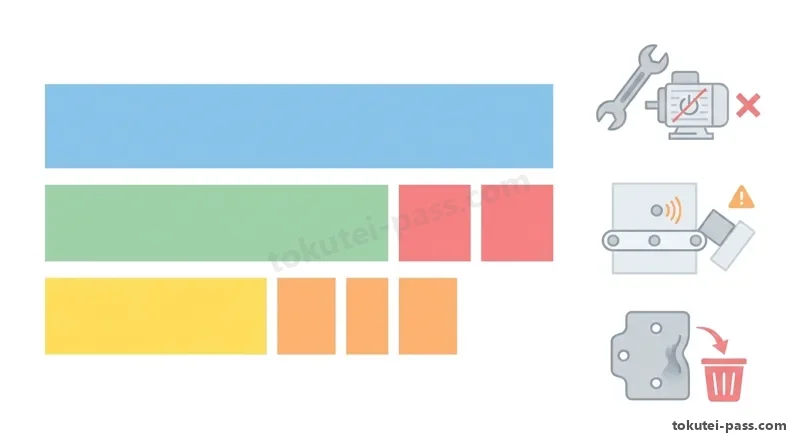
設備の効率を阻害する要因は「設備の6大ロス(または刃具交換ロスを分けて7大ロス)」と呼ばれ、3つのカテゴリーに分けて管理・計算します。
Factors that hinder equipment efficiency are called the "6 Big Losses of Equipment (or 7 Big Losses when cutting-tool replacement loss is separated)" and are managed and calculated in three categories.
第1の「停止ロス」は、①故障ロス(突発・慢性故障による停止)と②段取り・調整ロス(品種切替や刃具交換による停止)です。負荷時間から停止ロスを引いたものが「稼働時間」であり、「時間稼働率=稼働時間÷負荷時間」となります。
The first category, "Downtime Losses," comprises ① Breakdown Loss (stoppages from sudden or chronic failures) and ② Setup and Adjustment Loss (stoppages for product changeover or tool replacement). Subtracting downtime losses from Loading Time gives "Operating Time," and "Availability (Time Operating Rate) = Operating Time ÷ Loading Time."
第2の「性能ロス」は、③チョコ停・空転ロス(センサー検知やワーク詰まりによる一時的な小停止や空回り)と④速度低下ロス(設計基準速度より遅い運転)です。稼働時間から性能ロスを引いた割合が「性能稼働率=(基準サイクルタイム×加工数量)÷稼働時間」です。
The second category, "Performance Losses," comprises ③ Minor Stoppage (Chokotei) & Idling Loss (brief stoppages or idling due to sensor trips or jammed workpieces) and ④ Reduced Speed Loss (running slower than design standard speed). The ratio after subtracting performance losses is "Performance Efficiency = (Ideal Cycle Time × Processed Quantity) ÷ Operating Time."
第3の「不良ロス」は、⑤不良・手直しロスと⑥立上がり(スタートアップ)歩留まりロスです。加工数量に対する良品の割合が「適合品率(良品率)=良品数量÷加工数量」です。
The third category, "Defect Losses," comprises ⑤ Defect & Rework Loss and ⑥ Startup Yield Loss. The proportion of good units to total processed units is the "Quality Rate (Rate of Conforming Products) = Good Quantity ÷ Processed Quantity."
これら3つの率を掛け合わせた「設備総合効率(OEE)=時間稼働率×性能稼働率×適合品率」が、設備が真に価値を生み出した割合(価値稼働時間÷負荷時間)を示します。
Multiplying these three rates together yields "Overall Equipment Effectiveness (OEE) = Availability × Performance Efficiency × Quality Rate," which represents the proportion of time the equipment truly added value (Value-Operating Time ÷ Loading Time).
Key points
- 停止ロス(故障・段取り調整)→時間稼働率=(負荷時間-停止ロス時間)÷負荷時間。
Downtime Losses (breakdowns, setup/adjustment) → Availability = (Loading Time - Downtime Loss) ÷ Loading Time. - 性能ロス(チョコ停空転・速度低下)→性能稼働率=(基準サイクルタイム×加工数量)÷稼働時間。
Performance Losses (minor stoppages/idling, speed reduction) → Performance Efficiency = (Standard Cycle Time × Processed Quantity) ÷ Operating Time. - 設備総合効率(OEE)=時間稼働率×性能稼働率×適合品率(良品率)。
Overall Equipment Effectiveness (OEE) = Availability × Performance Efficiency × Quality Rate (good product rate). - 【例】負荷時間500分・停止ロス50分、基準サイクルタイム0.5分/個で加工数量720個 → 稼働時間=500-50=450分、時間稼働率=450÷500×100=90%、性能稼働率=(0.5×720)÷450×100=80%
Example: Loading time 500 min, downtime loss 50 min, standard cycle time 0.5 min/unit, processed quantity 720 units → Operating time = 500 − 50 = 450 min, Time operating rate = 450 ÷ 500 × 100 = 90%, Performance operating rate = (0.5 × 720) ÷ 450 × 100 = 80% - 【例】加工数量720個のうち良品684個(時間稼働率90%・性能稼働率80%) → 適合品率=684÷720×100=95%、設備総合効率(OEE)=0.90×0.80×0.95×100=68.4%
Example: 684 good units out of 720 processed units (time operating rate 90%, performance operating rate 80%) → Quality rate = 684 ÷ 720 × 100 = 95%, Overall Equipment Effectiveness (OEE) = 0.90 × 0.80 × 0.95 × 100 = 68.4%
| Word | Meaning |
|---|---|
| 設備の6大ロス(停止・性能・不良ロス) | 6 Big Losses of equipment (downtime, performance, defect losses) |
| チョコ停・空転ロス | minor stoppage (Chokotei) and idling loss |
| 設備総合効率(OEE) | Overall Equipment Effectiveness (OEE) |
| 時間稼働率・性能稼働率・適合品率 | Availability, Performance Efficiency, and Quality Rate |
6. 設備劣化の分類(機能的劣化と経済的劣化、自然劣化と強制劣化)
6. Classification of Equipment Deterioration (Functional vs. Economic, Natural vs. Forced)
設備の価値や性能が低下する「設備劣化」は、技術的・経済的な観点から「機能的劣化」と「経済的劣化」に分けられます。
"Equipment deterioration," the decline in value or performance of machinery, is divided from technical and economic viewpoints into "Functional Deterioration" and "Economic Deterioration."
「機能的劣化」のうち、摩耗・腐食・疲労・破損などにより設備自体の物理的な性能や精度が低下することを「絶対的劣化(物理的劣化)」と呼びます。
Within "Functional Deterioration," the decline in physical performance or precision of the machine itself due to wear, corrosion, fatigue, or breakage is called "Absolute Deterioration (physical deterioration / aging)."
これに対し、設備自体はまだ動くものの、技術革新により高性能な新型機械が登場したり市場ニーズが変化したりして、旧設備が見劣りしてしまう現象を「相対的劣化(陳腐化)」、また維持費がかさみ採算が合わなくなることを「経済的劣化」と呼びます。
In contrast, when the equipment itself still runs but technological innovation introduces higher-performing new models or market needs shift—making the old machine inferior—it is called "Relative Deterioration (obsolescence)"; when rising maintenance costs make continued operation unprofitable, it is called "Economic Deterioration."
一方、現場の保全管理において最も重要な分類が「自然劣化」と「強制劣化」です。「自然劣化」とは、正しい方法で使用・手入れしていても、時間の経過とともに本来の寿命にしたがって少しずつ進む劣化です。
Meanwhile, the most critical classification for shop-floor maintenance management is "Natural Deterioration" versus "Forced Deterioration." "Natural Deterioration" is wear that progresses gradually over time according to inherent service life even when the machine is used and cared for properly.
逆に「強制劣化」とは、清掃・給油・増締めを怠ったり、無理な過負荷運転や誤操作を行ったりすることで、人為的に本来より急速に早めてしまう劣化です。日常保全の第一の役割は、この「強制劣化の排除」にあります。
Conversely, "Forced Deterioration" is deterioration artificially accelerated far faster than normal by neglecting cleaning, lubrication, and bolt retightening, or by overloading and misoperating the machine. The primary role of daily maintenance is the "elimination of forced deterioration."
Key points
- 絶対的劣化(物理的な摩耗・老朽化)vs 相対的劣化(新技術の登場や市場変化による陳腐化)。
Absolute deterioration (physical wear and aging) vs. Relative deterioration (obsolescence due to new technology or market changes). - 自然劣化=正しく使っていても経年で進む劣化/強制劣化=清掃・給油・増締め不足や誤操作で人為的に早まる劣化。
Natural deterioration = gradual aging despite proper use / Forced deterioration = artificially accelerated decay caused by lack of cleaning, lubrication, retightening, or misoperation. - 日常保全(清掃・給油・増締め)を徹底して「強制劣化」をゼロにし、自然劣化のみの状態に戻すことが保全の基本。
Thorough daily maintenance (cleaning, lubricating, retightening) to reduce "Forced Deterioration" to zero and return equipment to natural deterioration only is the foundation of maintenance.
| Word | Meaning |
|---|---|
| 絶対的劣化(老朽化)と相対的劣化(陳腐化) | absolute deterioration (aging) and relative deterioration (obsolescence) |
| 経済的劣化 | economic deterioration |
| 自然劣化 | natural deterioration |
| 強制劣化(人為的な劣化促進) | forced deterioration (human-induced accelerated wear) |
7. 故障曲線(バスタブ曲線)の3期間と故障対策
7. The Three Periods of the Failure Curve (Bathtub Curve) and Countermeasures
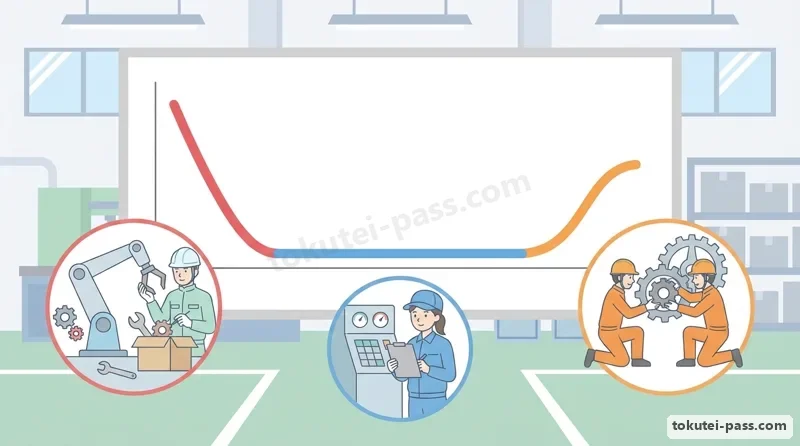
横軸に設備の「使用時間(経過時間)」、縦軸に「故障率」をとってグラフ化すると、西洋の浴槽(バスタブ)の断面に似た曲線になることから「バスタブ曲線(故障曲線)」と呼ばれます。これは3つの期間に分かれます。
Plotting equipment "operating time (elapsed time)" on the horizontal axis and "failure rate" on the vertical axis produces a curve resembling the cross-section of a bathtub, known as the "Bathtub Curve (failure rate curve)." It consists of three distinct periods.
第1の「初期故障期」は、使用開始直後に設計・製造・据付ミスや初期不良部品、作業者の不慣れなどによって高い故障率を示し、時間とともに急激に減少していく期間です。対策は試運転(デバッグ・エージング・スクリーニング)と初期管理の徹底です。
The first period, the "Initial (Early) Failure Period," exhibits a high failure rate immediately after commissioning due to design, manufacturing, or installation errors, defective initial parts, or operator unfamiliarity, which then drops rapidly over time. Countermeasures include trial runs (debugging, aging, screening) and thorough initial phase management.
第2の「偶発故障期」は、初期の不具合が出尽くし、故障率が最も低くほぼ一定で安定する期間です。突発的な過負荷や誤操作が主原因となるため、対策は正しい運転操作の遵守・ポカヨケ・日常保全の徹底です。
The second period, the "Random (Chance) Failure Period," occurs after initial defects have been weeded out; the failure rate is at its lowest and remains nearly constant and stable. Because sudden overloads or misoperations are the main causes, countermeasures are adherence to standard operating procedures, Poka-yoke, and daily maintenance.
第3の「摩耗故障期」は、部品の摩耗・金属疲労・経年劣化など寿命の到来によって故障率が再び急上昇する期間です。対策は、予防保全(定期的な部品交換・オーバーホール・状態監視)や設備更新です。
The third period, the "Wear-Out Failure Period," sees the failure rate rise sharply again as components reach the end of their service life due to wear, metal fatigue, and aging. Countermeasures are preventive maintenance (periodic part replacement, overhauls, condition monitoring) or equipment replacement.
Key points
- バスタブ曲線=横軸「時間」・縦軸「故障率」で、①初期故障期(減少型)→②偶発故障期(低位一定型)→③摩耗故障期(増加型)の順に推移する。
Bathtub Curve = horizontal axis "Time," vertical axis "Failure Rate," progressing through: ① Initial Failure Period (decreasing) → ② Random Failure Period (low and constant) → ③ Wear-Out Failure Period (increasing). - 初期故障期の対策=納入前の試運転・デバッグ・初期管理/偶発故障期の対策=誤操作防止(ポカヨケ)・日常点検。
Initial Failure countermeasures = pre-delivery trial runs, debugging, initial management / Random Failure countermeasures = preventing misoperation (Poka-yoke) and daily inspection. - 摩耗故障期の対策=予防保全(TBMによる定期交換・オーバーホール、CBMによる予知保全)。
Wear-Out Failure countermeasures = Preventive Maintenance (periodic replacement and overhaul via TBM, predictive maintenance via CBM).
| Word | Meaning |
|---|---|
| バスタブ曲線(故障曲線) | Bathtub Curve (failure rate curve) |
| 初期故障期(試運転・デバッグ) | initial failure period (trial runs and debugging) |
| 偶発故障期(低位安定) | random failure period (low stable failure rate) |
| 摩耗故障期(予防保全・定期交換) | wear-out failure period (preventive maintenance and periodic replacement) |
8. 重点設備の選定(A・B・Cランク)と予備品管理
8. Selecting Priority Equipment (A / B / C Ranking) and Spare Parts Management
工場内のすべての設備に同じ費用と手数をかけて高度な予防保全を行うのは非経済的です。そのため、故障した際の影響度に応じて設備の重要度を評価し、A・B・Cにランク分けする「重点設備の選定」を行います。
Spending equal money and effort on advanced preventive maintenance for every machine in a factory is uneconomical. Therefore, plants evaluate the criticality of each machine based on the impact of its failure and classify them into A, B, and C ranks—a process called "Selecting Priority Equipment."
重要度の評価基準には「PQCDSME」が用いられます。すなわち、生産(P:代替機がなく止まると全ラインが止まるか)、品質(Q:重大不良が出るか)、コスト(C:修理費や損害が高額か)、納期(D)、安全・環境(S・E:災害や公害を起こすか)などの観点です。
Criticality is evaluated using "PQCDSME" criteria: Production (P: is there no backup machine, so a stoppage halts the entire line?), Quality (Q: will it cause major defects?), Cost (C: are repair costs and losses high?), Delivery (D), and Safety & Environment (S, E: could failure cause accidents or pollution?).
最重点の「Aランク設備」には状態基準保全(CBM)や定期保全(TBM)・改良保全を手厚く実施し、「Bランク設備」には一般的な予防保全を、影響が軽微な「Cランク設備」には日常点検+事後保全(BM)を適用して保全コストを最適化します。
Top-priority "Rank A equipment" receives intensive Condition-Based Maintenance (CBM), Time-Based Maintenance (TBM), and Corrective Maintenance; "Rank B equipment" receives standard preventive maintenance; and low-impact "Rank C equipment" is managed economically with daily inspection plus Breakdown Maintenance (BM).
また修理用の「予備品(スペアパーツ)管理」でも、長納期の専用部品・常備消耗部品・市販標準部品に分類し、在庫切れによる設備長期停止と過剰在庫の両方を防ぐため、発注点方式などで適切に在庫管理します。
Similarly, in "Spare Parts Management" for repairs, parts are classified into long-lead-time custom parts, regularly stocked consumable parts, and off-the-shelf standard parts, and inventory is controlled via reorder-point methods to prevent both prolonged machine downtime from stockouts and excess inventory.
Key points
- 重点設備の選定=故障時の安全(S)・生産(P)・品質(Q)・納期(D)・コスト(C)への影響度でA・B・Cランクに分ける。
Selecting priority equipment = ranking machines into A, B, and C based on failure impact on Safety (S), Production (P), Quality (Q), Delivery (D), and Cost (C). - Aランク(最重点設備)は予防保全(CBM・TBM)や改良保全を徹底/Cランク(軽微な設備)は事後保全(BM)で経済的に管理。
Rank A (highest priority) receives thorough preventive (CBM, TBM) and corrective maintenance / Rank C (minor impact) is managed economically via Breakdown Maintenance (BM). - 予備品(スペアパーツ)管理=調達リードタイム・使用頻度・重要度に応じて常備品と都度購入品を区分し、欠品による長期停止を防ぐ。
Spare parts management = distinguishing stocked items from order-as-needed items based on procurement lead time, usage frequency, and criticality to prevent prolonged downtime from stockouts.
| Word | Meaning |
|---|---|
| 重点設備(A・B・Cランク評価) | priority equipment (A / B / C rank evaluation) |
| PQCDSMEによる設備評価 | equipment evaluation by PQCDSME criteria |
| 予備品(スペアパーツ)管理 | spare parts management |
| 常備品と都度発注品 | regularly stocked parts vs. order-on-demand parts |
試験によく出るポイントと覚え方
High-Frequency Exam Points and Memory Aids
設備管理の計算問題は2パターンが必出です。1つ目は「MTBF=総稼働時間÷故障回数(信頼性)」と「MTTR=総修理時間÷故障回数(保全性)」です。故障中の修理時間を稼働時間から引き忘れないよう注意しましょう。
Two calculation patterns in Equipment Management appear on almost every exam. First are "MTBF = Total Operating Time ÷ Number of Failures (Reliability)" and "MTTR = Total Repair Time ÷ Number of Failures (Maintainability)." Be careful not to forget to subtract repair downtime when calculating operating time.
2つ目は「設備総合効率(OEE)=時間稼働率×性能稼働率×適合品率」です。特に「故障・段取りは停止ロス(時間稼働率)」「チョコ停・速度低下は性能ロス(性能稼働率)」という6大ロスの分類は暗記必須です。
Second is "Overall Equipment Effectiveness (OEE) = Availability × Performance Efficiency × Quality Rate." Memorize the 6 Big Losses categories: "Breakdowns and Setup/Adjustment are Downtime Losses (Availability)," while "Minor Stoppages (Chokotei) and Reduced Speed are Performance Losses (Performance Efficiency)."
保全方式では、「TBM(時間基準=定期交換)とCBM(状態基準=予知保全)」「CM(改良保全=今ある設備の改造)とMP(保全予防=新設備の設計段階で壊れない設備を造る)」の入れ替えひっかけに要注意です。
For maintenance methods, watch out for trap questions swapping "TBM (time-based = periodic replacement) vs. CBM (condition-based = predictive maintenance)" and "CM (Corrective Maintenance = modifying existing machines) vs. MP (Maintenance Prevention = designing new machines from the start to be failure-free)."
さらに「自然劣化と強制劣化(清掃・給油・増締め不足による人為劣化)」および「バスタブ曲線の3期間(初期→偶発→摩耗故障期)と各対策」も毎回のように出題されます。
Additionally, "Natural Deterioration vs. Forced Deterioration (human-induced wear from neglecting cleaning, oiling, and retightening)" and the "3 periods of the Bathtub Curve (Initial → Random → Wear-Out) and their countermeasures" are tested repeatedly.
Key points
- MTBF=稼働時間÷故障回数(信頼性・大きいほど良い)/MTTR=修理時間÷故障回数(保全性・小さいほど良い)。
MTBF = Operating Time ÷ Failures (Reliability, larger is better) / MTTR = Repair Time ÷ Failures (Maintainability, smaller is better). - OEE=時間稼働率(故障・段取りロス)×性能稼働率(チョコ停・速度低下ロス)×適合品率(不良・立上がりロス)。
OEE = Availability (breakdown & setup loss) × Performance Efficiency (minor stoppage & speed loss) × Quality Rate (defect & startup loss). - CM(既存設備の改良)vs MP(新設設計段階の保全予防)/強制劣化=清掃・給油・増締めでゼロにする。
CM (improving existing equipment) vs. MP (maintenance prevention at new equipment design stage) / Forced deterioration = reduced to zero through Cleaning, Lubricating, and Retightening.
| Word | Meaning |
|---|---|
| MTBFとMTTRの計算 | MTBF and MTTR calculations |
| 6大ロスと設備総合効率(OEE) | 6 Big Losses and Overall Equipment Effectiveness (OEE) |
| CM(改良保全)とMP(保全予防) | CM (Corrective Maintenance) vs. MP (Maintenance Prevention) |
| 強制劣化の排除 | eliminating forced deterioration |
Equipment Management (Maintenance, TPM, OEE)
Practice this chapter in the appOfficial references
- 中央職業能力開発協会(JAVADA) ビジネス・キャリア検定試験 3級 生産管理オペレーション 試験範囲 — https://www.javada.or.jp/jigyou/gino/business/subject.html
- 中央職業能力開発協会 編『ビジネス・キャリア検定試験 標準テキスト【専門知識】生産管理オペレーション 3級〔第4版〕』 — https://www.javada.or.jp/jigyou/gino/business/text.html