
Process Management Basics (Production Types, Scheduling, Production Control)
工程管理基礎(生産形態・日程計画・生産統制)
Production Management Operations Grade 3 生産管理オペレーション (BC検定) · ビジネス・キャリア検定 生産管理オペレーション3級 · Written by Tokutei Pass based on the official study texts; not copied verbatim.
1. 工程管理の目的と生産計画・生産統制のサイクル
1. Objectives of Process Management and the Production Planning & Control Cycle
「工程管理」とは、工場における人員・機械設備・原材料などの生産要素を効率良く活用し、所定の品質と原価のもとで、約束した納期と生産数量を確実に達成するための管理活動です。
"Process management" is the management activity of efficiently utilizing factory production factors—workers, machinery, and raw materials—to reliably achieve promised delivery dates and production quantities under specified quality and cost.
工程管理の主な目的は、①納期の確保(遵守)、②生産期間(製造リードタイム)の短縮、③工程間の仕掛品在庫の減少、④設備や作業者の稼働率向上(遊休・手待ちの削減)の4点に集約されます。
The main objectives of process management are summarized in four points: 1. Securing (meeting) delivery dates, 2. Shortening production lead time, 3. Reducing work-in-process (WIP) inventory between processes, and 4. Improving operating rates of equipment and workers (reducing idle and waiting time).
工程管理の機能は、事前に「いつ・どこで・なにを・どれだけ作るか」を決める「生産計画(日程計画・工数計画など)」と、計画通りに生産が進むよう指示・監視・調整する「生産統制(手配・進捗管理・現品管理・余力管理)」の2つから成り立ちます。
Process management consists of two functions: "Production Planning (scheduling, man-hour planning, etc.)," which decides in advance "when, where, what, and how much to make," and "Production Control (order release, progress control, physical inventory control, capacity control)," which directs, monitors, and adjusts production to follow the plan.
また、受注生産などで設計完了を待っていては納期に間に合わない場合、調達期間(リードタイム)の長い特殊材料や購入部品だけを正式図面完成前に先行して発注・手配することを「先行手配」といいます。
Additionally, in make-to-order production when waiting for design completion would miss the delivery date, ordering long-lead-time special materials or purchased parts in advance before final drawings are completed is called "advance ordering (Senkou Tehai)."
Key points
- 工程管理の4目的:①納期の確保、②製造リードタイムの短縮、③仕掛品の減少、④設備・作業者の稼働率向上。
Four objectives of process management: 1. Securing delivery dates, 2. Shortening manufacturing lead time, 3. Reducing WIP inventory, 4. Improving equipment and worker operating rates. - 工程管理は「生産計画(P)」と「生産統制(D・C・A:差立・進捗・現品・余力管理)」のサイクルで回す。
Process management revolves around the cycle of "Production Planning (P)" and "Production Control (D-C-A: dispatching, progress, physical item, and spare capacity control)." - 調達期間が長い資材や部品を詳細設計完了前に前倒しで手配することを「先行手配」という。
Procuring materials or parts with long lead times ahead of detailed design completion is called "advance ordering (Senkou Tehai)."
| Word | Meaning |
|---|---|
| 工程管理 | process management |
| 生産計画と生産統制 | production planning and production control |
| 仕掛品 | work-in-process (WIP) |
| 先行手配 | advance ordering / advance arrangement |
2. 生産形態の分類①(見込生産と受注生産・デカップリングポイント)
2. Classification of Production Types 1 (Make-to-Stock vs. Make-to-Order, Decoupling Point)
「生産形態」は、注文と生産開始時期の関係によって「見込生産」と「受注生産」に分けられます。「見込生産」は、市場の需要予測に基づいてあらかじめ製品を見込んで生産し、完成品在庫から出荷する方式です。
Based on the timing of orders relative to production start, production types are divided into "Make-to-Stock (MTS)" and "Make-to-Order (MTO)." "Make-to-Stock (Mikomi Seisan)" produces goods in advance based on market demand forecasts and ships them from finished goods inventory.
見込生産(日用品・家電製品など)は、顧客注文から納品までのリードタイムが短く計画的な大量生産で原価を下げやすい反面、予測が外れると過剰在庫や売れ残りリスクが生じます。
Make-to-Stock (e.g., daily necessities, home appliances) offers short delivery lead times from customer order to shipment and lowers costs through planned mass production, but carries the risk of excess inventory or unsold stock if forecasts miss.
一方、「受注生産」は、顧客から注文を受けて仕様や数量・納期が確定してから設計・資材調達・製造を開始する方式です。完成品の在庫リスクはないものの、注文から納入までの期間が長くなり、工程の負荷変動が大きくなります。
Conversely, "Make-to-Order (Juchuu Seisan)" starts design, material procurement, and manufacturing only after receiving a customer order and confirming specifications, quantity, and delivery date. While free of finished goods inventory risk, it has a long lead time from order to delivery and large load fluctuations across processes.
また、共通部品や半製品(モジュール)までは需要予測による「見込生産」で作って在庫しておき、顧客注文が入ってから最終組立や仕様変更を「受注生産(BTO)」で行う方式もあり、この予測生産と受注生産の分岐点(在庫滞留点)を「デカップリングポイント」と呼びます。
Another approach produces common parts or semi-finished modules by "Make-to-Stock" based on forecasts and performs final assembly or customization by "Make-to-Order (BTO)" after receiving an order; this branching point (inventory holding point) between forecast-driven and order-driven production is called the "decoupling point."
Key points
- 見込生産=需要予測に基づき生産して製品在庫から出荷する(納期は短いが在庫過多・陳腐化のリスクがある)。
Make-to-Stock = producing based on demand forecasts and shipping from finished product inventory (short delivery time, but risks excess or obsolete stock). - 受注生産=顧客の注文確定後に生産を開始する(完成品在庫は持たないが納入リードタイムが長く負荷変動が大きい)。
Make-to-Order = starting production after customer order confirmation (no finished goods inventory, but long delivery lead time and large load fluctuations). - デカップリングポイント=見込生産(半製品在庫)から受注生産(最終組立)へ切り替わるサプライチェーン上の分岐点。
Decoupling point = the branching point in the supply chain where Make-to-Stock (semi-finished inventory) switches to Make-to-Order (final assembly).
| Word | Meaning |
|---|---|
| 見込生産 | Make-to-Stock production (MTS) |
| 受注生産 | Make-to-Order production (MTO) |
| 需要予測 | demand forecasting |
| デカップリングポイント | decoupling point |
3. 生産形態の分類②(品種と量・仕事の流し方・ライン生産とセル生産)
3. Classification of Production Types 2 (Variety-Volume, Work Flow, Line vs. Cellular Production)
品種の数と生産量の関係からは、「少種多量生産(専用機械を加工順に並べる製品別レイアウト/フローショップ向き)」と、「多種少量生産(汎用機械を種類別に集める機能別レイアウト/ジョブショップ向き)」に分かれます。
By the relationship between product variety and volume, production is divided into "low-variety high-volume production" (suited to product layout / flow shop arranging dedicated machines in processing sequence) and "high-variety low-volume production" (suited to functional layout / job shop grouping general-purpose machines by type).
また、仕事の流し方(連続性)からは、①注文ごとに1つずつ異なる製品を作る「個別生産」、②同じ設備で段取替えを行いながら一定数量(ロット)ごとにまとめて作る「ロット生産」、③長期間にわたり同一製品を絶え間なく流し続ける「連続生産」の3つに分類されます。
By the continuity of work flow, it is classified into three types: 1. "Job (individual) production" making unique products one by one per order, 2. "Lot (batch) production" producing in fixed batch sizes with setups on shared equipment, and 3. "Continuous production" running the same product nonstop over long periods.
ロット生産では、1回にまとめて作るロットサイズを大きくすると段取替え回数は減りますが在庫保管費用が増え、逆にロットを小さくすると在庫は減りますが段取替えが増えるため、外段取り化による「シングル段取り(10分未満での段取替え)」が重要になります。
In lot production, increasing lot size reduces setup frequency but increases inventory holding cost, whereas reducing lot size cuts inventory but increases setups; hence "Single-Minute Exchange of Die (Single Setup / SMED)"—shortening setups to under 10 minutes by converting internal setup to external setup—is vital.
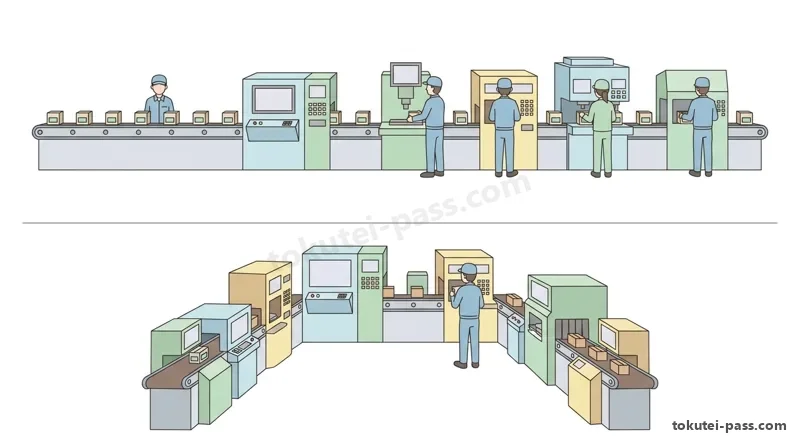
さらに組立職場では、ベルトコンベヤ等で単一工程を分業する「ライン生産方式」に対し、1人(または少人数)の多能工がU字型に配置した屋台で複数工程を最後まで組み立てる「セル生産方式」が普及しており、多品種少量や需要変動への柔軟性と作業者の達成感向上に優れています。
Furthermore, in assembly shops, in contrast to "line production" dividing single steps along a conveyor, "cellular manufacturing (cell production)"—where one or a few multi-skilled workers assemble multiple steps to completion inside a U-shaped stall—is widely used for its flexibility toward variety/volume changes and higher worker fulfillment.
Key points
- 少種多量生産=専用機・製品別レイアウト(フローショップ)、多種少量生産=汎用機・機能別レイアウト(ジョブショップ)。
Low-variety high-volume = dedicated machines, product layout (flow shop); High-variety low-volume = general-purpose machines, functional layout (job shop). - 仕事の流し方による分類:個別生産・ロット生産(段取替えを伴う)・連続生産。
Classification by work flow: Individual (job) production, Lot (batch) production (involving setups), and Continuous production. - セル生産方式(U字型ライン等)は、多能工が複数工程を担当し、多品種少量や生産量変動に柔軟に対応できる。
Cellular manufacturing (U-shaped cell line, etc.) uses multi-skilled workers handling multiple processes to flexibly accommodate high-variety low-volume demand. - 【例】1日稼働24,000秒(400分)で必要生産量960個、4工程の作業時間が18秒・22秒・20秒・20秒(計80秒) → サイクルタイム=24,000÷960=25秒、編成効率=80÷(4×25)×100=80%
Example: Daily operating time 24,000 sec (400 min), required output 960 units, 4 station times of 18 s, 22 s, 20 s, and 20 s (total 80 s) → Cycle time = 24,000 ÷ 960 = 25 s, Line balancing efficiency = 80 ÷ (4 × 25) × 100 = 80%
| Word | Meaning |
|---|---|
| 少種多量生産と多種少量生産 | low-variety high-volume vs. high-variety low-volume production |
| 個別生産・ロット生産・連続生産 | individual, lot, and continuous production |
| セル生産方式 | cellular manufacturing (cell production system) |
| 多能工 | multi-skilled worker (Tanoukou) |
| シングル段取り | Single Setup (SMED under 10 minutes) |
4. 日程計画(基準日程・フォワード/バックワード・ディスパッチング)
4. Scheduling (Master Standard Schedule, Forward/Backward Scheduling, Dispatching Rules)
「日程計画」は期間の長さにより、年間〜半年の「大日程計画」、月次(1〜3か月)の「中日程計画」、週次・日次の「小日程計画」に分かれます。各工程の標準的な加工時間に検査・運搬・停滞時間を加えた標準所要日数を「基準日程(製造リードタイム)」といい、完成日から逆算した通し番号を「手配番数」といいます。
"Scheduling" is divided by horizon into "master/long-term (annual to semi-annual)," "medium-term (monthly: 1–3 months)," and "short-term (weekly/daily) schedules." The standard required days combining standard processing time with inspection, transport, and delay times is called the "standard schedule (manufacturing lead time)," and serial numbers counted backward from completion are "schedule numbers."
作業開始日と完了日を決めるスケジューリングには2方式あります。「フォワード・スケジューリング」は、材料入荷日など着手可能日を基点に第1工程から順方向(前から後ろ)へ計画し、最も早い完成予定日を求める方式です(特急品などに適すが仕掛在庫が増えやすい)。
There are two scheduling methods to set start and finish dates. "Forward scheduling" plans forward from the first process starting from the earliest possible start date (such as material arrival) to find the earliest completion date (suited for rush orders, though WIP tends to increase).
一方、「バックワード・スケジューリング」は、顧客納期(完了期限日)を基点に最終工程から逆方向(後ろから前)へ基準日程を引いていき、最も遅くとも着手すべき「最終着手期限日」を求める方式であり、ジャストインタイム(JIT)やMRPの基本となります。
Conversely, "Backward scheduling" starts from the customer delivery date and subtracts standard lead times backward from the final process to determine the latest permissible "start deadline date," forming the basis of Just-In-Time (JIT) and MRP.
また、現場で待っている複数の仕事のうち、どれから先に加工するかを決める優先規則を「ディスパッチング・ルール(作業順序決定規則)」といいます。
Meanwhile, priority rules that determine which waiting job to process first on the shop floor are called "dispatching rules (job sequencing rules)."
代表例には、①先着順(FCFS)、②最短加工時間順(SPT:平均滞留時間や仕掛在庫を最小化)、③最早納期順(EDD:最大納期遅れを最小化)、④スラック(納期までの残時間-残加工時間)最小順があります。
Representative rules include: 1. First-Come, First-Served (FCFS), 2. Shortest Processing Time (SPT: minimizes average flow/retention time and WIP inventory), 3. Earliest Due Date (EDD: minimizes maximum tardiness), and 4. Minimum Slack (Slack = remaining time until due date - remaining processing time).
Key points
- フォワード方式=着手可能日から順方向に計算して最早完了日を求める/バックワード方式=納期から逆算して最終着手日を求める(仕掛品最小化)。
Forward scheduling = calculates forward from earliest start date to find earliest completion / Backward scheduling = calculates backward from due date to find latest start date (minimizing WIP). - ディスパッチング・ルール:SPT(最短加工時間順)は平均滞留時間・仕掛品を最小にし、EDD(最早納期順)は最大納期遅れを最小にする。
Dispatching rules: SPT (Shortest Processing Time) minimizes average retention time and WIP; EDD (Earliest Due Date) minimizes maximum delivery lateness. - スラック(余裕)=(納期までの残り時間)-(残りの加工所要時間)であり、この値が小さい(またはマイナス)仕事ほど緊急度が高い。
Slack (allowance) = (Time remaining until due date) - (Remaining processing time required); smaller (or negative) slack indicates higher urgency. - 【例】納期まで残り10日・残り加工時間7日の仕事Aと、残り6日・残り加工時間5日の仕事B → スラック=Aは10-7=3日、Bは6-5=1日(スラック最小のBを優先)
Example: Job A has 10 days until due date and 7 days remaining processing time; Job B has 6 days remaining and 5 days processing time → Slack: A = 10 − 7 = 3 days, B = 6 − 5 = 1 day (prioritize B with minimum slack)
| Word | Meaning |
|---|---|
| 基準日程(製造リードタイム) | standard schedule (manufacturing lead time) |
| フォワード・スケジューリング | Forward Scheduling |
| バックワード・スケジューリング | Backward Scheduling |
| ディスパッチング・ルール(SPT・EDD) | dispatching rules (SPT, EDD) |
5. 工数計画(負荷計画)と山積法・山崩し法・余力管理
5. Man-Hour (Load) Planning, Infinite/Finite Loading (Yamazumi/Yamakuzushi), and Capacity Control
日程計画と並んで重要な「工数計画(負荷計画)」は、受注や生産計画を達成するのに必要な仕事量である「負荷工数」と、職場の人や機械が持っている「保有能力工数」を期間別・工程別に比較し、両者のバランスをとる計画です。
Alongside scheduling, "man-hour planning (load planning)" compares the "load man-hours" (workload required to fulfill orders or production plans) against "available capacity man-hours" of shop workers and machines by period and process to balance the two.
「負荷工数」は「生産数量×単位当たり標準時間+準備段取時間」で求め、「保有能力工数」は「作業者数(または機械台数)×1日実働時間×稼働日数×想定稼働率(または能率)」で算出します。
"Load man-hours" is calculated as "Production quantity × Standard time per unit + Setup time," while "Available capacity man-hours" is calculated as "Number of workers (or machines) × Actual working hours per day × Working days × Expected operating (or efficiency) rate."
能力の限界を考えずに各作業の負荷工数をそのまま期間別に積み上げてグラフ化することを「山積み(山積法)」といいます。山積みの結果、保有能力線を超えた山(能力不足=過負荷)を削って谷(能力余剰)へならす調整作業を「山崩し(山崩し法/負荷平滑化)」といいます。
Piling up the load man-hours of each job by period onto a chart without considering capacity limits is called "infinite loading / piling up (Yamazumi method)." Leveling the peaks that exceed the available capacity line (overload) into the valleys (surplus capacity) is called "load leveling / peak shaving (Yamakuzushi method)."
山崩しおよび生産統制の「余力管理」で負荷>能力(能力不足)となった場合の対策には、①能力を増やす方法(残業・休日出勤、他部門からの応援受入れ、シフト増加)と、②負荷を減らす・ずらす方法(外注利用、余裕のある前後日程への前倒し・先送り、ロット分割)があります。
When load leveling or "capacity control (Yoryoku Kanri)" reveals Load > Capacity (capacity shortage), countermeasures include: 1. Increasing capacity (overtime, holiday work, receiving support from other departments, adding shifts) and 2. Reducing or shifting load (outsourcing, pulling forward or pushing back schedules, splitting lots).
Key points
- 負荷工数=生産数量×単位当たり標準時間+段取時間/余力=保有能力工数-負荷工数。
Load man-hours = Quantity × Unit standard time + Setup time / Spare capacity (Yoryoku) = Available capacity man-hours - Load man-hours. - 能力制約を無視して期間別に仕事量を積み上げることを「山積み」、能力線を超えた負荷を平準化することを「山崩し」という。
Accumulating workload by period regardless of capacity limits is "Yamazumi (piling up)"; leveling loads that exceed the capacity line is "Yamakuzushi (load leveling)." - 能力不足時の調整策:残業・応援受入れ(能力増強)、外注活用・日程の前倒し/変更(負荷調整)。
Countermeasures for capacity shortage: overtime or support workers (capacity boost); outsourcing or rescheduling earlier/later (load adjustment). - 【例】単位当たり標準時間0.5時間の製品を600個生産・段取時間20時間 → 負荷工数=600×0.5+20=320時間
Example: Producing 600 units with standard time 0.5 h/unit and setup time 20 h → Load man-hours = 600 × 0.5 + 20 = 320 hours - 【例】作業者5人・1日実働8時間・稼働10日・想定稼働率90%(負荷工数320時間) → 保有能力工数=5×8×10×0.9=360時間、余力=360-320=40時間
Example: 5 workers × 8 actual hours/day × 10 working days × 90% expected utilization (load: 320 hours) → Available capacity man-hours = 5 × 8 × 10 × 0.9 = 360 hours, Surplus capacity = 360 − 320 = 40 hours
| Word | Meaning |
|---|---|
| 工数計画(負荷計画) | man-hour planning (load planning) |
| 山積法と山崩し法 | Yamazumi (piling up) and Yamakuzushi (load leveling) methods |
| 余力管理 | spare capacity control (Yoryoku Kanri) |
| 保有能力工数 | available capacity man-hours |
6. 生産統制①(製作手配・差立・現品管理・ガントチャート)
6. Production Control 1 (Order Release, Dispatching/Sashitate, Physical Control, Gantt Chart)
生産統制の第一歩である「手配」には、製造部門や購買部門に生産・調達を公式に命令する「製作手配(製造命令)」と、現場の進捗や機械空き状況を見ながら個々の作業者へ具体的な作業順序と着手を指示する「作業手配(差立/ディスパッチング)」があります。
The first step of production control, "order arrangement," includes "manufacturing order release (Seisaku Tehai)" formally instructing production and purchasing departments, and "operation dispatching (Sashitate)" instructing individual workers on specific job sequences and start times based on shop progress and machine availability.
差立(作業分配)では、作業指導票・材料出庫票・移動票・検査票などの伝票類を発行し、「差立盤(管理盤)」に機械別・日付順に伝票を差し込んで現場の作業順序を目で見て管理します。
In dispatching (work allocation), vouchers such as operation instruction tickets, material issue slips, move tickets, and inspection tickets are issued and inserted into a "dispatch board (control board)" by machine and date for visual management of shop work sequences.
「現品管理」は、工場内を流れる原材料・仕掛品・完成品の「現物(品名・数量・所在場所)」と「帳票・コンピュータ上の情報」を常に一致させる活動です。品物に「現品票」や「移動票」「かんばん」を必ず添付して紛失や異材混入を防ぎます。
"Physical inventory control (Genpin Kanri)" is the activity of keeping the "actual physical goods (item name, quantity, location)" of raw materials, WIP, and finished goods flowing through the plant constantly matched with "information on slips and computers." Attaching "identification tags (Genpin-hyou)," "move tickets," or "Kanban" prevents loss and mix-ups.
また、「進捗管理(進度管理)」で最も広く使われる「ガントチャート(Gantt chart)」は、縦軸に機械や作業者・注文品目を並べ、横軸に時間(日付)をとって、予定期間と実績進捗を横棒(バー)で上下対比して描く図表であり、現在日(チェック日)の縦線より実績棒が左にあれば「遅れ」、右にあれば「進み」と一目で判別できます。
Meanwhile, the "Gantt chart," widely used in "progress control," lists machines, workers, or orders on the vertical axis and time (dates) on the horizontal axis, comparing planned periods and actual progress with horizontal bars; if the actual bar ends to the left of the current check-date line, it indicates "behind schedule," and to the right, "ahead of schedule."
Key points
- 製作手配=製造・購買部門への生産命令/差立(作業手配)=現場での作業順序決定と具体的な作業指示。
Manufacturing order release = formal production command to manufacturing/purchasing / Dispatching (Sashitate) = deciding shop-floor job sequence and issuing concrete work instructions. - 現品管理=現品票や移動票・かんばんを用いて、現物(品目・数量・場所)と情報(伝票・データ)を常に一致させる。
Physical control (Genpin Kanri) = using item tags, move tickets, and Kanban to keep physical items (name, quantity, location) always matched with data. - ガントチャート=横軸に時間をとり、計画と実績を横棒で対比して各作業の進み・遅れを視覚的に把握する図表。
Gantt chart = plots time on the horizontal axis and compares plan vs. actual with horizontal bars to visually grasp ahead/behind status.
| Word | Meaning |
|---|---|
| 差立(ディスパッチング) | dispatching / work allocation (Sashitate) |
| 現品管理と現品票 | physical item control and identification tag (Genpin-hyou) |
| 進捗管理(進度管理) | progress control (expediting) |
| ガントチャート | Gantt chart |
7. 生産統制②(流動数曲線の読み取りと仕掛在庫・滞留時間の計算)
7. Production Control 2 (Reading Cumulative Flow Curves and Calculating WIP & Retention Time)
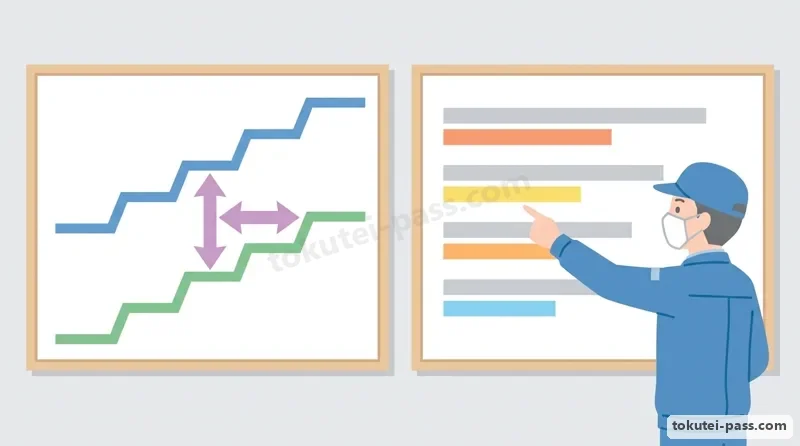
量産工程などの進捗・仕掛状況を定量的に管理する代表的なグラフが「流動数曲線」です。横軸に時間(日付)、縦軸に「累計数量」をとり、工程への「累計投入量曲線(上側の線)」と工程からの「累計産出量曲線/完成線(下側の線)」の2本の折れ線を描きます。
A representative graph for quantitatively managing progress and WIP status in mass-production processes is the "Cumulative Flow Curve (Ryuudousuu Kyokusen)." With time (dates) on the horizontal axis and "cumulative quantity" on the vertical axis, it plots two lines: the "cumulative input curve" (upper line) and the "cumulative output/completion curve" (lower line).
ある時点(横軸の特定の日)における2本の曲線の「縦方向の差(累計投入数-累計産出数)」は、その時点で工程内に残っている「仕掛品在庫量(現在仕掛数)」を表します。
At any given point in time (a specific date on the horizontal axis), the "vertical difference (Cumulative Input - Cumulative Output)" between the two curves represents the "work-in-process (WIP) inventory quantity" remaining in the process at that time.
一方、ある累計数量における2本の曲線の「横方向の差(投入日から同じ累計数が産出される日までの日数差)」は、品物がその工程を通過するのにかかった「平均滞留時間(通過時間/製造リードタイム)」を表します。
Conversely, at any given cumulative quantity level, the "horizontal difference (number of days from when that cumulative quantity was input until the same cumulative quantity was output)" between the two curves represents the "average retention/flow time (transit time / manufacturing lead time)."
したがって、2本の曲線の間隔が広がるほど仕掛品が増えてリードタイムが長くなっている(工程の停滞悪化)ことを意味し、逆に2本の線が接近しているほど仕掛品が少なく短期間で流れている良好な状態と診断できます。
Therefore, a widening gap between the two curves indicates increasing WIP and lengthening lead time (worsening process stagnation), whereas closely spaced curves indicate low WIP and smooth, rapid flow.
Key points
- 流動数曲線は、横軸に「時間(日)」、縦軸に「累計数量」をとり、累計投入線(上)と累計産出線(下)を描く。
A Cumulative Flow Curve plots "Time (days)" on the horizontal axis and "Cumulative quantity" on the vertical axis, showing cumulative input (top) and cumulative output (bottom). - 2本の曲線の「縦の差(垂直距離)」=その時点の「仕掛品在庫量(累計投入量-累計産出量)」。
"Vertical difference" between the two curves = "WIP inventory quantity (Cumulative Input - Cumulative Output)" at that point in time. - 2本の曲線の「横の差(水平距離)」=品物が工程内にとどまる「平均滞留時間(通過日数・リードタイム)」。
"Horizontal difference" between the two curves = "Average retention/transit time (lead time in days)" that items stay in the process. - 【例】流動数曲線で第5日目の累計投入500個・累計産出350個、累計350個到達が投入第2日・産出第5日 → 仕掛品在庫量(縦の差)=500-350=150個、平均滞留時間(横の差)=5-2=3日
Example: On a cumulative flow diagram, day 5 cumulative input is 500 units and cumulative output is 350 units; cumulative 350 units is reached on day 2 for input and day 5 for output → WIP inventory (vertical gap) = 500 − 350 = 150 units, Average lead time (horizontal gap) = 5 − 2 = 3 days
| Word | Meaning |
|---|---|
| 流動数曲線 | Cumulative Flow Curve (Ryuudousuu Kyokusen) |
| 累計投入量と累計産出量 | cumulative input and cumulative output |
| 仕掛品在庫量(縦の差) | WIP inventory quantity (vertical difference) |
| 平均滞留時間(横の差) | average retention/lead time (horizontal difference) |
8. 生産性・効率指標の計算(歩留率・作業能率・稼働率・操業度)
8. Calculating Productivity & Efficiency Indicators (Yield Rate, Work Efficiency, Operating Rate, Capacity Utilization)
生産統制では現場の効率を4つの定量指標で評価します。第1の「歩留率(%)」は投入した原材料や部品に対して良品として産出された割合であり、「歩留率(%)=(良品産出量÷原材料総投入量)×100」で求めます。
Production control evaluates shop-floor efficiency using four quantitative indicators. First, "Yield rate (Budomari-ritsu %)" is the ratio of good units produced to total raw materials or parts input: "Yield Rate (%) = (Good Output Quantity ÷ Total Material Input Quantity) × 100."
複数の工程を連続して通る場合の「総合歩留率(直行率)」は、各工程の歩留率の「掛け算(第1工程歩留率×第2工程歩留率…)」になります(例:第1工程90%・第2工程90%なら0.9×0.9=81%)。
When passing sequentially through multiple processes, the "overall (cumulative) yield rate" is the "product (multiplication) of each process's yield rate (Process 1 Yield × Process 2 Yield...)" (e.g., if Process 1 is 90% and Process 2 is 90%, 0.9 × 0.9 = 81%).
第2の「作業能率(%)」は、実際に作業した時間(実働時間)に対して標準時間換算でどれだけの仕事を仕上げたかを示し、「作業能率(%)=(生産量×単位当たり標準時間)÷実働時間×100=標準時間合計÷実働時間合計×100」で計算します。
Second, "Work efficiency (Sagyou Nouritsu %)" shows how much work converted into standard time was accomplished relative to actual working time: "Work Efficiency (%) = (Production Quantity × Unit Standard Time) ÷ Actual Working Time × 100 = Total Standard Time ÷ Total Actual Working Time × 100."
第3の「稼働率(作業者稼働率)」は、定時の所定労働時間のうち、手待ちや朝礼・故障待ちなどの非実働時間を除いて実際に作業した「実働時間」の割合であり、「稼働率(%)=実働時間÷所定労働時間×100」で求めます。
Third, "Operating rate (worker operating rate %)" is the proportion of scheduled working hours spent in "actual working time" after subtracting non-working time such as waiting for materials, morning meetings, or equipment breakdowns: "Operating Rate (%) = Actual Working Time ÷ Scheduled Working Time × 100."
第4の「操業度(%)」は、工場設備の最大または基準生産能力に対する実際生産量の比率であり、「操業度(%)=実際生産量÷基準生産能力×100」で表されます。
Fourth, "Capacity utilization rate (Sougyoudo %)" refers to the ratio of actual production volume to the maximum or standard production capacity of factory equipment: "Capacity Utilization (%) = Actual Production Volume ÷ Standard Production Capacity × 100."
Key points
- 歩留率(%)=(良品数÷総投入数)×100/複数工程の総合歩留率=各工程歩留率の積(掛け算)。
Yield Rate (%) = (Good units ÷ Total input units) × 100 / Overall yield across multiple processes = product (multiplication) of individual process yields. - 作業能率(%)=(生産数量×単位当たり標準時間)÷実働時間×100(分母は所定時間ではなく実働時間!)。
Work Efficiency (%) = (Production quantity × Unit standard time) ÷ Actual working time × 100 (Denominator is actual working time, NOT scheduled time!). - 稼働率(%)=実働時間÷所定労働時間×100(実働時間=所定労働時間-手待ち・故障待ち等の非実働時間)。
Operating Rate (%) = Actual working time ÷ Scheduled working time × 100 (Actual working time = Scheduled time - non-working waiting/breakdown time). - 【例】原料500個投入し第1工程で良品400個(第2工程歩留率95%)、基準生産能力500個に対し実際生産量400個 → 第1工程歩留率=400÷500×100=80%、総合歩留率=0.80×0.95×100=76%、操業度=400÷500×100=80%
Example: 500 raw units input yielding 400 good units in Process 1 (Process 2 yield: 95%); actual output 400 units against standard capacity 500 units → Process 1 yield = 400 ÷ 500 × 100 = 80%, Overall yield = 0.80 × 0.95 × 100 = 76%, Capacity utilization rate = 400 ÷ 500 × 100 = 80% - 【例】所定労働時間400分のうち手待ち等の非実働40分で、標準時間3分/個の製品を132個生産 → 実働時間=400-40=360分、稼働率=360÷400×100=90%、作業能率=(132×3)÷360×100=110%
Example: Out of 400 scheduled working minutes, 40 minutes are idle/non-working time, and 132 units with standard time 3 min/unit are produced → Actual working time = 400 − 40 = 360 min, Operating rate = 360 ÷ 400 × 100 = 90%, Work efficiency = (132 × 3) ÷ 360 × 100 = 110%
| Word | Meaning |
|---|---|
| 歩留率(総合歩留率) | yield rate (overall/cumulative yield rate) |
| 作業能率 | work efficiency (Sagyou Nouritsu) |
| 稼働率と実働時間 | operating rate and actual working time |
| 操業度 | capacity utilization rate (Sougyoudo) |
試験によく出るポイントと覚え方
Frequently Tested Points & Memory Aids
流動数曲線は毎期必出レベルです。「縦の差=仕掛品在庫量(個)」「横の差=滞留時間・通過日数(日)」の組合わせを逆にするひっかけ問題と、表から各日の累計投入-累計産出を計算する問題が出ます。
The Cumulative Flow Curve appears on almost every exam. Watch out for trap questions that swap "Vertical difference = WIP inventory quantity (units)" with "Horizontal difference = Retention/transit time (days)," as well as table calculation problems asking for Cumulative Input minus Cumulative Output.
「作業能率」の計算では、分母に「所定労働時間(例:480分)」をそのまま入れてしまうミスが多発します。必ず手待ちや機械故障時間を引いた「実働時間」を分母にして、「標準時間合計÷実働時間×100」で計算してください。
When calculating "Work Efficiency," a common mistake is plugging "Scheduled working time (e.g., 480 min)" directly into the denominator. Always subtract waiting and machine breakdown times first to find "Actual working time," then calculate "Total Standard Time ÷ Actual Working Time × 100."
スケジューリングでは「フォワード=着手可能日から順算」「バックワード=納期から逆算」、ディスパッチングでは「SPT(最短加工時間順)=平均滞留時間・仕掛在庫を最小化」「EDD(最早納期順)=最大納期遅れを最小化」をセットで覚えましょう。
Pair up scheduling and dispatching rules in memory: "Forward = calculate forward from earliest start date," "Backward = calculate backward from due date"; "SPT (Shortest Processing Time) = minimizes average retention time & WIP," "EDD (Earliest Due Date) = minimizes maximum delivery lateness."
Key points
- 見込生産(予測生産・製品在庫出荷)と受注生産(注文確定後生産)の分岐点=デカップリングポイント。
Branching point between Make-to-Stock (forecast production) and Make-to-Order (post-order production) = Decoupling Point. - フォワード方式=着手可能日から前→後ろへ計画/バックワード方式=納期から後ろ→前へ逆算して着手日決定。
Forward scheduling = plans forward from startable date / Backward scheduling = calculates backward from due date to determine start deadline. - ディスパッチング:SPT(最短加工時間順)=平均滞留時間最小/EDD(最早納期順)=最大納期遅れ最小。
Dispatching rules: SPT (Shortest Processing Time) = minimum average retention time / EDD (Earliest Due Date) = minimum maximum tardiness. - 流動数曲線:累計投入線と累計産出線の「縦の差=仕掛品在庫量」「横の差=平均滞留時間(通過期間)」。
Cumulative Flow Curve: Between cumulative input and output lines, "Vertical gap = WIP inventory," "Horizontal gap = Average retention/lead time." - 効率計算:作業能率=標準時間合計÷実働時間×100/稼働率=実働時間÷所定労働時間×100/歩留率=良品数÷投入数×100。
Efficiency formulas: Work Efficiency = Total ST ÷ Actual Working Time × 100 / Operating Rate = Actual Working Time ÷ Scheduled Time × 100 / Yield = Good ÷ Input × 100.
| Word | Meaning |
|---|---|
| 流動数曲線の縦の差と横の差 | vertical gap vs. horizontal gap on a Cumulative Flow Curve |
| 作業能率と稼働率 | work efficiency vs. operating rate |
| SPT(最短加工時間順)とEDD(最早納期順) | SPT (Shortest Processing Time) and EDD (Earliest Due Date) |
| 山積みと山崩し | Yamazumi (infinite loading) and Yamakuzushi (load leveling) |
Process & Schedule Control
Practice this chapter in the appOfficial references
- 中央職業能力開発協会(JAVADA) ビジネス・キャリア検定試験 3級 生産管理オペレーション 試験範囲 — https://www.javada.or.jp/jigyou/gino/business/subject.html
- 中央職業能力開発協会 編『ビジネス・キャリア検定試験 標準テキスト【専門知識】生産管理オペレーション 3級〔第4版〕』 — https://www.javada.or.jp/jigyou/gino/business/text.html