
Work Management Basics (Production Systems, IE, 5S)
作業管理基礎(生産システム・IE・5S)
Production Management Operations Grade 3 生産管理オペレーション (BC検定) · ビジネス・キャリア検定 生産管理オペレーション3級 · Written by Tokutei Pass based on the official study texts; not copied verbatim.
1. 生産システムと生産管理の目的(QCD・PQCDSME)
1. Production Systems and Objectives of Production Management (QCD, PQCDSME)
製造業における「生産システム」とは、外部から投入された経営資源(インプット)に加工や組立などの変換作用を加え、高い付加価値を持つ製品やサービス(アウトプット)として産出する仕組みです。
In manufacturing, a "production system" is a mechanism that applies transformation processes such as machining and assembly to management resources fed from outside (Inputs) to produce high value-added products or services (Outputs).
インプットとなる代表的な資源は、人(Man)・機械設備(Machine)・原材料や部品(Material)の「3M」であり、これに作業方法(Method)や資金(Money)・情報(Information)を加えて管理します。
Representative input resources are the "3Ms"—Man, Machine, and Material—which are managed together with working Method, Money, and Information.
生産管理の基本的な目的は、顧客が求める「品質(Quality:Q)」の製品を、できるだけ安い「原価(Cost:C)」で、約束した「納期(Delivery:D)」までに確実に供給する「QCD」の最適化にあります。
The fundamental objective of production management is optimizing "QCD": reliably supplying products that meet customer-required "Quality (Q)", at the lowest possible "Cost (C)", by the promised "Delivery date (D)".
さらに近年の工場運営では、QCDの3つに生産性(Productivity:P)、安全性(Safety:S)、作業者の意欲・士気(Morale:M)、環境保全(Environment:E)を加えた「PQCDSME」を総合的に高めることが求められます。
Furthermore, modern factory operations require comprehensively improving "PQCDSME" by adding Productivity (P), Safety (S), worker Morale (M), and Environmental protection (E) to the three pillars of QCD.
Key points
- 生産システムは、3M(人・機械・材料)や情報などのインプットを付加価値のある製品(アウトプット)へ変換する仕組みである。
A production system transforms inputs such as the 3Ms (Man, Machine, Material) and information into value-added products (outputs). - 生産管理の3大目的は「品質(Q)・原価(C)・納期(D)」の維持・向上であり、互いのトレードオフ(二律背反)をバランスよく調和させる。
The three primary goals of production management are maintaining and improving "Quality (Q), Cost (C), and Delivery (D)" while balancing their trade-offs. - 現場監督者はQCDに生産性(P)・安全(S)・士気(M)・環境(E)を加えたPQCDSMEを意識して職場を管理する。
Shop-floor supervisors manage the workplace with awareness of PQCDSME, adding Productivity (P), Safety (S), Morale (M), and Environment (E) to QCD.
| Word | Meaning |
|---|---|
| 生産システム | production system |
| 3M(人・機械・材料) | 3Ms (Man, Machine, Material) |
| QCD(品質・原価・納期) | QCD (Quality, Cost, Delivery) |
| 付加価値 | added value |
2. 生産性の概念(物的労働生産性・付加価値労働生産性)と作業標準化
2. Concept of Productivity (Physical vs. Value-Added Labor Productivity) and Work Standardization
生産過程の効率を表す指標が「生産性」であり、基本式は「生産性=産出量(アウトプット)÷投入量(インプット)」で定義されます。少ない投入資源で多くの産出を得るほど生産性は高くなります。
The indicator expressing the efficiency of a production process is "productivity," defined by the basic formula: "Productivity = Output ÷ Input." Producing greater output from fewer input resources yields higher productivity.
分母に労働量(人員数や延べ労働時間)をとるものを「労働生産性」といいます。分子に生産個数や重量などの物量をとる「物的労働生産性」と、分子に付加価値額(売上高から外部購入価値を引いた額)をとる「付加価値労働生産性」の2種類があります。
Productivity that uses labor input (number of workers or total man-hours) as the denominator is called "labor productivity." There are two types: "physical labor productivity," which uses physical quantity (units or weight) as the numerator, and "value-added labor productivity," which uses added value (sales minus externally purchased value) as the numerator.
作業管理とは、作業者が安全・確実・迅速・楽に働ける「最善の作業方法」を追究して標準作業として定め、作業者を指導・訓練して維持・改善していく活動です。
Work management is the activity of pursuing the "best working method" that enables workers to work safely, reliably, quickly, and comfortably, establishing it as standard work, and training workers to maintain and improve it.
標準化された作業手順や使用治工具・品質確認急所を文書化した「作業標準書(標準作業票)」を整えることで、属人化や品質のばらつきを防ぎ、改善の出発点(SDCAからPDCAへの土台)を作ることができます。
Preparing a documented "Work Standard Sheet (Standard Operation Sheet)" specifying standardized procedures, jigs and tools used, and key quality checkpoints prevents skill dependency and quality variation, building a foundation to move from maintenance (SDCA) to improvement (PDCA).
Key points
- 生産性=アウトプット(産出)÷インプット(投入)で求められ、分母を労働投入量とするものを労働生産性という。
Productivity = Output ÷ Input; when the denominator is labor input, it is called labor productivity. - 物的労働生産性=生産量÷労働投入量、付加価値労働生産性=付加価値額÷労働投入量である。
Physical labor productivity = Production volume ÷ Labor input; Value-added labor productivity = Value added ÷ Labor input. - 作業管理は最善の作業方法(標準作業)と標準時間を設定し、作業標準書による指導と継続的改善を行う。
Work management establishes the best working method (standard work) and standard time, providing guidance via work standard sheets and continuous improvement. - 【例】作業者5人が各8時間(延べ40人時)働き、売上高100万円・外部購入価値40万円で製品800個を生産 → 物的労働生産性=800÷40=20個/人時、付加価値額=100-40=60万円、付加価値労働生産性=60万円÷5人=12万円/人
Example: 5 workers working 8 hours each (40 man-hours total) produce 800 units with sales of 1,000,000 yen and external purchases of 400,000 yen → Physical labor productivity = 800 ÷ 40 = 20 units/man-hour, Value added = 1,000,000 − 400,000 = 600,000 yen, Value-added labor productivity = 600,000 ÷ 5 = 120,000 yen/worker
| Word | Meaning |
|---|---|
| 物的労働生産性 | physical labor productivity |
| 付加価値労働生産性 | value-added labor productivity |
| 標準作業 | standard work / standard operation |
| 作業標準書 | work standard sheet (SOP) |
3. 標準時間の構成と外掛け法・内掛け法による計算
3. Structure of Standard Time and Calculation by External and Internal Allowance Methods
「標準時間(ST)」とは、その仕事に適正を持ち習熟した平均的な作業者が、所定の作業条件のもとで、定められた品質水準を保ちながら標準的な作業速度(ペース)で実施したときに必要とされる時間です。
"Standard Time (ST)" is the time required for an average worker with proper aptitude and skill to perform a task at a standard working pace under specified conditions while maintaining the required quality level.
標準時間は、ロットごとに1回だけ発生する「準備段取作業時間」と、製品1単位ごとに繰り返し発生する「主体作業時間」に大別されます。そしてそれぞれが「正味時間」と「余裕時間」の和(標準時間=正味時間+余裕時間)で構成されます。
Standard time is broadly divided into "setup/preparation time," which occurs once per lot, and "principal operation time," which repeats for each unit of product. Each consists of the sum of "net time" and "allowance time" (Standard Time = Net Time + Allowance Time).
余裕時間には、作業者の生理現象や疲労回復のための「人的余裕(用達余裕・疲労余裕)」と、機械への給油・清掃・材料手待ち・朝礼など不規則に発生する「職場余裕(作業余裕)」があります。
Allowance time includes "personal and fatigue allowances" for physiological needs and recovery from fatigue, and "workplace allowances (operation allowances)" that occur irregularly such as oiling, cleaning, waiting for materials, or morning meetings.
余裕率の計算には2方式あります。「外掛け法」は「余裕率=余裕時間÷正味時間」と定義し、「標準時間=正味時間×(1+外掛け余裕率)」で求めます(例:正味20分・外掛け余裕率15%なら20×1.15=23分)。
There are two methods for calculating the allowance rate. The "external addition method (Sotogake)" defines "Allowance Rate = Allowance Time ÷ Net Time" and calculates "Standard Time = Net Time × (1 + External Allowance Rate)" (e.g., if net time is 20 min and external allowance rate is 15%, 20 × 1.15 = 23 min).
一方、「内掛け法」は「余裕率=余裕時間÷標準時間(=余裕時間÷(正味時間+余裕時間))」と定義し、「標準時間=正味時間÷(1-内掛け余裕率)」で算出します(例:正味16分・内掛け余裕率20%なら16÷(1-0.20)=20分)。
Conversely, the "internal addition method (Uchigake)" defines "Allowance Rate = Allowance Time ÷ Standard Time" and calculates "Standard Time = Net Time ÷ (1 - Internal Allowance Rate)" (e.g., if net time is 16 min and internal allowance rate is 20%, 16 ÷ (1 - 0.20) = 20 min).
Key points
- 標準時間=正味時間+余裕時間であり、ロット単位の「準備段取作業時間」と個数単位の「主体作業時間」に分かれる。
Standard Time = Net Time + Allowance Time, divided into lot-based "setup time" and unit-based "principal operation time." - 外掛け法:余裕率=余裕時間÷正味時間 ⇒ 標準時間=正味時間×(1+外掛け余裕率)。
External method (Sotogake): Allowance Rate = Allowance Time ÷ Net Time ⇒ Standard Time = Net Time × (1 + External Allowance Rate). - 内掛け法:余裕率=余裕時間÷標準時間 ⇒ 標準時間=正味時間÷(1-内掛け余裕率)。
Internal method (Uchigake): Allowance Rate = Allowance Time ÷ Standard Time ⇒ Standard Time = Net Time ÷ (1 - Internal Allowance Rate). - 【例】1個あたり主体作業の正味時間2分・外掛け余裕率10%、1ロット(100個)の準備段取標準時間15分 → 1個あたり標準時間=2×(1+0.10)=2.2分、1ロット合計標準時間=15+2.2×100=235分
Example: Net time per unit for main work 2 min, external allowance factor 10%, standard setup time per lot (100 units) 15 min → Standard time per unit = 2 × (1 + 0.10) = 2.2 min, Total standard time per lot = 15 + 2.2 × 100 = 235 min - 【例】1単位あたり正味時間45秒・内掛け余裕率10%(余裕時間5秒) → 標準時間=45÷(1-0.10)=50秒(内掛け余裕率=5÷50×100=10%)
Example: Net time per unit 45 sec, internal allowance ratio 10% (allowance time 5 sec) → Standard time = 45 ÷ (1 − 0.10) = 50 sec (internal allowance ratio = 5 ÷ 50 × 100 = 10%)
| Word | Meaning |
|---|---|
| 標準時間 | Standard Time (ST) |
| 正味時間と余裕時間 | net time and allowance time |
| 外掛け法 | external allowance method (Sotogake) |
| 内掛け法 | internal allowance method (Uchigake) |
| 準備段取作業時間 | setup and preparation time |
4. IE(インダストリアル・エンジニアリング)の体系と工程分析(JIS図記号)
4. System of Industrial Engineering (IE) and Process Analysis (JIS Symbols)
IE(Industrial Engineering)は、フレデリック・テイラー(科学的管理法・時間研究の創始者)とフランク・ギルブレス(動作研究・サーブリッグ分析の創始者)の研究を源流とし、作業方法を改善する「手法研究(メソッドエンジニアリング)」と時間を測る「作業測定(ワークメジャメント)」の2本柱で成り立ちます。
Industrial Engineering (IE) originates from the pioneering work of Frederick Taylor (founder of Scientific Management and Time Study) and Frank Gilbreth (founder of Motion Study and Therblig analysis), consisting of two pillars: "Method Engineering" to improve work methods and "Work Measurement" to measure time.
手法研究の第一歩である「工程分析」は、原材料から完成品になるまでの過程をJIS Z 8206の4つの基本図記号で表し、工程全体の流れや停滞・運搬のムダを可視化する手法です。
The first step of method engineering, "process analysis," represents the process from raw materials to finished goods using four basic chart symbols defined in JIS Z 8206 to visualize overall flow and waste in delays and transport.
4つの基本要素と図記号は、①「加工」=大きな丸(○:形や性質を変える・組み立てる)、②「運搬」=小さな丸または矢印(〇/→:位置を移動する)、③「検査」=四角(□:数量検査)およびひし形(◇:品質検査)、④「停滞」=逆三角形(▽:計画的な貯蔵)および半円形(D:工程間の滞留)です。
The four basic elements and symbols are: 1. "Operation" = large circle (○: changing shape/properties or assembling), 2. "Transportation" = small circle or arrow (〇 / →: moving location), 3. "Inspection" = square (□: quantity inspection) and diamond (◇: quality inspection), 4. "Delay/Storage" = inverted triangle (▽: planned storage) and D-shape (D: temporary delay between processes).
分析対象により、物の流れを追う「製品工程分析(単純・直列・合流・分岐の4型)」、人の動きを追う「作業者工程分析」、人と機械や複数人の関わりを追う「連合工程分析」に分類されます。
Depending on the subject analyzed, it is classified into "product process analysis" tracking material flow (simple, straight-line, converging, and diverging types), "operator process analysis" tracking human movement, and "combined process analysis" tracking interactions between workers and machines.
Key points
- IEの歴史:テイラーは「時間研究(ストップウォッチ法)」、ギルブレスは「動作研究(サーブリッグ分析)」を創始した。
History of IE: Taylor founded "Time Study (stopwatch method)," while Gilbreth founded "Motion Study (Therblig analysis)." - 工程図記号(JIS Z 8206):加工=大丸(○)、運搬=小丸(〇)または矢印(→)、数量検査=四角(□)、品質検査=ひし形(◇)。
Process chart symbols (JIS Z 8206): Operation = large circle (○), Transportation = small circle (〇) or arrow (→), Quantity inspection = square (□), Quality inspection = diamond (◇). - 停滞の図記号:計画的な保管である「貯蔵」=逆三角形(▽)、次工程待ちの一時停滞である「滞留」=D字形(D)。
Delay symbols: Planned keeping "Storage" = inverted triangle (▽); temporary waiting between processes "Delay" = D-shape (D).
| Word | Meaning |
|---|---|
| IE(インダストリアル・エンジニアリング) | Industrial Engineering (IE) |
| 手法研究と作業測定 | method engineering and work measurement |
| 工程分析 | process analysis |
| 貯蔵(▽)と滞留(D) | storage (▽) and delay (D) |
5. 動作研究(サーブリッグ分析の18基本動作)と時間研究(レイティング)
5. Motion Study (18 Fundamental Therblig Motions) and Time Study (Rating)
ギルブレスが考案した「サーブリッグ(Therblig)分析」は、作業者の手や目の動きを18種類の基本動作(動素)に分解し、第1類〜第3類に分けてムダな動作を排除する手法です。
"Therblig analysis," devised by Gilbreth, breaks down a worker's hand and eye movements into 18 fundamental motions (therbligs) grouped into Classes 1 to 3 to eliminate wasteful movement.
「第1類」は作業を進めるのに必要な有効動作(空手移動[手を伸ばす]、つかむ、運ぶ、位置を決める、組み立てる、使う、分解する、手放す、検査するの9動作)であり、距離短縮や治具化で効率化します。
"Class 1" consists of 9 effective motions necessary to advance work (transport empty/reach, grasp, transport loaded, position, assemble, use, disassemble, release load, inspect), which are streamlined by shortening distances or using jigs.
「第2類」は思考や探索で第1類を遅らせる5動作(探す、見出す、選ぶ、考える、前置きする)であり、整頓・定位置管理でなくします。
"Class 2" consists of 5 motions that retard Class 1 due to mental or visual searching (search, find, select, plan, pre-position), which are eliminated through 5S (Set in Order and fixed-location storage).
「第3類」は作業を進めない無益な4動作(保持、休む、避けられない遅れ、避けられる遅れ)で、特に片手で品物を持ち続ける「保持」は固定治具で排除します。
"Class 3" consists of 4 non-productive motions that do not advance the work at all (hold, rest, unavoidable delay, avoidable delay); in particular, "Hold" (continuing to hold a part with one hand) should be eliminated first using holding fixtures.
一方、「時間研究(ストップウォッチ法)」では要素作業ごとの観測時間を測り、標準速度(=100)と比較評価する「レイティング」を行います。「正味時間=観測時間×(レイティング係数÷100)」で求めます(例:観測50秒・係数110なら55秒)。
Meanwhile, in "Time Study (stopwatch method)," observed times are measured for each work element and adjusted by "Rating (work pace evaluation)" against standard speed (= 100). Net time is calculated as: "Net Time = Observed Time × (Rating Factor ÷ 100)" (e.g., 50 sec observed at rating 110 gives 55 sec).
Key points
- サーブリッグ第1類=作業を進める基本動作(つかむ・運ぶ・組み立てる・使う等)。
Therblig Class 1 = fundamental motions that advance work (grasp, transport, assemble, use, etc.). - サーブリッグ第2類=動作を遅らせる動作(探す・選ぶ・考える等 → 整頓で排除)、第3類=作業を進めない動作(保持・遅れ・休止 → 治具で排除)。
Therblig Class 2 = motions that delay work (search, select, plan → eliminate via Set in Order); Class 3 = non-productive motions (hold, delay, rest → eliminate via fixtures). - 時間研究の正味時間=観測時間×(レイティング値÷100)で算定する。
Net Time in time study = Observed Time × (Rating value ÷ 100). - 【例】ストップウォッチ観測時間40秒・レイティング係数120(正常ペース基準=100) → 正味時間=40×(120÷100)=48秒
Example: Stopwatch observed time 40 sec, rating factor 120 (normal pace standard = 100) → Normal (net) time = 40 × (120 ÷ 100) = 48 sec
| Word | Meaning |
|---|---|
| サーブリッグ分析 | Therblig motion analysis |
| 保持(第3類) | Hold (Class 3 Therblig) |
| 時間研究 | Time Study |
| レイティング(作業速度評価) | Rating (work speed evaluation) |
6. 稼働分析(ワークサンプリング法)と連合作業分析(マン・マシン・チャート)
6. Operation Analysis (Work Sampling) and Combined Work Analysis (Man-Machine Chart)
職場の人や機械が「どの状態(稼働・手待ち・段取り・故障停止など)にどれだけの割合で時間を費やしているか」を調べる手法を「稼働分析」といい、1日中付きっきりで測る「連続観測法」と、ランダムな時刻に瞬間的に観察する「瞬間観測法(ワークサンプリング法)」があります。
"Operation analysis" investigates what percentage of time workers and machines spend in each state (operating, waiting, setup, breakdown, etc.), comprising the "continuous observation method" and the "instantaneous observation method (Work Sampling method)" conducted at random times.
ワークサンプリング法は、統計的確率理論に基づき、1人の観測者が多数の作業者や機械を同時に少ない労力で調査でき、被観測者に心理的圧迫を与えにくいのが大きな利点です。
Based on statistical probability theory, Work Sampling has the major advantages that a single observer can survey many workers or machines simultaneously with little effort while causing minimal psychological pressure on those observed.
総観測回数Nのうち注目事象の観測数をnとすると、生起比率は「p=n÷N」です。信頼度95%(係数2)で許容絶対誤差E以内に収める必要観測数は「N=4×p×(1-p)÷E²」(相対誤差Sなら「N=4×(1-p)÷(S²×p)」)で求めます(例:p=0.2、E=0.04なら400回)。
When total observations are N and occurrences of the target event are n, the occurrence ratio is "p = n ÷ N." At a 95% confidence level (factor 2), the required number of observations for an allowable absolute error E is "N = 4 × p × (1 - p) ÷ E²" (or "N = 4 × (1 - p) ÷ (S² × p)" for relative error S; e.g., if p = 0.2 and E = 0.04, N = 400).
また、1人の作業者と1台(または複数台)の機械が協働する作業を時系列の棒グラフで並べて描く手法を「連合作業分析(マン・マシン・チャート)」といいます。作業者の活動を「単独作業・連合作業・手待ち」、機械を「自動運転・連合作業・遊休(停止)」に分け、手待ち時間を減らして「複数台持ち(多台持ち)」を実現するのに活用します。
Additionally, "combined work analysis (Man-Machine Chart)" plots time-series bar charts of a worker collaborating with one or more machines. Dividing human activity into "independent work, combined work, waiting" and machine state into "automatic run, combined work, idle" helps reduce waiting time and achieve multi-machine handling.
Key points
- ワークサンプリング法(瞬間観測法)は、ランダムな時刻に瞬間観測を行い、1人で多数の対象の稼働率や余裕率を効率良く求められる。
Work Sampling performs instantaneous observations at random times, allowing one person to efficiently determine operating and allowance ratios for many targets. - 信頼度95%での必要観測数Nの公式:絶対誤差Eのとき N=4×p×(1-p)÷E²、相対誤差Sのとき N=4×(1-p)÷(S²×p)。
Required observations N at 95% confidence: for absolute error E, N = 4 × p × (1 - p) ÷ E²; for relative error S, N = 4 × (1 - p) ÷ (S² × p). - マン・マシン・チャート(連合作業図)は、人の「手待ち」と機械の「遊休」を視覚化し、サイクルタイム短縮や複数台持ちの検討に使う。
A Man-Machine Chart visualizes human "waiting" and machine "idle" times to shorten cycle time and study multi-machine operation. - 【例】ワークサンプリング予備観測100回中非稼働25回(生起比率p=0.25)、信頼度95%で許容絶対誤差E=0.05 → 必要観測数N=4×0.25×(1-0.25)÷0.05²=300回(相対誤差S=0.10ならN=4×(1-0.25)÷(0.10²×0.25)=1,200回)
Example: Work sampling pilot study shows 25 non-working observations out of 100 (occurrence ratio p = 0.25), 95% confidence with allowable absolute error E = 0.05 → Required observations N = 4 × 0.25 × (1 − 0.25) ÷ 0.05² = 300 (for relative error S = 0.10, N = 4 × (1 − 0.25) ÷ (0.10² × 0.25) = 1,200) - 【例】マン・マシン・チャートで材料着脱(連合作業)15秒+機械自動加工65秒(うち作業者の単独作業45秒) → サイクルタイム=15+65=80秒、作業者の手待ち時間=65-45=20秒(手待ち率=20÷80×100=25%)
Example: On a man-machine chart, loading/unloading (combined work) is 15 sec + automatic machining is 65 sec (during which operator independent work is 45 sec) → Cycle time = 15 + 65 = 80 sec, Operator idle time = 65 − 45 = 20 sec (idle ratio = 20 ÷ 80 × 100 = 25%)
| Word | Meaning |
|---|---|
| ワークサンプリング法 | Work Sampling method |
| 生起比率 | occurrence ratio (p) |
| マン・マシン・チャート | Man-Machine Chart |
| 手待ちと遊休 | worker waiting and machine idle time |
| 複数台持ち | multi-machine handling |
7. 作業改善の基本原則(ECRSの原則・動作経済の4原則・ポカよけ)
7. Basic Principles of Work Improvement (ECRS Principles, 4 Principles of Motion Economy, Poka-yoke)
改善の優先順位を示す「ECRS(イクルス)の原則」は、①Eliminate(排除:なくせないか)→ ②Combine(結合:一緒にできないか)→ ③Rearrange(交換:順序や担当者を変えられないか)→ ④Simplify(簡素化:簡単にできないか)の順に検討します。
The "ECRS principles" indicate the priority order for improvement: 1. Eliminate (Can we remove it?) → 2. Combine (Can we do them together?) → 3. Rearrange (Can we change the sequence or person?) → 4. Simplify (Can we make it simpler?).
最も効果が大きいのは最初の「E(排除)」であり、不要な作業をそのままにしていきなり自動化や簡素化(S)を行ってはいけません。
The greatest impact comes from the first step, "E (Eliminate)"; never automate or simplify (S) unnecessary tasks without first trying to eliminate them.
また、「動作経済の4原則」は、①両手を同時に使う(左右対称に動かす)、②動作数を少なくする(不必要な動きを減らす)、③動作距離を短くする(部品箱を扇形の正常作業域内に置く)、④動作を楽にする(重力シュートや固定治具を使い「保持」をなくす)の4つです。
Meanwhile, the "Four Principles of Motion Economy" are: 1. Use both hands simultaneously (move symmetrically), 2. Minimize the number of motions (reduce unnecessary movements), 3. Shorten motion distances (place part bins in a fan-shaped normal working area), and 4. Make motions easier (use gravity chutes and fixtures to eliminate holding).
さらに、作業者のうっかりミス(ポカミス)を物理的・機械的に防ぐ仕組みを「ポカよけ(フールプルーフ)」といい、異常時に機械を止める「停止方式」、非対称ピンなどで逆組付を物理的に不可能にする「制御方式」、音や光で知らせる「警報方式(注意方式)」があります。
Furthermore, mechanisms that physically or mechanically prevent human error are called "Poka-yoke (foolproofing)," classified into the "stop method" (stopping the machine on abnormality), "control method" (using asymmetric pins to make reverse assembly impossible), and "warning method" (alerting with sound or light).

Key points
- ECRSの原則は「E(排除)→ C(結合)→ R(交換・順序変更)→ S(簡素化)」の優先順で適用し、まずE(なくせないか)から考える。
Apply ECRS in strict priority order: "E (Eliminate) → C (Combine) → R (Rearrange) → S (Simplify)," always considering E first. - 動作経済の4原則:①両手同時使用、②動作数の節約、③動作距離の短縮、④動作を楽にする(重力・治工具の活用)。
Four Principles of Motion Economy: 1. Use both hands together, 2. Reduce number of motions, 3. Shorten motion distance, 4. Make motions easier (use gravity and jigs). - ポカよけ(フールプルーフ)には「停止方式・制御方式・警報方式」があり、人間の注意力だけに頼らず不良ゼロを実現する。
Poka-yoke (mistake-proofing) includes "stop, control, and warning methods" to achieve zero defects without relying solely on human attention.
| Word | Meaning |
|---|---|
| ECRSの原則 | ECRS principles |
| 動作経済の4原則 | Four Principles of Motion Economy |
| 正常作業域 | normal working area |
| ポカよけ(フールプルーフ) | Poka-yoke (mistake-proofing / foolproofing) |
8. 5S活動(整理・整頓・清掃・清潔・しつけ)と赤札作戦・形跡管理
8. 5S Activities (Sort, Set in Order, Shine, Standardize, Sustain), Red Tag Strategy, and Shadow Boards
職場管理と改善の土台となる「5S」とは、「整理・整頓・清掃・清潔・しつけ(躾)」の5つの頭文字をとった活動であり、単なる美化運動ではなく安全確保・品質向上・ムダ排除の基本です。
"5S," the foundation of workplace management and improvement, stands for "Seiri (Sort), Seiton (Set in Order), Seisou (Shine), Seiketsu (Standardize), and Shitsuke (Sustain)." Rather than mere beautification, it is the basis for safety, quality improvement, and waste elimination.
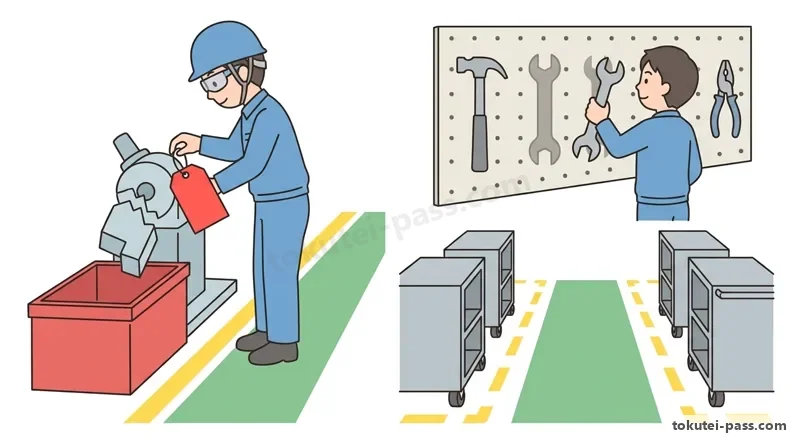
「整理」は、職場にあるものを「必要なものと不要なもの」に明確に分け、不要なものを捨てる(処分・撤去する)ことです。要るか要らないか判断しにくいものに赤い札を貼って期限内に処分を決める「赤札作戦」が有効です。
"Seiri (Sort)" means clearly separating items in the workplace into "necessary and unnecessary" and discarding (disposing of or removing) unnecessary ones. The "Red Tag Strategy"—attaching red tags to items of unclear necessity to decide disposal within a deadline—is highly effective.
「整頓」は、整理して残した「必要なものを、誰でもすぐ取り出せて元に戻せるように、置き場所・置き方・表示(最大・最小量)を決める」ことです。場所と品名・数量を示す「看板作戦」や、工具の輪郭(影絵)を描いて欠品が一目で分かるようにする「形跡管理(姿置き)」を行います。
"Seiton (Set in Order)" means "deciding fixed locations, storage methods, and labels (max/min quantities) for necessary items kept after sorting so anyone can retrieve and return them immediately." Practices include the "Signboard Strategy" showing location, item name, and quantity, and "trace/shadow management (shadow boards)" drawing tool outlines so missing tools are spotted at a glance.
「清掃」はゴミや汚れ・切粉を取り除いて磨き、同時に設備のガタつきや油漏れをチェックする「清掃点検」です。「清潔」は整理・整頓・清掃(3S)が徹底して維持されている状態を指し、「しつけ」は決められたルールや手順を正しく守る習慣づけをすることをいいます。
"Seisou (Shine)" means removing trash, dirt, and chips while checking equipment for looseness or oil leaks (cleaning as inspection). "Seiketsu (Standardize)" refers to the state where the first 3Ss (Sort, Set in Order, Shine) are thoroughly maintained, and "Shitsuke (Sustain)" means building the habit of properly following established rules and procedures.
Key points
- 整理=必要なものと不要なものを分け、不要なものを捨てること(赤札作戦)。
Seiri (Sort) = separating necessary from unnecessary items and discarding the unnecessary (Red Tag Strategy). - 整頓=必要なものをすぐ取り出せるよう定位置・定品・定量を決め表示すること(看板作戦・形跡管理/姿置き)。
Seiton (Set in Order) = deciding fixed location, fixed item, and fixed quantity with clear labels for instant retrieval (Signboard Strategy, shadow boards). - 清掃=掃除を通じて設備点検を行うこと、清潔=3S(整理・整頓・清掃)を維持した状態、しつけ=ルールを守る習慣化。
Seisou (Shine) = inspecting equipment through cleaning; Seiketsu (Standardize) = state of maintaining the 3Ss; Shitsuke (Sustain) = habitual rule compliance.
| Word | Meaning |
|---|---|
| 整理と整頓 | Seiri (Sort) and Seiton (Set in Order) |
| 清潔としつけ | Seiketsu (Standardize) and Shitsuke (Sustain) |
| 赤札作戦 | Red Tag Strategy (for Seiri) |
| 形跡管理(姿置き) | shadow board / trace management (for Seiton) |
試験によく出るポイントと覚え方
Frequently Tested Points & Memory Aids
本試験では「整理(不要品を捨てる)」と「整頓(すぐ取り出せるよう置き場所を決め表示する)」の定義の入れ替え、および「清掃」と「清潔(3Sが維持された状態)」の入れ替えが超頻出です。
Exams very frequently swap the definitions of "Seiri - Sort (discarding unnecessary items)" and "Seiton - Set in Order (designating and labeling locations for immediate retrieval)," as well as swapping "Seisou - Shine" and "Seiketsu - Standardize (the state where 3S is maintained)."
標準時間の計算では、「外掛け法:ST=正味時間×(1+余裕率)」と「内掛け法:ST=正味時間÷(1-余裕率)」のどちらで問われているかを必ず確認しましょう。準備段取時間はロット全体で1回分のみ加算する点にも注意が必要です。
When calculating Standard Time (ST), always verify whether the problem specifies the "External method: ST = Net Time × (1 + Allowance Rate)" or the "Internal method: ST = Net Time ÷ (1 - Allowance Rate)." Also note that setup time is added only once per entire lot.
また、工程分析の検査記号「数量検査=四角(□)、品質検査=ひし形(◇)」と停滞記号「貯蔵=逆三角(▽)、滞留=D」、サーブリッグ第2類(探す・選ぶ・考える)と第3類(保持・遅れ・休む)の分類は確実に暗記してください。
Memorize the process analysis inspection symbols "Quantity inspection = square (□), Quality inspection = diamond (◇)," delay symbols "Storage = inverted triangle (▽), Delay = D," and Therblig Class 2 (search, select, plan) vs. Class 3 (hold, delay, rest).
Key points
- 標準時間の計算:外掛け法=正味×(1+余裕率)/内掛け法=正味÷(1-余裕率)/正味時間=観測時間×(レイティング÷100)。
Standard Time formulas: External = Net × (1 + Allowance Rate) / Internal = Net ÷ (1 - Allowance Rate) / Net Time = Observed Time × (Rating ÷ 100). - ワークサンプリング必要観測数(信頼度95%):N=4×p×(1-p)÷E²(Eは許容絶対誤差、pは生起比率)。
Work Sampling required observations (95% confidence): N = 4 × p × (1 - p) ÷ E² (E = allowable absolute error, p = occurrence ratio). - 工程図記号:加工=○、運搬=〇または→、数量検査=□、品質検査=◇、貯蔵=▽、滞留=D。
Process chart symbols: Operation = ○, Transport = 〇 or →, Quantity inspection = □, Quality inspection = ◇, Storage = ▽, Delay = D. - サーブリッグ分類:第1類=有効動作(つかむ・組み立てる等)、第2類=遅らせる動作(探す・選ぶ・考える)、第3類=無益動作(保持・遅れ・休止)。
Therblig classes: Class 1 = effective motions (grasp, assemble, etc.), Class 2 = delaying motions (search, select, plan), Class 3 = non-productive motions (hold, delay, rest). - ECRSの優先順:E(排除)→C(結合)→R(交換)→S(簡素化)/5S:整理(捨てる=赤札)と整頓(置き方表示=看板・形跡管理)。
ECRS priority: E (Eliminate) → C (Combine) → R (Rearrange) → S (Simplify) / 5S: Seiri (discard = Red Tag) vs. Seiton (display location = Signboard & Shadow Board).
| Word | Meaning |
|---|---|
| 外掛け余裕率と内掛け余裕率 | external vs. internal allowance rate |
| 数量検査(□)と品質検査(◇) | quantity inspection (□) and quality inspection (◇) |
| サーブリッグ第1類〜第3類 | Therblig Classes 1 to 3 |
| ECRS(排除・結合・交換・簡素化) | ECRS (Eliminate, Combine, Rearrange, Simplify) |
Work Management (IE, Standard Time, 5S)
Practice this chapter in the appOfficial references
- 中央職業能力開発協会(JAVADA) ビジネス・キャリア検定試験 3級 生産管理オペレーション 試験範囲 — https://www.javada.or.jp/jigyou/gino/business/subject.html
- 中央職業能力開発協会 編『ビジネス・キャリア検定試験 標準テキスト【専門知識】生産管理オペレーション 3級〔第4版〕』 — https://www.javada.or.jp/jigyou/gino/business/text.html