
Home › Sample questions › Accommodation (SSW 2)
Tokutei Ginou 2 Accommodation (Hotel) practice test with answers – free sample questions
宿泊分野(2号)
10 sample questions in the real exam format, with furigana, English translation, answers and explanations. Tap "Show answer" under each question. For the full question bank and realistic mock exams, open the free app.
Question 1
旅館業法の目的および営業の許可に関する記述として、正しいものはどれか。
Which of the following statements is CORRECT regarding the purpose and operating permit under the Hotel Business Act (Ryokangyoho)?
- A. 宿泊施設を新たに営業する際は、都道府県知事または保健所長の許可を受けなければならない。
When opening a new accommodation facility for business, one must obtain a permit from the Prefectural Governor or the Public Health Center Director. - B. 宿泊施設を新たに営業する際は、営業開始後10日以内に観光庁長官へ届け出ればよい。
When opening a new accommodation facility for business, one only needs to submit a notification to the Japan Tourism Agency Commissioner within 10 days after starting operations. - C. 客室数が10室未満の小規模な施設であれば、消防署長への事前届出のみで宿泊料を受け取れる。
Small-scale facilities with fewer than 10 guest rooms may collect accommodation fees simply by filing a prior notification with the Fire Station Chief. - D. 既存の宿泊施設を事業譲渡により引き継ぐ場合は、承認や許可の手続きを経ずに営業を継続できる。
When taking over an existing accommodation facility through a business transfer, operations may be continued without going through approval or permit procedures.
Show answer
Correct answer: A
Under the Hotel Business Act (Ryokangyoho), the purpose of the law is to ensure public health and improve public welfare; any facility charging accommodation fees must obtain an operating permit from the Prefectural Governor or Public Health Center Director before opening. Merely notifying the Tourism Agency or Fire Station, or taking over a business without prior approval/permit procedures, is not permitted.
| Word | Meaning |
|---|---|
| 旅館業法 | Hotel Business Act |
| 保健所長 | Public Health Center Director |
| 公衆衛生 | public health |
Question 2
宿泊施設における火災発生時の「2方向避難」の原則に関する説明として、正しいものはどれか。
Which of the following explanations is CORRECT regarding the principle of "Two-Way Evacuation" (2-hoko hinan) during a fire at an accommodation facility?
- A. 非常階段と非常用エレベーターの2つを併用し、宿泊客を優先度に応じて2グループに分けて避難させること。
Using both emergency stairs and emergency elevators together to divide staying guests into two groups for evacuation based on priority. - B. 1つの経路が炎や煙で通れない場合も、別の経路から安全に避難できるようにしておくこと。
Ensuring that if one evacuation route becomes impassable due to flames or smoke, guests can safely evacuate via another route. - C. 出火階より上の階は屋上の退避スペースへ、下の階は1階の正面玄関へと上下2方向に分けて誘導すること。
Guiding guests in two vertical directions by sending floors above the fire floor to a rooftop refuge area and floors below to the first-floor main entrance. - D. 1つの避難階段の内部を手すりで2列に区切り、宿泊客の避難動線と自衛消防隊の消火動線を分けること。
Dividing the interior of a single evacuation stairwell into two lanes with a handrail to separate the guest evacuation flow from the in-house fire brigade's firefighting flow.
Show answer
Correct answer: B
The principle of two-way evacuation (2-hoko hinan) means securing at least two independent evacuation routes in different directions so that even if one route is blocked by fire or smoke, guests can safely escape through the other route. Elevators are not used for guest evacuation during a fire, nor does the principle mean dividing a single stairwell into two lanes.
| Word | Meaning |
|---|---|
| 2方向避難 | two-way evacuation |
| 避難経路 | evacuation route |
| 非常階段 | emergency stairs |
Question 3
旅行業の登録をしていない宿泊施設が独自に宿泊プランを造成・販売する際、「旅行業法」に違反する行為はどれか。
When an accommodation facility without travel agency registration independently creates and sells accommodation plans, which of the following acts VIOLATES the "Travel Agency Act" (Ryokogyoho)?
- A. 地域の伝統工芸の体験工房と提携し、陶芸体験チケットが付いた宿泊プランを販売する。
Partnering with a local traditional craft workshop to sell an accommodation plan that includes a pottery experience ticket. - B. 館内のレストランでの地元食材フルコースと貸切温泉入浴を組み合わせたプランを販売する。
Selling a plan that combines a full-course local ingredient dinner at the in-house restaurant with private hot spring bath use. - C. 飛行機や鉄道、貸切バスなどの交通機関の乗車券をセットにした宿泊プランを販売する。
Selling an accommodation plan packaged together with tickets for transportation such as airplanes, trains, or chartered buses. - D. 自社ホームページ限定で、チェックアウト時刻を通常より2時間延長できる特典プランを販売する。
Selling an official-website-exclusive perk plan that extends the check-out time by 2 hours beyond the standard time.
Show answer
Correct answer: C
Under the Travel Agency Act (Ryokogyoho), if an accommodation facility without travel agency registration packages and sells accommodation plans combined with transportation such as flights, trains, or buses, it violates the law. Plans combining meals, hot springs, late check-out, or local craft tickets without transportation are lawful.
💡 Travel Agency Act (Ryokogyoho) rule: An unregistered hotel packaging and selling accommodation plans combined with transportation (airplanes, trains, or buses) violates the law.
| Word | Meaning |
|---|---|
| 旅行業法 | Travel Agency Act |
| 造成 | creation/development (of tour/stay plans) |
| 交通機関 | transportation |
Question 4
自社ホームページにおける「ブッキングエンジン」と「ベストレート保証」の運用に関する記述として、適切なものはどれか。
Which of the following statements is APPROPRIATE regarding the operation of a "Booking Engine" and "Best Rate Guarantee" on the hotel's official website?
- A. ブッキングエンジンとは複数の予約サイトの在庫を自動調整するシステムであり、自社サイトの決済機能は持たない。
A Booking Engine is a system that automatically adjusts room inventory across multiple booking sites and does not include payment functionality on the official website. - B. ベストレート保証とは、OTAでの販売価格を自社サイトより常に10%低く設定して露出を増やす手法である。
Best Rate Guarantee is a method of always setting sales prices on OTAs 10% lower than on the official website in order to increase exposure. - C. ベストレート保証を行う場合は、会員限定割引や早期予約特典などの価格差を設けることは認められない。
When offering a Best Rate Guarantee, setting price differences through member-only discounts or early-bird perks is not permitted. - D. 自社サイトにブッキングエンジンを導入しベストレート保証を行うことで、直接予約を促し手数料負担を抑えられる。
Introducing a Booking Engine on the official site and offering a Best Rate Guarantee encourages direct bookings and reduces commission costs.
Show answer
Correct answer: D
A Booking Engine is the reservation and payment system integrated into the hotel's official website (whereas a Site Controller synchronizes inventory across OTAs). Combining it with a Best Rate Guarantee—promising that the official website offers the lowest rate for the same stay conditions compared to OTAs—drives direct bookings and reduces third-party commission expenses.
| Word | Meaning |
|---|---|
| 保証 | guarantee |
| 直接予約 | direct booking |
| 手数料 | commission fee |
Question 5
予約管理における「オーバーブッキング」と「ダブルブッキング」の違いに関する説明として、正しいものはどれか。
Which of the following explanations is CORRECT regarding the difference between "Overbooking" and "Double booking" in reservation management?
- A. オーバーブッキングはキャンセルを見込んで多めに予約をとる手法で、ダブルブッキングは1室に複数予約が重なるミスである。
Overbooking is a strategy of accepting more reservations than actual rooms in anticipation of cancellations, whereas Double booking is an error where multiple bookings overlap for a single room. - B. オーバーブッキングは入力ミスによる二重予約のことであり、ダブルブッキングは稼働率を高めるための計画的な販売戦略である。
Overbooking is a duplicate booking caused by a data entry mistake, whereas Double booking is a planned sales strategy to increase occupancy rates. - C. オーバーブッキングはOTA経由の予約超過を指し、ダブルブッキングは電話予約のみで発生する在庫超過を指す。
Overbooking refers to excess reservations coming through OTAs, whereas Double booking refers to inventory excess occurring only with telephone reservations. - D. ダブルブッキングが発生した際は、予約日が遅い方の契約をホテル側の判断で無償解除でき、代替室の手配は不要である。
When a Double booking occurs, the hotel may unilaterally cancel the later reservation free of charge without needing to arrange an alternative room.
Show answer
Correct answer: A
Overbooking is a revenue management method of accepting slightly more bookings than actual room inventory anticipating cancellations and no-shows. Double booking is an operational error where multiple guests are booked into the same room; when it happens, the hotel cannot unilaterally cancel the booking without recourse—it must apologize sincerely and arrange an alternative room at a nearby accommodation facility.
💡 Distinguish clearly: Overbooking = strategic sales anticipating cancellations; Double booking = error assigning multiple bookings to one room (must apologize and arrange nearby hotel).
| Word | Meaning |
|---|---|
| 実室数 | actual number of rooms |
| 二重予約 | duplicate reservation |
| 代替 | alternative / substitute |
Question 6
接客スタッフの基本の立ち姿勢として、部下へ指導すべき正しい足元と体の構えはどれか。
Which of the following is the CORRECT foot and body posture to instruct subordinates on as the basic standing posture for customer service staff?
- A. 両足を肩幅と同じ広さに開いて平行に立ち、両手はすぐ動けるよう体の横に自然に下ろして待機する。
Stand with feet parallel at shoulder-width apart and keep both hands hanging naturally at the sides of the body so as to move quickly. - B. かかとをつけてつま先を少し開け、背筋を伸ばし手を体の前で揃える。
Keep the heels together with toes slightly open, straighten the back, and clasp the hands neatly in front of the body. - C. かかととつま先の両方を隙間なく揃えて立ち、両手は背中の腰の位置で組んで胸を張り待機する。
Stand with both heels and toes pressed completely together without any gap, puffing out the chest with hands clasped behind the lower back. - D. 片足を半歩後ろに引いて重心を後ろ足に置き、あごを上げて遠くのお客様まで見渡せる姿勢を保つ。
Draw one foot half a step back with weight placed on the rear leg, raising the chin slightly to survey guests from afar.
Show answer
Correct answer: B
The standard standing posture in the accommodation industry requires placing the heels together with the toes slightly open (kakato wo tsukete, tsumasaki wo sukoshi akeru), straightening the spine, lightly tucking the chin, and folding the hands neatly in front of the body. Standing with feet shoulder-width apart, clasping hands behind the back, or shifting weight onto a rear foot are improper.
| Word | Meaning |
|---|---|
| 立ち姿勢 | standing posture |
| つま先 | toes / tiptoes |
| 背筋 | spine / back |
Question 7
ホテルや旅館のレストランにおけるマネージャー(店長)の役割と管理業務として、最も適切なものはどれか。
Which of the following is MOST APPROPRIATE as the role and management responsibility of a restaurant manager in a hotel or ryokan?
- A. ホールの接客指導とシフト作成のみを担当し、食材原価や売上などの数値管理は料理長に一任する。
Taking charge only of dining floor service coaching and shift scheduling while leaving numerical management such as food cost and sales entirely to the head chef. - B. 売上目標の達成と原価管理に専念し、現場でのクレーム対応や衛生管理はホールリーダーに任せる。
Focusing exclusively on achieving sales targets and cost control while leaving on-site complaint handling and hygiene management to the floor leader. - C. VIP客の接遇と予約台帳の管理のみを行い、新人スタッフの教育やオペレーション改善には関与しない。
Handling only VIP guest hospitality and reservation ledger management without getting involved in new staff training or operational improvements. - D. 接客の品質管理や衛生管理、クレーム対応に加え、従業員教育や顧客管理などの店舗運営全般を担う。
Overseeing overall restaurant operations including service quality control, hygiene management, complaint handling, staff training, and customer management.
Show answer
Correct answer: D
A restaurant manager (or store manager) is responsible not just for a single area but for overall store management: service quality control, sales and cost control, food safety and hygiene management, handling guest complaints, staff training (jugyoin kyoiku), and customer information management (kokyaku kanri).
| Word | Meaning |
|---|---|
| 品質管理 | quality control |
| 従業員教育 | employee training |
| 顧客管理 | customer management |
Question 8
総客室数120室のホテルにおいて、ある日の販売室数が96室、客室売上高が1,440,000円であった。この日の「OCC(客室稼働率)」「ADR(平均客室単価)」「RevPAR」の組み合わせとして、正しいものはどれか。
At a hotel with 120 total rooms, 96 rooms were sold on a certain day and room revenue was 1,440,000 yen. Which of the following combinations of "OCC (Occupancy Rate)", "ADR (Average Daily Rate)", and "RevPAR" for that day is CORRECT?
- A. OCC:75% / ADR:15,000円 / RevPAR:11,250円
OCC: 75% / ADR: 15,000 yen / RevPAR: 11,250 yen - B. OCC:80% / ADR:12,000円 / RevPAR:15,000円
OCC: 80% / ADR: 12,000 yen / RevPAR: 15,000 yen - C. OCC:80% / ADR:15,000円 / RevPAR:12,000円
OCC: 80% / ADR: 15,000 yen / RevPAR: 12,000 yen - D. OCC:85% / ADR:16,000円 / RevPAR:13,600円
OCC: 85% / ADR: 16,000 yen / RevPAR: 13,600 yen
Show answer
Correct answer: C
Using the room KPI formulas: (1) OCC = Rooms Sold ÷ Total Available Rooms = 96 ÷ 120 × 100 = 80%; (2) ADR = Room Revenue ÷ Rooms Sold = 1,440,000 yen ÷ 96 = 15,000 yen; (3) RevPAR = Room Revenue ÷ Total Available Rooms = 1,440,000 yen ÷ 120 = 12,000 yen (or ADR × OCC = 15,000 × 0.80 = 12,000 yen).
💡 Room KPI formulas: OCC = 96 ÷ 120 = 80%; ADR = Room Revenue ÷ Rooms Sold (1,440,000 ÷ 96 = 15,000 yen); RevPAR = Room Revenue ÷ Total Rooms (12,000 yen).
| Word | Meaning |
|---|---|
| 客室稼働率 | occupancy rate (OCC) |
| 平均客室単価 | average daily rate (ADR) |
| 販売室数 | number of rooms sold |
Question 9
あるホテルレストランの月間売上高が8,000,000円、食材原価が2,800,000円であった。現在の食材原価率と、業界の標準的な目標値である「30%」に抑えるために削減すべき食材原価額の組み合わせとして、正しいものはどれか。
A hotel restaurant has monthly sales of 8,000,000 yen and food cost of 2,800,000 yen. Which of the following combinations is CORRECT for the "Current food cost ratio" and the "Amount of food cost to reduce" in order to meet the standard industry target of 30%?
- A. 現在の食材原価率:32% / 削減すべき食材原価額:160,000円
Current food cost ratio: 32% / Amount of food cost to reduce: 160,000 yen - B. 現在の食材原価率:35% / 削減すべき食材原価額:400,000円
Current food cost ratio: 35% / Amount of food cost to reduce: 400,000 yen - C. 現在の食材原価率:35% / 削減すべき食材原価額:280,000円
Current food cost ratio: 35% / Amount of food cost to reduce: 280,000 yen - D. 現在の食材原価率:40% / 削減すべき食材原価額:800,000円
Current food cost ratio: 40% / Amount of food cost to reduce: 800,000 yen
Show answer
Correct answer: B
Food cost ratio = Food Cost ÷ Sales × 100 = 2,800,000 ÷ 8,000,000 × 100 = 35%. At the standard target of 30% on sales of 8,000,000 yen, the target food cost is 8,000,000 × 30% = 2,400,000 yen. Thus, the amount of food cost to reduce through F&B control is 2,800,000 - 2,400,000 = 400,000 yen.
| Word | Meaning |
|---|---|
| 食材原価率 | food cost ratio |
| 目標値 | target value |
| 削減 | reduction |
Question 10
図のように、始業前の点検でリーダーが部下の「基本の立ち姿勢」と「身だしなみ」を確認している。指導内容として最も適切なものはどれか。
As shown in the illustration, a team leader is checking a subordinate's "Basic standing posture" and "Grooming" during a pre-shift inspection. Which of the following coaching instructions is MOST APPROPRIATE?
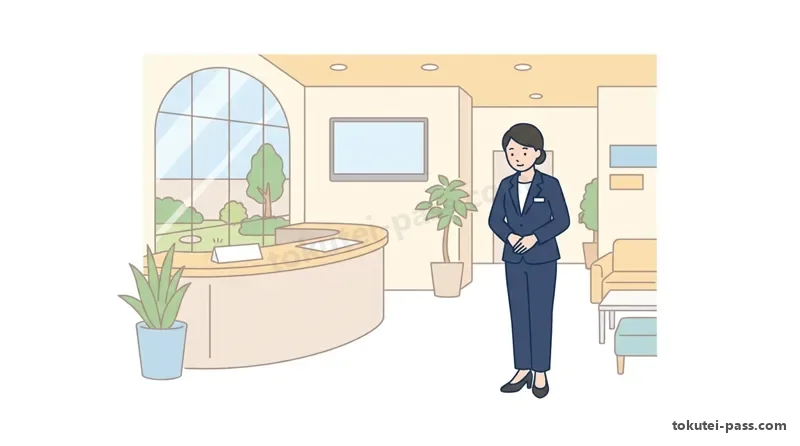
- A. 両足を肩幅に開いて重心を安定させ、両手はすぐ案内できるよう体の横に下ろして待つよう指導する。
Instruct the staff member to stand with feet shoulder-width apart to stabilize their center of gravity and keep both hands down at their sides to guide guests immediately. - B. 親しみやすさを演出するため、季節のアクセサリーや華やかな香りの香水を身につけるよう指導する。
Instruct the staff member to wear seasonal accessories and fragrant perfume in order to project a friendly and approachable impression. - C. 長い時間立っても疲れが出ないよう、片足に重心をかけて腕を背中の後ろで組んで立つよう指導する。
Instruct the staff member to shift their center of gravity onto one leg and clasp their arms behind their back so they do not get tired from standing long hours. - D. かかとをつけてつま先を少し開け、背筋を伸ばし清潔感のある身だしなみを保つよう指導する。
Instruct the staff member to keep their heels together with toes slightly open, straighten their back, and maintain clean grooming.
Show answer
Correct answer: D
During pre-shift inspections, leaders must ensure staff maintain the proper standing posture—heels together, toes slightly open, straight back, and hands neatly clasped in front—along with clean, neat grooming free of perfume or unnecessary accessories.
| Word | Meaning |
|---|---|
| 始業前 | before starting work / pre-shift |
| 清潔感 | cleanliness / neatness |
| 重心 | center of gravity / weight |