Safety and Hygiene Management, Inns and Hotels Act & Foundational Knowledge (Operating Permits, Bi-Annual Fire Drills, Vomit Cleanup, O157, Circulating Hot Springs)
安全衛生管理・旅館業法・基礎知識(営業許可・年2回以上の消防訓練・吐瀉物処理・O157・循環式温泉)
Accommodation (SSW 2) · 宿泊分野(2号) · Written by Tokutei Pass based on the official study texts; not copied verbatim.
旅館業法の目的・営業種別・行政処分
Purpose, Business Categories, and Administrative Dispositions of the Inns and Hotels Act
旅館業法は、公衆衛生の確保および国民生活の向上に寄与することを目的とし、宿泊施設が備えるべき構造設備の基準や衛生措置を定めています。宿泊料を受けて人を宿泊させる営業を行うには、都道府県知事(または保健所設置市の市長・特別区の区長/保健所長)の許可を受ける必要があります。
The Inns and Hotels Act aims to ensure public health and contribute to improving national living standards by establishing structural/equipment standards and hygiene measures required of accommodation facilities. Operating a business that lodges people for a fee requires a permit from the prefectural governor (or the mayor of a city with a public health center, a special ward mayor, or the public health center director).
許可を得るためには、客室の広さ・換気・採光・照明・防湿・清潔・トイレ・洗面設備などの構造設備基準を満たさなければなりません。旅館業法における営業種別は、①旅館・ホテル営業、②簡易宿所営業(カプセルホテルやホステルなど多人数で共用する施設)、③下宿営業(1か月以上の単位で宿泊させる施設)の3種類に分類されます。
To obtain a permit, a facility must meet structural and equipment standards regarding guest room floor area, ventilation, natural lighting, illumination, moisture prevention, cleanliness, toilets, and washbasins. Business categories under the Inns and Hotels Act are classified into three types: (1) Hotel and Ryokan business, (2) Common lodging house business (facilities shared by multiple people such as capsule hotels and hostels), and (3) Boarding house business (lodging guests for periods of one month or longer).
営業者には宿泊者名簿を備え、氏名・住所・連絡先(日本国内に住所を有しない外国人は国籍・旅券番号)を記載して保存する義務があります。また、伝染性の疾病にかかっている者や違法行為・迷惑行為のおそれがある場合などを除き、正当な理由なく宿泊を拒んではなりません。
Operators are obligated to maintain and preserve a guest register recording each guest's name, address, and contact information (plus nationality and passport number for foreign nationals without a registered address in Japan). Furthermore, except when a guest has a contagious disease or is likely to engage in illegal or nuisance behavior, accommodation must not be refused without justifiable grounds.
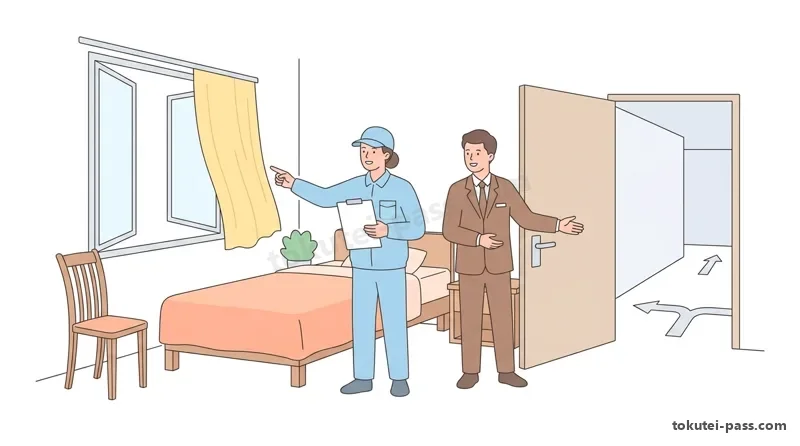
保健所の職員(環境衛生監視員)は、公衆衛生上必要な場合に施設へ立入検査を行う権限を持っています。法令違反や構造設備・衛生基準への不適合が判明した場合には、改善命令、営業停止命令、営業許可の取消しといった行政処分や、罰金などの罰則が科されます。
Public health center officials (environmental sanitation inspectors) have the authority to conduct on-site inspections of facilities when necessary for public health. If legal violations or non-compliance with structural/hygiene standards are found, administrative dispositions such as improvement orders, business suspension orders, or revocation of the operating permit, as well as fines and penalties, may be imposed.
Key points
- 旅館業を営むには都道府県知事(保健所長等)の許可が必要であり、①旅館・ホテル営業、②簡易宿所営業、③下宿営業の3種別がある。
Operating an accommodation business requires a permit from the prefectural governor (or public health center director) and falls into three categories: (1) Hotel/Ryokan, (2) Common lodging house, and (3) Boarding house. - 客室の広さ・換気・採光・照明・防湿・トイレ等の構造設備基準を満たし、宿泊者名簿を備え付けて保存しなければならない。
Facilities must meet structural/equipment standards for room size, ventilation, lighting, moisture control, toilets, etc., and must maintain and preserve a guest register. - 保健所による立入検査の対象となり、違反時には営業停止命令や営業許可の取消し、さらに罰金等の処分が科される。
Facilities are subject to on-site inspections by the public health center, and violations can result in business suspension orders, permit revocation, or fines.
| Word | Meaning |
|---|---|
| 旅館業法 | Inns and Hotels Act (Hotel Business Act) |
| 簡易宿所営業 | common lodging house business (capsule hotels, hostels) |
| 立入検査と行政処分 | on-site inspection and administrative disposition (business suspension/revocation) |
防災体制・2方向避難の原則・年2回以上の消防訓練
Disaster Preparedness, Two-Way Evacuation Principle, and Bi-Annual Fire Drills
不特定多数のお客様が宿泊する旅館・ホテルでは、火災や地震などの災害に備え、日頃から非常口や避難経路を確認しておくことが不可欠です。1つの経路が煙や炎で塞がれても別のルートから確実に脱出できるよう、お客様を含め「2方向避難の原則」を徹底します。
In inns and hotels where an unspecified large number of guests stay, checking emergency exits and evacuation routes on a daily basis in preparation for fires and earthquakes is essential. To ensure that guests and staff can reliably escape via an alternate route even if one path is blocked by smoke or flames, the 'two-way evacuation principle' must be thoroughly enforced.
非常ドア(防火扉)は、火災発生時に煙や炎を遮断し、延焼を食い止める重要な役割を担っています。そのため、非常ドアの周辺や避難通路・階段には、荷物やリネンワゴンなどの物品を絶対に置いてはなりません。
Emergency doors (fire doors) play a critical role in blocking smoke and flames during a fire and stopping the spread of fire. Therefore, luggage, linen carts, or any other items must never be placed around emergency doors or in evacuation corridors and stairwells.
消防法により、旅館・ホテルなどの宿泊施設では、消火訓練・避難訓練を「年に2回以上」実施することが義務付けられています(通報訓練も消防計画に基づき定期的に行います)。夜間などスタッフの人数が少ない時間帯を想定した実践的な訓練を重ね、自衛消防隊の役割分担を明確にします。
Under the Fire Service Act, accommodation facilities such as inns and hotels are required to conduct firefighting drills and evacuation drills 'at least twice a year' (emergency reporting drills are also held regularly under the fire prevention plan). Practical drills assuming nighttime hours when fewer staff members are on duty should be repeated, and the roles of the in-house self-defense firefighting team must be clearly defined.
館内で急病人やけが人が発生した際には、ただちに119番へ通報し、施設の名称・住所とともに、お客様の「症状・年齢・性別」を正確に伝えます。心肺停止の場合は周囲のスタッフと協力して胸骨圧迫とAED(自動体外式除細動器)による救命処置を行い、事件・事故は110番へ通報します。
When a sudden illness or injury occurs inside the facility, immediately call 119 and accurately report the facility's name and address along with the guest's 'symptoms, age, and gender'. In the event of cardiopulmonary arrest, cooperate with surrounding staff to perform chest compressions and life-saving treatment using an AED (Automated External Defibrillator); report crimes or accidents to 110.
Key points
- 災害時の「2方向避難の原則」を徹底し、煙や炎を遮断する非常ドアの周りや避難経路には絶対に物を置かない。
Enforce the 'two-way evacuation principle' during disasters and never place objects around emergency doors (which block smoke and flames) or along evacuation routes. - 宿泊施設では消火・避難の消防訓練を「年に2回以上」実施することが義務付けられている。
Accommodation facilities are legally required to conduct firefighting and evacuation drills 'at least twice a year'. - 急病人発生時は119番に通報して「症状・年齢・性別」を伝え、必要に応じてAEDを使用する。
When a guest falls suddenly ill, call 119 to report their 'symptoms, age, and gender' and use an AED as needed.
| Word | Meaning |
|---|---|
| 2方向避難の原則 | two-way evacuation principle |
| 非常ドア(防火扉) | emergency / fire door (blocks smoke and stops fire from spreading) |
| 消防訓練(年2回以上) | fire drill (mandatory at least twice a year) |
消防設備の運用・初期消火の限界・個人情報管理
Fire Equipment Operation, Limits of Initial Firefighting, and Personal Data Security
旅館・ホテルには自動火災報知設備の設置が義務付けられており、防災センターやフロントなどで「24時間の監視体制」を維持しなければなりません。また、感知器の誤作動や故障を防ぎ、いざという時に確実に作動させるため、専門業者による定期的な保守点検が不可欠です。
Inns and hotels are required to install automatic fire alarm systems and must maintain a '24-hour monitoring system' at the disaster prevention center or front desk. In addition, periodic maintenance and inspection by specialized contractors are essential to prevent sensor malfunctions or failures and ensure reliable activation in an emergency.
火災を発見した際の初期消火において、粉末消火器などで消火できるのは「天井に火が移る前まで」です。炎が天井に達した場合や煙が充満した場合は、消火器での消火は不可能であるため、ただちに初期消火を中止して避難するか、屋内消火栓(屋内消火設備)での対応・避難誘導に切り替えます。
During initial firefighting upon discovering a fire, a dry chemical fire extinguisher can extinguish a fire only 'before the fire reaches the ceiling'. Once flames reach the ceiling or smoke fills the room, extinguishing the fire with a portable extinguisher is impossible; immediately abort extinguisher firefighting and either evacuate or switch to indoor fire hydrants and guest evacuation guidance.
火災や地震による避難時には、停電による閉じ込めや煙突効果による煙の流入を防ぐため、エレベーターは絶対に使用せず非常階段で避難を誘導します。高齢者・障がい者・妊婦・外国人など災害時要配慮者には、スタッフが個別に声をかけて安全な場所へ誘導します。
During evacuation due to a fire or earthquake, never use elevators in order to prevent entrapment from power outages or smoke inhalation from the stack effect; always guide guests down emergency stairs. For people requiring special assistance during disasters—such as elderly guests, guests with disabilities, pregnant guests, and foreign guests—staff should speak to them individually and guide them to safety.
また、業務セキュリティの観点から、顧客の個人情報は厳重に管理しなければなりません。たとえば、DM(ダイレクトメール)の配信作業などを理由に、顧客の個人情報データをノートパソコンやUSBメモリにコピーして自宅へ持ち帰る行為は、情報漏洩の重大な原因となるため絶対に禁止されています。
Furthermore, from an operational security standpoint, customer personal data must be strictly protected. For example, copying customer personal information onto a laptop computer or USB drive and taking it home to perform direct mail (DM) distribution work is strictly prohibited, as it is a major cause of data breaches.
Key points
- 自動火災報知設備は「24時間の監視体制」と誤作動を防ぐ定期点検が必要である。
Automatic fire alarm systems require a '24-hour monitoring system' and periodic maintenance to prevent false alarms. - 消火器で初期消火できる限界は「天井に火が移る前まで」であり、避難時はエレベーターを絶対に使わない。
The limit for initial firefighting with a fire extinguisher is 'before the fire reaches the ceiling', and elevators must never be used during evacuation. - DM配信作業などのために顧客の個人情報をノートパソコン等にコピーして自宅へ持ち帰ることは厳禁である。
Copying customer personal information onto a laptop to take home for DM distribution work is strictly prohibited.
| Word | Meaning |
|---|---|
| 自動火災報知設備 | automatic fire alarm system (24-hour monitoring and periodic inspection) |
| 屋内消火栓 | indoor fire hydrant |
| 個人情報の持ち出し禁止 | prohibition on taking personal data outside (e.g., copying to a laptop to take home) |
従業員の安全・体調報告・不審物および不審者対応
Employee Safety, Health Reporting, and Handling Suspicious Objects and Persons
従業員自身の労働安全を守るため、高所作業や重量物の運搬、薬品の取り扱いでは決められた作業手順と保護具の着用を徹底します。万が一業務中にケガや事故が発生した場合は、軽微なものであっても隠さず速やかに責任者へ報告します。
To protect employees' own occupational safety, strictly follow established work procedures and wear protective gear when working at heights, carrying heavy objects, or handling chemicals. If an injury or accident occurs during work, even a minor one, report it promptly to a supervisor without concealing it.
感染症や食中毒の拡大を防ぐため、従業員に「咳・喉の痛み・発熱(37.5度以上)・下痢・腹痛・おう吐」などの症状がある場合や、手指に化膿創(傷)がある場合は、自己判断で隠して勤務せず、出勤前に必ず上司・責任者へ報告して指示を仰ぎます。
To prevent the spread of infectious diseases and food poisoning, if an employee has symptoms such as 'cough, sore throat, fever (37.5 degrees C or higher), diarrhea, abdominal pain, or vomiting', or has a suppurating wound (cut) on the hands or fingers, they must never conceal it on their own judgment and report to work; they must report to their supervisor before starting work and follow instructions.
館内の巡回や清掃中に、持ち主不明のバッグや不審物を発見した場合は、爆発物などの危険があるため、絶対に触ったり開けたり、足で蹴ったりしてはなりません。ただちに周囲のお客様を遠ざけ、上司へ報告して警察へ連絡します。
If an unattended bag or suspicious object is found during facility patrols or cleaning, never touch it, open it, or kick it, as there is a risk of explosives. Immediately keep surrounding guests away, report to a supervisor, and contact the police.
また、館内をうろつく不審者や危険な言動をする人物を発見した際にも、従業員が「一人で対応せず、必ず複数人で対応する」ことが鉄則です。自身とお客様の安全を最優先に確保しながら、速やかに責任者や警備担当・警察へ応援を要請します。
Similarly, when spotting a suspicious person loitering in the building or someone acting dangerously, the ironclad rule is for staff 'never to respond alone, but always to respond with multiple people'. While prioritizing the safety of yourself and guests, promptly request backup from supervisors, security staff, and the police.
Key points
- 発熱(37.5度以上)・咳・喉の痛み・下痢・腹痛・おう吐がある場合は、自己判断せず必ず上司に報告する。
If experiencing fever (37.5 degrees C or higher), cough, sore throat, diarrhea, abdominal pain, or vomiting, do not judge on your own—always report to a supervisor. - 不審物を発見したら絶対に触ったり開けたりせず、周囲の安全を確保して上司・警察へ連絡する。
When discovering a suspicious object, never touch or open it; secure the surrounding area and contact a supervisor and the police. - 不審者への対応は危険を避けるため「一人ではなく必ず複数人」で行い、速やかに上司や警察へ通報する。
To avoid danger when dealing with a suspicious person, always respond 'with multiple people rather than alone' and promptly notify a supervisor or the police.
| Word | Meaning |
|---|---|
| 体調不良の報告義務 | duty to report poor health (fever 37.5 degrees C or higher, diarrhea, vomiting, etc.) |
| 不審物・不審者対応 | handling suspicious objects and persons (do not touch; respond with multiple staff) |
| 化膿創 | suppurating wound (source of Staphylococcus aureus contamination) |
吐瀉物(おう吐物)の処理とノロウイルス感染対策
Cleaning Up Vomit and Norovirus Infection Control
客室や共用通路・トイレなどでお客様の吐瀉物(おう吐物)を発見した場合は、常に「ノロウイルスなどの感染症」の可能性を疑って対処しなければなりません。ノロウイルスは感染力が非常に強く、乾燥して空気中に舞い上がった飛沫を吸い込むことでも二次感染を引き起こします。
When guest vomit is found in a guest room, common corridor, or restroom, you must always suspect the possibility of an 'infectious disease such as Norovirus' when responding. Norovirus is extremely contagious and can cause secondary infection even when dried droplets become airborne and are inhaled.
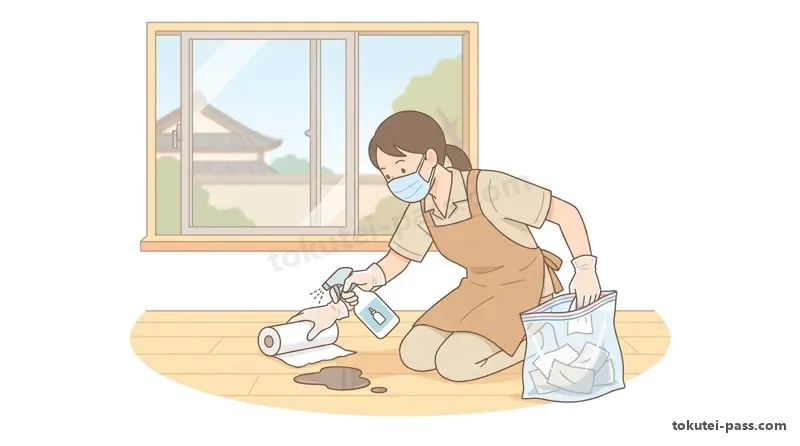
吐瀉物の処理を行うスタッフは、必ず「使い捨ての手袋・マスク・エプロン」を着用し、直接手で触れたり飛沫を吸い込んだりしないよう保護します。また、周囲への感染拡大を防ぐため、処理作業は「できるだけ少人数」で迅速に行い、関係のない人を近づけないようにします。
Staff cleaning up vomit must always wear 'disposable gloves, a mask, and an apron' to protect themselves from direct contact or inhaling droplets. Furthermore, to prevent the spread of infection to surrounding areas, cleanup must be performed quickly by 'as few people as possible', keeping unrelated people away.
ノロウイルスには一般的なアルコール消毒が効きにくいため、消毒には必ず「次亜塩素酸ナトリウム(塩素系消毒液)」を使用します。ペーパータオルで吐瀉物を外側から内側へ静かに拭き取り、次亜塩素酸ナトリウムで浸すように消毒します。
Because ordinary alcohol sanitizers are largely ineffective against Norovirus, always use 'sodium hypochlorite (chlorine-based disinfectant)' for disinfection. Gently wipe up the vomit from the outside inward with paper towels, then soak the area thoroughly with sodium hypochlorite to disinfect it.
使用したペーパータオルや使い捨て手袋・マスクは、ウイルスが外に漏れないようビニール袋に入れて消毒液を注ぎ、固く密閉して廃棄します。作業中および作業後は窓を開けて十分に換気を行い、処理を終えたスタッフは石けんと流水で念入りに手洗いとうがいを実施します。
Place used paper towels, disposable gloves, and masks into a plastic bag, pour disinfectant over them, and seal the bag tightly before disposal so the virus cannot escape. Ventilate the area thoroughly by opening windows during and after the work, and staff who completed the cleanup must wash their hands thoroughly with soap and running water and gargle.
Key points
- 吐瀉物(おう吐物)の処理はノロウイルス等の感染を疑い、必ず「使い捨て手袋とマスク」を着用する。
When cleaning up vomit, suspect Norovirus infection and always wear 'disposable gloves and a mask'. - 感染拡大を防ぐため、おう吐物の処理は「できるだけ少人数」で行い、十分に換気する。
To prevent the spread of infection, perform vomit cleanup with 'as few people as possible' and ventilate thoroughly. - ノロウイルスの消毒には「次亜塩素酸ナトリウム(塩素系消毒液)」を用い、使用済みの用具はビニール袋に密閉して廃棄する。
Use 'sodium hypochlorite (chlorine-based disinfectant)' against Norovirus and seal used tools tightly in a plastic bag for disposal.
| Word | Meaning |
|---|---|
| 吐瀉物(おう吐物) | vomit (must be handled with disposable gloves, mask, and as few people as possible) |
| 次亜塩素酸ナトリウム | sodium hypochlorite (chlorine-based disinfectant effective against Norovirus) |
| 二次感染防止 | prevention of secondary infection |
保健所指導とHACCP・温度管理・O157対策
Public Health Center Guidance, HACCP, Temperature Control, and O157 Countermeasures
宿泊施設における飲食提供では、管轄の「保健所の指導」に従うとともに、食品衛生法に基づく「HACCP(ハサップ)」の手法によって、原材料の受入れから調理・提供に至るすべての工程で衛生管理と記録を徹底します。食中毒予防の3原則である「菌をつけない・増やさない・やっつける」を確実に実行します。
In food and beverage service at accommodation facilities, follow the 'guidance of the jurisdictional public health center' and apply 'HACCP' methods under the Food Sanitation Act to enforce hygiene management and record-keeping across all processes from receiving raw ingredients to cooking and serving. Reliably practice the three principles of food poisoning prevention: 'Keep bacteria off, prevent growth, and kill bacteria'.
「増やさない」ための温度管理として、冷蔵庫は10℃以下(特に生鮮食品は2〜5℃)、冷凍庫はマイナス15℃以下に保ち、毎日温度を点検・記録します。冷凍食材を解凍する際は、細菌が増殖しやすく旨味を含むドリップが出る「室温(常温)解凍」を避け、冷蔵庫内解凍や流水解凍を行います。
For temperature control to 'prevent growth', keep refrigerators at 10 degrees C or below (2 to 5 degrees C for perishable foods) and freezers at -15 degrees C or below, checking and recording temperatures daily. When thawing frozen ingredients, avoid 'room-temperature thawing'—which promotes bacterial growth and causes flavorful drip loss—and instead thaw inside a refrigerator or under running water.
細菌性食中毒の代表例である「腸管出血性大腸菌O157(オーイチゴーナナ)」は、牛などの家畜の腸内に存在し、加熱不十分な食肉や二次汚染された生野菜などから感染します。O157に感染すると、激しい腹痛や水様便、さらに出血性の下痢(血便)などの重篤な症状を引き起こします。
A representative bacterial food poisoning agent, 'enterohemorrhagic Escherichia coli O157', lives in the intestines of livestock such as cattle and infects people through undercooked meat or cross-contaminated raw vegetables. Infection with O157 causes severe symptoms including intense abdominal pain, watery diarrhea, and hemorrhagic (bloody) diarrhea.
O157やサルモネラ属菌・カンピロバクターなどの食中毒菌を「やっつける」には、食品の「中心部を75℃で1分以上」(ノロウイルスのおそれがある二枚貝などは85〜90℃で90秒以上)加熱することが有効です。調理器具は肉・魚・野菜ごとに使い分け、使用後は洗浄・熱湯または塩素系薬剤で消毒します。
To 'kill' foodborne bacteria such as O157, Salmonella, and Campylobacter, heating the 'center of the food to 75 degrees C for at least 1 minute' (or 85 to 90 degrees C for at least 90 seconds for bivalves that may carry Norovirus) is effective. Use separate knives and cutting boards for meat, fish, and vegetables, and wash and sanitize them with boiling water or chlorine agents after use.
Key points
- 保健所の指導とHACCPに基づき、冷蔵庫(2〜5℃/10℃以下)・冷凍庫(-15℃以下)の温度管理を徹底し、室温解凍を避ける。
Follow public health center guidance and HACCP, strictly manage refrigerator (2 to 5 degrees C / 10 degrees C or below) and freezer (-15 degrees C or below) temperatures, and avoid room-temperature thawing. - 腸管出血性大腸菌O157は激しい腹痛や出血性の下痢を引き起こすが、中心部75℃・1分以上の加熱で死滅する。
Enterohemorrhagic E. coli O157 causes severe abdominal pain and hemorrhagic diarrhea, but is killed by heating the center to 75 degrees C for at least 1 minute. - 包丁・まな板は食材ごとに区分使用し、交差汚染(二次汚染)を防ぐ。
Use separate knives and cutting boards for each food category to prevent cross-contamination.
| Word | Meaning |
|---|---|
| 腸管出血性大腸菌O157 | enterohemorrhagic E. coli O157 (causes hemorrhagic diarrhea; killed at 75 degrees C for at least 1 min) |
| 室温解凍の禁止 | prohibition of room-temperature thawing (prevents drip loss and bacterial growth) |
| HACCP(ハサップ) | Hazard Analysis and Critical Control Points (HACCP) |
身だしなみ(靴の履き方)と循環式温泉の衛生管理
Personal Grooming (Footwear Rules) and Hygiene Management of Circulating Hot Springs
宿泊施設で働くスタッフは、清潔な制服・整えられた髪や爪など、衛生面と安全面の両方から正しい身だしなみを保ちます。特に履物については、転倒事故を防ぎ美しい立ち居振る舞いを維持するため、「靴のかかとをつぶして履かない」ことが基本ルールとして厳格に求められます。
Staff working at accommodation facilities maintain proper grooming for both hygiene and safety, including a clean uniform and neatly kept hair and nails. Regarding footwear in particular, to prevent tripping accidents and maintain graceful posture, the basic rule 'never step on the heels of your shoes when wearing them' is strictly enforced.
また、日常の健康・衛生管理として、外から戻った際やトイレの後、食事や配膳の前には必ず「手洗い・うがい」を励行します。さらに、お客様の体調変化や館内環境の調整、食中毒警報に備えるため、毎日の「天気・気温・湿度」に関心を持って確認する習慣をつけます。
In addition, as part of daily health and hygiene management, always practice 'handwashing and gargling' when returning from outside, after using the restroom, and before eating or serving food. Furthermore, make it a daily habit to check the 'weather, temperature, and humidity' to prepare for changes in guests' physical condition, indoor climate adjustments, and food poisoning alerts.
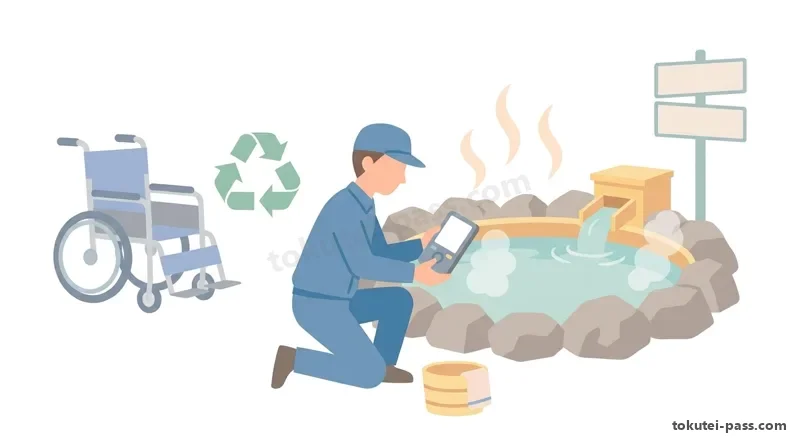
大浴場や温泉施設、とりわけお湯をろ過して循環させる「循環式温泉(循環ろ過式浴場)」では、水質の衛生管理が極めて重要です。管理が不十分であると、浴槽や配管のぬめり(バイオフィルム)で「レジオネラ属菌」が増殖し、重篤な肺炎(レジオネラ症)を引き起こす危険があります。
In large public baths and hot spring facilities—especially 'circulating hot springs (circulating filtration baths)' where bathwater is filtered and recirculated—water quality hygiene management is critically important. If management is inadequate, 'Legionella bacteria' proliferate in slimy biofilm inside bathtubs and pipes, posing a risk of severe pneumonia (Legionnaires' disease).
レジオネラ属菌による集団感染を防ぐため、循環式温泉では法令・条例の基準に基づき、ろ過器やヘアーキャッチャーの清掃・換水を行うとともに、お湯の「塩素消毒を定期的に行い、遊離残留塩素濃度を測定・記録する」ことが義務付けられています。
To prevent mass outbreaks caused by Legionella bacteria, circulating hot springs are legally required under laws and municipal ordinances to clean filters and hair catchers, replace bathwater, and 'periodically perform chlorine disinfection of the bathwater while measuring and recording free residual chlorine levels'.
Key points
- 安全と礼儀のため「靴のかかとをつぶして履かない」ことを徹底し、手洗い・うがいと日々の天気・気温・湿度の確認を習慣化する。
Strictly follow the rule 'never step on the heels of your shoes' for safety and courtesy, and make handwashing, gargling, and checking daily weather, temperature, and humidity a habit. - 循環式温泉(循環ろ過式浴場)では、レジオネラ属菌の増殖を防ぐため「定期的な塩素消毒」と残留塩素濃度の測定が不可欠である。
In circulating hot springs (circulating filtration baths), 'periodic chlorine disinfection' and measuring residual chlorine concentration are essential to prevent Legionella bacteria growth. - 浴槽の換水やろ過器・配管の洗浄を計画的に実施し、公衆浴場の衛生基準を遵守する。
Systematically replace bathwater and clean filters and piping in compliance with public bath hygiene standards.
| Word | Meaning |
|---|---|
| 循環式温泉 | circulating hot spring bath (requires periodic chlorine disinfection) |
| レジオネラ属菌 | Legionella bacteria (causes severe pneumonia if circulating baths are not properly disinfected) |
| 塩素消毒 | chlorine disinfection |
施設設備管理・ユニバーサルデザイン・SDGsの推進
Facility Equipment Management, Universal Design, and Promoting SDGs
空調・給湯・照明・エレベーター・水回りなどの施設設備は、お客様の快適性と安全性に直結します。日常業務の中で異音・水漏れ・破損などの不具合を発見した場合は、放置せず速やかに「施設管理担当者」へ連絡して修繕を手配します。
Facility equipment such as air conditioning, hot water supply, lighting, elevators, and plumbing directly affects guest comfort and safety. When discovering defects such as abnormal noise, water leaks, or damage during daily operations, do not leave them unattended—promptly notify the 'facility management person in charge' to arrange repairs.
多様なお客様を迎える宿泊施設では、障がいのある方や高齢者の障壁を取り除く「バリアフリー」だけでなく、「年齢・性別・国籍・障がいの有無にかかわらず、最初からすべての人にとって使いやすいように施設や製品を設計する」という「ユニバーサルデザイン」の考え方が重視されています。
In accommodation facilities welcoming diverse guests, emphasis is placed not only on 'Barrier-free' (removing obstacles for people with disabilities and the elderly), but also on the concept of 'Universal Design'—which means 'designing facilities and products from the outset so that they are easy for all people to use, regardless of age, gender, nationality, or disability'.
バックヤード(事務室・倉庫・リネン室)においても「5S(整理・整頓・清掃・清潔・躾)」を徹底することで、業務効率が向上し、労働災害や備品の紛失を防ぐことができます。
Even in back-of-house areas (offices, storage rooms, linen rooms), thoroughly practicing the '5S principles (Sort, Set in order, Shine, Standardize, Sustain)' improves operational efficiency and prevents occupational accidents and lost supplies.
さらに、国際社会の共通目標である「SDGs(持続可能な開発目標)」への取り組みとして、館内での節電・節水、ペーパーレス化による紙の節約、ゴミの分別とリサイクル、連泊時のエコ清掃、ビュッフェや宴会での「食品ロス削減」などを従業員一人ひとりが実践します。
Furthermore, as part of efforts toward the international community's shared 'SDGs (Sustainable Development Goals)', every employee practices power and water conservation in the facility, paper reduction through paperless operations, waste sorting and recycling, eco-cleaning for multi-night stays, and 'food loss reduction' at buffets and banquets.
Key points
- 年齢・性別・国籍・障がいの有無にかかわらず、すべての人に使いやすく設計する「ユニバーサルデザイン」を理解する。
Understand 'Universal Design'—designing facilities and products to be usable by all people regardless of age, gender, nationality, or disability. - 設備の故障や不具合を発見したら速やかに「施設管理担当者」へ報告し、バックヤードの5Sを徹底する。
Promptly report equipment malfunctions or defects to the 'facility management person in charge' and enforce 5S in back-of-house areas. - SDGsの達成に向け、節電・節水・紙の節約・ゴミの分別・リサイクル・食品ロス削減に取り組む。
Work toward achieving SDGs through power/water/paper conservation, waste sorting, recycling, and food loss reduction.
| Word | Meaning |
|---|---|
| ユニバーサルデザイン | Universal Design (designed to be usable by all people regardless of age, gender, nationality, or disability) |
| バリアフリー | Barrier-free (removing obstacles for elderly people and people with disabilities) |
| SDGs(持続可能な開発目標) | Sustainable Development Goals (SDGs) |
試験対策の急所(2号:安全衛生・旅館業法)
Exam Essentials (Type 2: Safety, Hygiene & Inns and Hotels Act)
2号試験の「旅館業法」では、都道府県知事(保健所長等)の営業許可、3つの営業種別(旅館・ホテル営業/簡易宿所営業/下宿営業)、宿泊者名簿の義務、保健所の立入検査、違反時の営業停止・許可取消し・罰金が頻出です。
On the Type 2 exam for the 'Inns and Hotels Act', frequent topics include: operating permits from the prefectural governor (or public health center director), the three business categories (Hotel/Ryokan, Common lodging house, Boarding house), guest register obligations, on-site inspections by the public health center, and business suspension, permit revocation, or fines for violations.
「防火・防災・セキュリティ」では、①消防訓練は年2回以上、②非常ドアの周りに物を置かない、③自動火災報知設備の24時間監視と定期点検、④消火器は天井に火が移る前まで、⑤不審者は複数人で対応、⑥DM作業等で顧客の個人情報を自宅へ持ち帰らない、が定番の正誤問題です。
In 'Fire Prevention, Disaster Preparedness & Security', classic true/false points include: (1) Fire drills at least twice a year, (2) Never placing objects around emergency doors, (3) 24-hour monitoring and periodic inspection of automatic fire alarm systems, (4) Fire extinguishers are effective only before fire reaches the ceiling, (5) Responding to suspicious persons with multiple staff, and (6) Never taking customer personal data home for DM work.
「衛生管理」では、①吐瀉物(おう吐物)はノロウイルスを疑い、使い捨て手袋・マスクを着用して次亜塩素酸ナトリウムで消毒し、できるだけ「少人数」で処理する、②O157は中心部75℃・1分以上の加熱で予防する、③循環式温泉はレジオネラ属菌対策として定期的に塩素消毒を行う、を確実に押さえましょう。
In 'Hygiene Management', be sure to master: (1) Suspect Norovirus when cleaning up vomit—wear disposable gloves and a mask, disinfect with sodium hypochlorite, and handle with 'as few people as possible', (2) Prevent O157 by heating the center to 75 degrees C for at least 1 minute, and (3) Periodically disinfect circulating hot springs with chlorine to prevent Legionella bacteria.
さらに、「靴のかかとをつぶして履かない」という身だしなみルールや、「すべての人にとって使いやすい設計=ユニバーサルデザイン」と「障壁の除去=バリアフリー」の定義の違いも、ひっかけ選択肢として狙われやすい重要ポイントです。
Additionally, the grooming rule 'never step on the heels of your shoes' and the distinction between 'design usable by all people = Universal Design' and 'removing obstacles = Barrier-free' are high-frequency trap options on the exam.
Key points
- 消防訓練は「年2回以上」、消火器での消火は「天井に火が移る前まで」、不審者は「複数人で対応」。
Fire drills 'at least twice a year', extinguisher firefighting 'before fire reaches the ceiling', and handling suspicious persons 'with multiple staff'. - 吐瀉物の処理は「使い捨て手袋・マスク・次亜塩素酸ナトリウム・少人数」、循環式温泉は「定期的な塩素消毒」。
Vomit cleanup requires 'disposable gloves, mask, sodium hypochlorite, and as few people as possible'; circulating hot springs require 'periodic chlorine disinfection'. - 個人情報の自宅持ち帰り禁止、O157の75℃・1分以上加熱、ユニバーサルデザインの定義を正確に区別する。
Accurately distinguish the ban on taking personal data home, heating to 75 degrees C for at least 1 min against O157, and the definition of Universal Design.
| Word | Meaning |
|---|---|
| 営業停止・許可取消し | business suspension and permit revocation (for violations of the Inns and Hotels Act) |
| 天井に火が移る前 | before fire reaches the ceiling (limit of initial firefighting with an extinguisher) |
| 少人数での吐瀉物処理 | cleaning up vomit with as few people as possible (to prevent Norovirus spread) |
Hotel Business Act, Safety & Facility Management
Practice this chapter in the appOfficial references
- 全国旅館ホテル生活衛生同業組合連合会 特定技能2号評価試験(宿泊分野)学習用テキスト — https://www.zenryoren.jp/execution/
- 全国旅館ホテル生活衛生同業組合連合会 用語集(宿泊分野)学習用テキスト 日本語・英語併記版 — https://www.zenryoren.jp/execution/