Restaurant Service Operations (Basic Actions, Japanese & Western Serving, Food Allergies & Terminology)
レストランサービス業務(基本動作・和食と洋食の配膳・アレルギー対応・専門用語)
Accommodation (Hotel) · 宿泊分野 · Written by Tokutei Pass based on the official study texts; not copied verbatim.
レストランサービスの基本動作と笑顔のつくり方・お出迎え
Basic Restaurant Service Actions, How to Make a Good Smile, and Welcoming Guests
宿泊施設内のレストランや食事処では、お客様においしく快適にお食事を楽しんでいただくため、明るいあいさつと丁寧な基本動作が求められます。
In restaurants and dining venues within accommodation facilities, bright greetings and polite basic movements are essential so that guests can enjoy their meals deliciously and comfortably.
接客時の「良い笑顔」をつくるポイントは、「口の両端(口角)をキュッとあげること」と「目じりをやさしくさげること」です。自然で温かい笑顔がレストランの雰囲気を明るくします。
The key points for creating a 'good smile' during customer service are 'lifting both corners of your mouth (Kuchi no ryohaji o ageru)' and 'gently lowering the outer corners of your eyes (Mejiri o sageru)'. A natural, warm smile brightens the atmosphere of the restaurant.
お客様が来店されたら「いらっしゃいませ」とお迎えし、ご予約名や人数、禁煙席・喫煙席などのご希望を確認して、お席まで丁寧にご案内し椅子を引いて着席をおすすめします。
When guests arrive at the restaurant, welcome them with 'Irasshaimase', confirm the reservation name, number of guests, and seating preferences (such as non-smoking or smoking), then politely guide them to their table and pull out the chair to offer them a seat.
食事中のお客様のテーブルに伺う時や離れる時は「失礼いたします」と会釈(約15度)し、お帰りの際には「ありがとうございました」と最敬礼(約45度)でお見送りします。
When approaching or leaving the table of guests who are dining, say 'Shitsurei itashimasu' with a light bow (Eshaku, about 15 degrees); when guests leave, see them off with 'Arigato gozaimashita' and a deep bow (Saikeirei, about 45 degrees).
Key points
- 良い笑顔をつくるポイントは「口の両端をあげること」と「目じりをさげること」である。
The key points to making a good smile are 'lifting both corners of the mouth' and 'lowering the outer corners of the eyes'. - 来店時は「いらっしゃいませ」とお迎えし、人数や希望を確認して席へ案内する。
When guests arrive, welcome them with 'Irasshaimase', confirm the party size and preferences, and guide them to their table. - テーブルに伺う時や離れる時は「失礼します」と会釈(約15度)をする。
When approaching or leaving a dining table, say 'Shitsurei shimasu' and perform a light bow (Eshaku, about 15°).
| Word | Meaning |
|---|---|
| 口の両端をあげる | lifting both corners of the mouth |
| 目じりをさげる | lowering the outer corners of the eyes |
| 着席のご案内 | guiding guests to their seats |
| お出迎えとお見送り | welcoming and seeing off guests |
レストランスタッフの服装と身だしなみ(衛生面の厳守事項)
Restaurant Staff Uniform and Grooming (Strict Hygiene Requirements)
飲食物を直接扱うレストランスタッフにとって、清潔な服装と身だしなみは「衛生管理(異物混入や食中毒の防止)」に直結する最重要事項です。
For restaurant staff who directly handle food and beverages, clean attire and proper grooming are top priorities directly linked to 'hygiene management (preventing foreign object contamination and food poisoning)'.
髪の毛が料理に入らないよう、常に清潔にし、長い髪はヘアピンやゴム、ヘアバンド、ヘアネットなどで確実にまとめます。また、男性スタッフは毎日必ずひげを剃ります。
To prevent hair from falling into dishes, always keep hair clean, and securely tie back long hair using hairpins, elastic bands, hairbands, or hairnets. Male staff must shave their facial hair every day.
手指はこまめに洗って消毒し、爪は常に短く切りそろえます。マニキュアやネイルアートは、欠けて料理に混入する危険があるため固く禁止されています。
Wash and sanitize hands and fingers frequently, and keep fingernails trimmed short at all times. Nail polish (manicure) and nail art are strictly prohibited because chipped pieces could fall into the food.
また、料理の繊細な香りを邪魔するため「香水」はつけません。指輪・腕時計・大きなイヤリングなどの装飾品(アクセサリー)も、衛生面および食器を傷つけるおそれがあるため外します。
Furthermore, do not wear 'perfume (Kosui)' because it interferes with the delicate aroma of the food. Jewelry and accessories such as rings, wristwatches, and large earrings must also be removed for hygiene reasons and to prevent scratching tableware.
Key points
- 長い髪はヘアネットやヘアバンド・ゴムでまとめ、男性は毎日ひげを剃る。
Tie back long hair securely with a hairnet, hairband, or elastic, and male staff must shave daily. - 爪は短く切り、異物混入防止のためマニキュアやネイルアートはしない。
Keep fingernails cut short; nail polish and nail art are prohibited to prevent foreign matter contamination. - 料理の香りを損ねる「香水」や、衛生上問題となる指輪などの装飾品はつけない。
Do not wear 'perfume' that spoils the aroma of food, or jewelry such as rings that pose hygiene issues.
| Word | Meaning |
|---|---|
| ヘアネット・ヘアバンド | hairnet and hairband |
| ネイルアート・マニキュア禁止 | prohibition of nail art and manicure |
| 香水・装飾品(アクセサリー) | perfume and jewelry / accessories |
| 異物混入防止 | preventing foreign object contamination |
注文のうかがい(オーダーテイク)とグラス・皿の正しい扱い方
Taking Orders (Order-Take) and Proper Handling of Glasses and Plates
お客様が着席されたらお水(またはお茶)とおしぼり、メニューをお出しします。注文(オーダー)が決まった合図があれば速やかに伺い、注文内容は必ず「復唱」して間違いを防ぎます。
Once guests are seated, serve water (or tea), wet hand towels (oshibori), and menus. When a guest signals they are ready to order, approach promptly and always 'repeat back (Fukusho)' the order details to prevent mistakes.
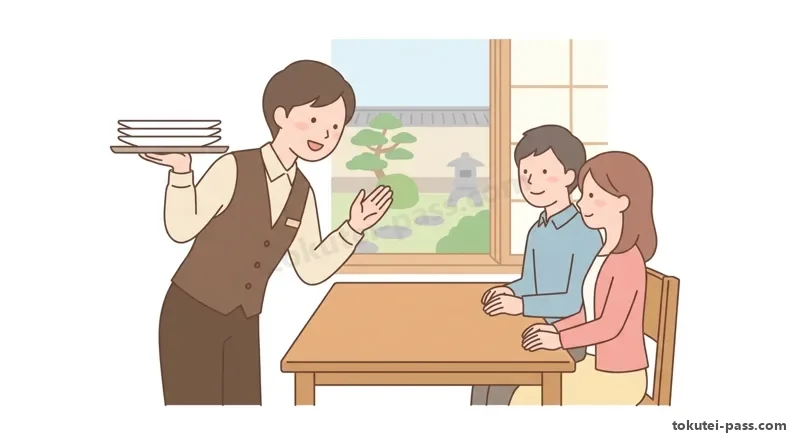
お水や飲み物の入ったコップ・グラスを運んだり提供したりする際は、お客様の口が触れる上部(縁)に指が触れないよう、必ず「コップ(グラス)の半分より下」を持ちます。
When carrying or serving cups or glasses containing water or beverages, always hold 'below the halfway point of the cup or glass (Koppu no hanbun yori shita)' so your fingers never touch the upper rim where the guest's mouth touches.
料理を盛り付けたお皿を持つ際は、お皿の内側や料理に親指が入ったり指紋がついたりしないよう、お皿の縁の下側を支えて持ち、料理の正面(絵柄や盛り付けの向き)をお客様側に向けて置きます。
When holding a plate with food, support the underside of the rim so your thumb does not enter the inside of the plate or leave fingerprints, and place the plate down quietly with the front of the dish facing the customer.
お客様が食べ終わったお皿を下げる(バッシングする)際には、無言で下げず「お下げしてもよろしいでしょうか」「失礼いたします」と一声かけてから静かに下げます。
When clearing plates after a guest has finished eating (bussing), never remove them silently; always ask first by saying 'O-sage shitemo yoroshii desho ka (May I clear your plate?)' or 'Shitsurei itashimasu' before quietly clearing.
Key points
- 注文(オーダー)を受けた際は、聞き間違いを防ぐため必ず注文内容を「復唱」する。
When taking an order, always 'repeat back (Fukusho)' the order details to prevent misunderstandings. - 飲み物のコップやグラスを持つときは、衛生面から必ず「コップの半分より下」を持つ。
When holding a beverage cup or glass, always hold 'below the halfway point of the glass' for hygiene reasons. - お皿の内側に指や指紋をつけないように持ち、料理の正面をお客様に向けて静かに供する。
Hold plates without putting fingers or fingerprints inside the rim, and serve with the front of the dish facing the guest.
| Word | Meaning |
|---|---|
| オーダーテイク(注文伺い) | taking customer orders (Order-take) |
| コップの半分より下を持つ | holding below the halfway point of a cup/glass |
| 料理の正面(向き) | front orientation of a dish |
| バッシング(空いた皿を下げる) | clearing empty plates (Bussing) |
日本料理(和食)の特徴と「一汁三菜」の配膳位置
Characteristics of Japanese Cuisine (Washoku) and 'Ichiju-Sansai' Table Layout
日本料理(和食)の大きな特徴は、春夏秋冬の「四季」の移り変わりを大切にし、その季節に最もおいしく栄養価が高い食材である「旬(しゅん)の食材」を活かすことです。
A major characteristic of Japanese cuisine (Washoku) is cherishing the changing of the 'four seasons (Shiki: spring, summer, autumn, winter)' and making the most of 'seasonal ingredients (Shun no shokuzai)' when they are most delicious and nutritious.
また、その地域でとれた新鮮な農産物や水産物をその地域で消費する「地産地消」も、旅館やホテルの食事における大きな魅力となっています。
In addition, 'Chisan-chisho (local production for local consumption)'—consuming fresh agricultural and marine products harvested in the local area—is a major attraction of meals served at ryokans and hotels.
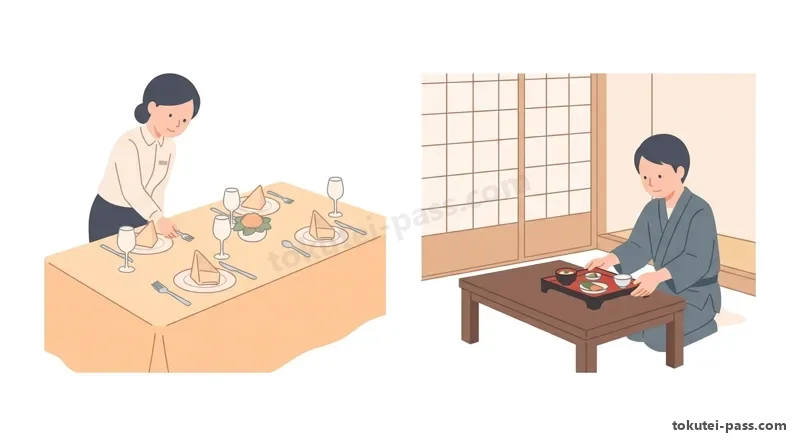
和食の基本献立である「一汁三菜」とは、「ご飯(主食)」と「汁物(1品)」に、おかず3品(「主菜1品」と「副菜2品」)を組み合わせた栄養バランスの良い食事形式です(香の物=漬物は数に含めません)。
'Ichiju-sansai (One soup, three dishes)', the basic menu structure of Washoku, is a nutritionally balanced meal format combining 'rice (staple food)' and '1 soup (Shirumono)' with 3 side dishes: '1 main dish (Shusai)' and '2 side dishes (Fukusai)' (pickles / Ko-no-mono are not counted in the three).
一汁三菜の正しい配膳位置は、お客様から見て「左手前にご飯」「右手前に汁物」「右奥に主菜(焼き魚や肉料理など)」「左奥・中央奥に副菜(煮物や和え物)」、そして「一番手前に横向きでお箸(箸先は左)」を並べます。
The correct serving layout for Ichiju-sansai from the guest's perspective is: 'rice at the front left', 'soup at the front right', 'main dish (grilled fish or meat) at the rear right', 'side dishes (simmered or dressed vegetables) at the rear left and center', and 'chopsticks placed horizontally at the very front (tips pointing left)'.
Key points
- 和食は「四季」の表現、最もおいしい時期の食材「旬」、地域の食材を使う「地産地消」を重視する。
Washoku emphasizes expressing the 'four seasons (Shiki)', peak seasonal ingredients ('Shun'), and using local ingredients ('Chisan-chisho'). - 「一汁三菜」は、ご飯+汁物1品+おかず3品(主菜1・副菜2)で構成される和食の基本形である。
'Ichiju-sansai' is the basic Washoku meal consisting of rice + 1 soup + 3 dishes (1 main dish, 2 side dishes). - 配膳位置はお客様から見て「左手前=ご飯」「右手前=汁物」「左奥=副菜」「右奥=主菜」である。
Layout from the guest's perspective: 'Front left = Rice', 'Front right = Soup', 'Rear left = Side dish', 'Rear right = Main dish'.
| Word | Meaning |
|---|---|
| 旬の食材 | seasonal ingredients at their peak (Shun) |
| 地産地消 | local production for local consumption (Chisan-chisho) |
| 一汁三菜 | one soup and three dishes (Ichiju-sansai) |
| 左手前にご飯・右手前に汁物 | rice at front left, soup at front right |
会席料理(和食コース)の提供順序9ステップ
Nine-Step Serving Order of Kaiseki Ryori (Japanese Course Meal)
日本の旅館やホテルの夕食では、お酒とともにコース形式で順番に料理を楽しむ「会席料理」が多く提供されます。その基本の提供順序(9ステップ)を正確に覚えておく必要があります。
For dinner at Japanese ryokans and hotels, 'Kaiseki ryori'—a multi-course meal enjoyed sequentially alongside alcohol—is widely served. You must accurately memorize its basic 9-step serving sequence.
最初に「①前菜(先付け:お酒と楽しむ少しずつの料理)」、続いて「②椀盛(吸物:蓋つきのお椀に入った澄まし汁)」、そして「③お造り(向付け:季節の新鮮な魚介類の刺身)」を出します。
First serve '(1) Zensai (Sakizuke: small appetizer portions enjoyed with drinks)', followed by '(2) Wanmori (Suimono: clear soup served in a lidded bowl)', and then '(3) O-tsukuri (Mukozuke: sashimi of fresh seasonal seafood)'.
次に「④焼き物(魚や肉を焼いた料理)」、「⑤煮物(炊き合わせ:野菜や魚などを煮た料理)」、「⑥揚物(天ぷらや唐揚げなど油で揚げた料理)」、「⑦酢の物(口直しのさっぱりした酢あえ料理)」の順に供します。
Next, serve in order: '(4) Yakimono (grilled fish or meat dish)', '(5) Nimono (Takiawase: simmered vegetables, fish, etc.)', '(6) Agemono (deep-fried dishes such as tempura or karaage)', and '(7) Su-no-mono (refreshing vinegared dish to cleanse the palate)'.
そして食事の締めくくりとして「⑧ごはん・香の物(漬物)・止め椀(みそ汁)」をお出しし、最後に「⑨水菓子(季節の果物や甘味デザート)」とお茶を提供します。
Then, to conclude the meal, serve '(8) Gohan (rice), Ko-no-mono (pickles), and Tome-wan (miso soup)', and finally serve '(9) Mizugashi (seasonal fruits or sweet dessert)' along with green tea.
Key points
- 会席料理の前半は「①前菜 → ②椀盛(吸物) → ③お造り(刺身)」の順に提供する。
The first part of Kaiseki is served in the order: '(1) Zensai (Appetizer) -> (2) Wanmori (Clear soup) -> (3) O-tsukuri (Sashimi)'. - 中盤の調理法の流れは「④焼き物 → ⑤煮物 → ⑥揚物 → ⑦酢の物」の順である。
The middle cooking progression is: '(4) Yakimono (Grilled) -> (5) Nimono (Simmered) -> (6) Agemono (Fried) -> (7) Su-no-mono (Vinegared)'. - 終盤は「⑧ごはん・香の物(漬物) → ⑨水菓子(果物・デザート)」で締めくくる。
The meal concludes with: '(8) Rice & Ko-no-mono (pickles) -> (9) Mizugashi (fruits / dessert)'.
| Word | Meaning |
|---|---|
| 会席料理 | Japanese multi-course banquet cuisine (Kaiseki ryori) |
| 椀盛(吸物)・お造り | clear soup in a bowl (Wanmori / Suimono) and sashimi (O-tsukuri) |
| 香の物(漬物) | Japanese pickles served with rice (Ko-no-mono) |
| 水菓子(果物・デザート) | seasonal fruit / dessert at the end of a Japanese meal (Mizugashi) |
西洋料理(フルコース)の提供順序とシルバー・配膳のルール
Serving Order of Western Full Course Meals, Silverware, and Serving Rules
西洋料理(洋食)のフルコースの基本順序は、「①オードブル(前菜)→ ②スープ → ③魚料理(ポワソン)→ ④ソルベ(お口直しのシャーベット)→ ⑤肉料理(メインディッシュ)→ ⑥デザート・コーヒー(または紅茶)」です(パンはスープの後から肉料理まで供します)。
The basic serving order of a Western full course meal is: '(1) Hors d'oeuvre (Appetizer) -> (2) Soup -> (3) Fish dish (Poisson) -> (4) Sorbet (palate-cleansing sherbet) -> (5) Meat dish (Main dish) -> (6) Dessert & Coffee (or black tea)' (bread is served from after the soup until the meat dish).
洋食テーブルのナイフ・フォーク・スプーン(シルバー/カトラリー)は、お皿の左右に並べられており、お客様は「一番外側に置かれたものから順番に内側へ」使っていきます。
On a Western dining table, knives, forks, and spoons (Silver / Cutlery) are lined up on the left and right sides of the plate, and guests use them 'in order from the outermost utensils inward toward the plate'.
洋食の配膳(サーブ)の原則として、お皿に盛られた「料理はお客様の左側から提供」し、「飲み物(ワインや水)およびスープ等はお客様の右側から提供」します。
As a fundamental rule of Western table service, plated 'food dishes are served from the customer's left side', whereas 'beverages (such as wine and water) and soup are served from the customer's right side'.
またナイフとフォークのサインとして、お皿の上で「ハの字」に置かれていれば「食事中(まだ下げない)」、お皿の「右下(時計の4時〜5時の方向)にそろえて並べられていれば食事終了(お皿を下げてよい)」の合図です。
Regarding knife and fork signals on the plate: if placed in an inverted V shape ('Ha no ji'), it signals 'still eating (do not clear the plate yet)'; if placed 'neatly together at the bottom right of the plate (around the 4 to 5 o'clock position)', it signals 'finished eating (ready to be cleared)'.
Key points
- 洋食コースの順序は「①オードブル → ②スープ → ③魚料理 → ④ソルベ → ⑤肉料理 → ⑥デザート・コーヒー」。
Western course order: '(1) Hors d'oeuvre -> (2) Soup -> (3) Fish dish -> (4) Sorbet -> (5) Meat dish -> (6) Dessert & Coffee'. - シルバー(ナイフ・フォーク)は外側から順に使い、料理はお客様の「左側」から、飲み物は「右側」から提供する。
Silverware (knives and forks) is used from the outside in; serve food from the guest's 'left' and drinks from the 'right'. - ナイフ・フォークが「ハの字」なら食事中、「右下にそろえて置かれていれば食事終了」の合図である。
Knife and fork in an inverted V ('Ha no ji') shape means still eating; placed together at the 'bottom right' means finished eating.
| Word | Meaning |
|---|---|
| オードブル(前菜)・ソルベ | appetizer (Hors d'oeuvre) and palate-cleansing sherbet (Sorbet) |
| 外側から内側へ使う | using cutlery from the outside inward |
| 料理は左・飲み物は右から | serving food from the left, beverages from the right |
| ナイフとフォークの合図 | knife and fork placement signals |
食物アレルギー・宗教上の配慮と衛生管理・開店閉店作業
Food Allergies, Religious Dietary Considerations, Hygiene, and Opening/Closing Work
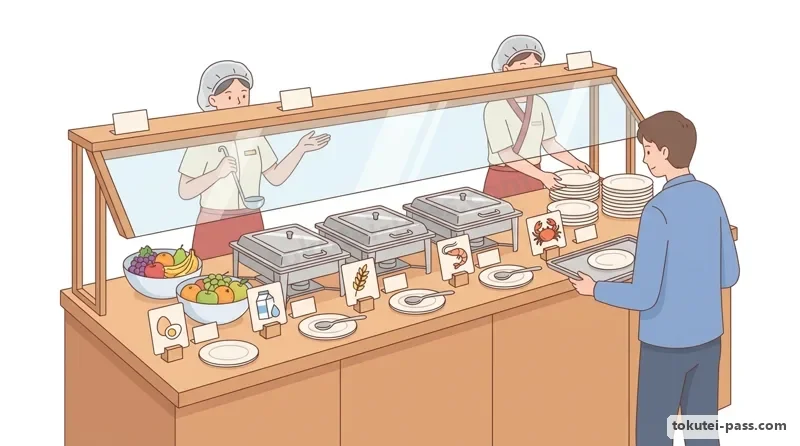
食物アレルギーを持つお客様が原因食材(アレルゲン)を摂取すると、呼吸困難や血圧低下、意識障害など命に関わる重篤な「アナフィラキシーショック」を引き起こす危険があります。
If a guest with a food allergy ingests a causative ingredient (allergen), there is a risk of triggering life-threatening 'anaphylaxis shock', causing difficulty breathing, a drop in blood pressure, or loss of consciousness.
そのため、アレルギーの有無や対象食材を事前または注文時に正確に確認し、調理場(キッチン)およびサービススタッフ全員で情報を共有します。自分一人の判断で「入っていません」と答えては絶対にいけません。
Therefore, accurately confirm any allergies and specific ingredients in advance or when taking orders, and share the information among the kitchen and all service staff. Never answer 'it is not included' based on your own personal judgment.
また多様なお客様への対応として、イスラム教の戒律に従い豚肉やアルコールを一切含まない「ハラール(Halal)料理」や、肉や魚を食べない菜食主義者「ベジタリアン(Vegetarian)」への配慮も重要です。
In addition, to accommodate diverse guests, it is important to understand and respect 'Halal cuisine' (prepared according to Islamic law without any pork or alcohol) and 'Vegetarians' (who do not eat meat or fish).
衛生管理と開店・閉店作業では、テーブルや椅子の清掃・消毒、カスターセットの補充を行い、食材保管時は食中毒防止のため「生の肉や魚は他の食材と分けて冷蔵・冷凍保存」します。
In hygiene management and opening/closing tasks, clean and sanitize tables and chairs, replenish caster sets, and when storing ingredients to prevent food poisoning, 'keep raw meat and raw fish separated from other ingredients in refrigerated or frozen storage'.
Key points
- 食物アレルギーは命に関わる「アナフィラキシーショック」を起こすおそれがあり、調理場・スタッフ全員で共有する。
Food allergies can cause life-threatening 'anaphylaxis shock' and must be shared across the kitchen and all staff. - イスラム教徒向けの「ハラール」や菜食主義者「ベジタリアン」など、宗教・信条に応じた食事対応を理解する。
Understand dietary needs based on religion or belief, such as 'Halal' for Muslims and 'Vegetarian' for non-meat eaters. - 食中毒(二次汚染)を防ぐため、「生の肉や魚は分けて冷蔵・冷凍保存」する。
To prevent food poisoning (cross-contamination), 'store raw meat and raw fish separately in the refrigerator or freezer'.
| Word | Meaning |
|---|---|
| 食物アレルギー | food allergy (Shokumotsu allergy) |
| アナフィラキシーショック | anaphylaxis shock |
| ハラール・ベジタリアン | Halal and Vegetarian diets |
| 分けて冷蔵・冷凍保存 | separating raw meat/fish for refrigerated or frozen storage |
レストラン業務の重要専門用語(シルバー・カスターセット・ブッフェ・アラカルト等)
Essential Restaurant Terminology (Silver, Caster Set, Buffet, A La Carte, etc.)
レストラン現場で使われる専門用語は試験でも頻出です。「シルバー(カトラリー)」はナイフ・フォーク・スプーンなどの金属製食器類、「カスターセット」はテーブル上に置かれた塩・こしょう・しょう油などの調味料入れ一式を指します。
Technical terms used in restaurants appear frequently on the exam. 'Silver (Cutlery)' refers to metal tableware such as knives, forks, and spoons, while 'Caster set' refers to the tabletop set of seasoning containers such as salt, pepper, and soy sauce.
「配膳」は料理や食器を並べてお客様に出すこと、「ケータリング」は指定された会場や屋外へ出張して料理を準備・提供するサービス、「ウェルカムドリンク」は到着時に提供するお出迎えの飲み物です。
'Haizen' means arranging and serving dishes and tableware to guests; 'Catering' is a service that travels to a designated venue or outdoor location to prepare and serve food; 'Welcome drink' is a complimentary beverage served upon arrival.
「ブッフェ料理(バイキング)」は並べられた料理をお客様自身が自由に取り分ける形式、「アラカルト」はコースではなくメニューから一品ずつ好きな料理を選んで注文する形式、「メインディッシュ」はコースの中心となる主菜です。
'Buffet (Viking)' is a style where guests freely serve themselves from displayed dishes; 'A la carte' is ordering individual dishes of one's choice from the menu rather than a set course; 'Main dish' is the central main course dish.
また、「ソムリエ」はワインなどの飲み物に関する専門知識を持ちお客様に提案・サービスする専門職、「テイクアウト」は料理を容器に詰めて店外や客室へ持ち帰ることを意味します。
Additionally, a 'Sommelier' is a specialist with expert knowledge of wine and beverages who advises and serves guests, and 'Takeout' means packing food into containers to take outside the restaurant or back to a guest room.
Key points
- 「シルバー」はナイフ・フォーク・スプーン類、「カスターセット」は卓上の塩・こしょう等の調味料入れ一式。
'Silver' refers to knives, forks, and spoons; 'Caster set' is the tabletop seasoning container set (salt, pepper, etc.). - 「ブッフェ」はお客様が料理を自由に取る形式、「アラカルト」は一品ずつ個別に注文する料理。
'Buffet' is a self-service dining style; 'A la carte' means ordering dishes individually from the menu. - 「ソムリエ」はワインの専門職、「ケータリング」は出張配膳サービス、「テイクアウト」は持ち帰りである。
'Sommelier' is a wine specialist, 'Catering' is off-site food service, and 'Takeout' is food to go.
| Word | Meaning |
|---|---|
| シルバー(カトラリー) | metal cutlery / silverware (Silver) |
| カスターセット(卓上調味料入れ) | tabletop seasoning container set (Caster set) |
| ブッフェ料理とアラカルト | buffet dining and a la carte dishes |
| ソムリエ・ケータリング | wine specialist (Sommelier) and off-site catering |
試験でよく出るポイントと覚え方
Frequently Tested Points and Memory Tips
基本動作と衛生では、「笑顔=口の両端をあげる・目じりをさげる」「コップは半分より下を持つ」「生の肉や魚は分けて冷蔵・冷凍保存」「ネイルアート・香水・指輪は禁止」がそのまま正誤問題で出題されます。
In basic movements and hygiene, statements such as 'Smile = lift both corners of the mouth and lower the outer corners of the eyes', 'Hold a glass below the halfway point', 'Store raw meat and fish separately in the refrigerator/freezer', and 'No nail art, perfume, or rings' are tested directly in True/False questions.
和食の「一汁三菜」の配置は、「左手前=ご飯、右手前=汁物、左奥=副菜、右奥=主菜」です。「ご飯は左、汁は右」と確実に記憶しましょう。
For the Japanese 'Ichiju-sansai' layout: 'Front left = Rice, Front right = Soup, Rear left = Side dish, Rear right = Main dish'. Firmly remember 'Rice on the left, Soup on the right'.
会席料理の9順序「①前菜→②椀盛(吸物)→③お造り→④焼き物→⑤煮物→⑥揚物→⑦酢の物→⑧ごはん・香の物→⑨水菓子」と、洋食コースの6順序「①オードブル→②スープ→③魚→④ソルベ→⑤肉→⑥デザート・コーヒー」は空欄補充の定番です。
The 9-step Kaiseki sequence '(1) Zensai -> (2) Wanmori (Suimono) -> (3) O-tsukuri -> (4) Yakimono -> (5) Nimono -> (6) Agemono -> (7) Su-no-mono -> (8) Rice & Ko-no-mono -> (9) Mizugashi' and the 6-step Western course '(1) Hors d'oeuvre -> (2) Soup -> (3) Fish -> (4) Sorbet -> (5) Meat -> (6) Dessert & Coffee' are classic fill-in-the-blank questions.
レストラン用語(シルバー、カスターセット、ブッフェ、アラカルト、ソムリエ、ハラール、ベジタリアン)の意味の組み合わせ問題も毎試験必ず出題されるため、1つずつ整理しておきましょう。
Matching questions for restaurant terminology (Silver, Caster set, Buffet, A la carte, Sommelier, Halal, Vegetarian) appear on every exam, so review each definition carefully.
Key points
- 笑顔は「口の両端をあげる・目じりをさげる」、グラス・コップは「半分より下」を持つ。
Smile: 'lift both corners of the mouth and lower the outer corners of the eyes'; hold cups/glasses 'below the halfway point'. - 一汁三菜は「左手前にご飯・右手前に汁物・左奥に副菜・右奥に主菜」。
Ichiju-sansai: 'Front left = Rice, Front right = Soup, Rear left = Side dish, Rear right = Main dish'. - 会席料理:前菜→椀盛→お造り→焼き物→煮物→揚物→酢の物→ごはん・香の物→水菓子。
Kaiseki: Zensai -> Wanmori -> O-tsukuri -> Yakimono -> Nimono -> Agemono -> Su-no-mono -> Rice & pickles -> Mizugashi. - 洋食フルコース:オードブル→スープ→魚料理→(ソルベ)→肉料理→デザート・コーヒー。
Western Full Course: Hors d'oeuvre -> Soup -> Fish dish -> (Sorbet) -> Meat dish -> Dessert & Coffee. - 用語:シルバー=金属食器、カスターセット=卓上調味料入れ、アラカルト=一品料理、ハラール=イスラム教対応食。
Terms: Silver = metal cutlery, Caster set = tabletop seasonings, A la carte = single dish order, Halal = Islamic dietary food.
| Word | Meaning |
|---|---|
| 一汁三菜の配膳位置 | Ichiju-sansai table arrangement |
| 会席料理の提供順序 | Kaiseki ryori serving sequence |
| 西洋料理のフルコース | Western full course meal |
| シルバーとカスターセット | Silverware and Caster set |
Restaurant Service
Practice this chapter in the appOfficial references
- 全国旅館ホテル生活衛生同業組合連合会 特定技能1号評価試験(宿泊分野)学習用テキスト — https://www.zenryoren.jp/execution/
- 全国旅館ホテル生活衛生同業組合連合会 用語集(宿泊分野)学習用テキスト 日本語・英語併記版 — https://www.zenryoren.jp/execution/