
Customer Service Operations (Greetings, Posture & Bowing, Keigo, Guiding & Complaint Handling)
接客業務の基本(あいさつ・姿勢とお辞儀・敬語・誘導と苦情対応)
Accommodation (Hotel) · 宿泊分野 · Written by Tokutei Pass based on the official study texts; not copied verbatim.
あいさつの基本と接客用語・従業員同士の礼儀
Fundamentals of Greeting, Essential Service Phrases, and Workplace Etiquette
あいさつは接客の基本であり、お客様に気持ちよく滞在していただくとともに、働く側も気持ちよく業務を行うために不可欠です。あいさつは「明るく元気に笑顔で」「相手に届く声で」「相手の目を見て」「気持ちを込めて」行います。
Greeting is the foundation of customer service: greeting guests warmly allows them to enjoy a pleasant stay and helps staff work with a positive mindset. Always greet 'with a bright, cheerful smile', 'with a voice clear enough to reach the other person', 'looking the other person in the eye', and 'putting your heart into it'.
覚えておくべき基本のあいさつとして、来館・来店時は「いらっしゃいませ」、お帰りの時は「ありがとうございました」、ご要望に応えられる時は「はい、かしこまりました」、客室やテーブルへ伺う時・離れる時は「失礼します(失礼いたします)」を使います。
Essential customer greetings include: 'Irasshaimase (Welcome)' when a guest arrives at the hotel, ryokan, or restaurant; 'Arigato gozaimashita (Thank you very much)' when a guest leaves; 'Hai, kashikomarimashita (Certainly)' when responding to a request; and 'Shitsurei shimasu (Excuse me)' when entering or leaving a guest room or restaurant table.
こちらからお願いする時は「恐れ入りますが、……」、待っていただく時は「少々お待ちください(ませ)」、お待たせした時は「お待たせいたしました」、苦情やお詫びの時は「申し訳ございません」と伝え、お詫び後はすぐにチームの責任者へ報告します。
Use 'Osoreirimasu ga... (Pardon me, but...)' when asking a guest for something; 'Shosho omachi kudasai(mase) (Please wait a moment)' when asking a guest to wait; 'Omatase itashimashita (Thank you for waiting)' after making a guest wait; and 'Moshiwake gozaimasen (I am deeply sorry)' when apologizing or receiving a complaint—always apologize first and immediately report to the team leader.
また従業員同士のあいさつでは、出勤時に「おはようございます」、退勤時に「お先に失礼します」、退勤する人へ「お疲れさまでした」、休憩前に「休憩に入ります」と言い、同僚の名前を呼ぶ時は名字に「さん」をつけて「○○さん」と呼びます。
For workplace greetings among staff: say 'Ohayo gozaimasu' when arriving for work, 'Osaki ni shitsurei shimasu' when leaving work, 'Otsukaresama deshita' to colleagues who are leaving, and 'Kyukei ni hairimasu' before taking a break. Address colleagues by their last name followed by '-san' to maintain professionalism.
Key points
- あいさつは「明るく元気に笑顔で・相手に届く声で・相手の目を見て・気持ちを込めて」行う。
Greet guests with a bright smile, a clear audible voice, eye contact, and heartfelt sincerity. - 要望受諾時は「はい、かしこまりました」、依頼時は「恐れ入りますが」、お詫び時は「申し訳ございません」を使う。
Use 'Hai, kashikomarimashita' to accept requests, 'Osoreirimasu ga' when asking a favor, and 'Moshiwake gozaimasen' when apologizing. - 職場では「おはようございます・お先に失礼します・お疲れさまでした・休憩に入ります」と言い、名字に「さん」をつけて呼ぶ。
Among staff, use standard workplace greetings for arriving, leaving, and breaks, and address colleagues as 'Last Name + san'.
| Word | Meaning |
|---|---|
| かしこまりました | Certainly / Understood (Kashikomarimashita) |
| 恐れ入りますが | Excuse me / Pardon me, but... (Osoreirimasu ga) |
| 申し訳ございません | I am deeply sorry (Moshiwake gozaimasen) |
| お待たせいたしました | Thank you for waiting (Omatase itashimashita) |
| お先に失礼します・お疲れさまでした | workplace greetings when leaving (Osaki ni shitsurei shimasu / Otsukaresama deshita) |
身だしなみの3原則と接客の基本立ち姿勢
Three Principles of Grooming and Basic Standing Posture in Customer Service
ホテルや旅館のスタッフには、お客様に安心感と好印象を持っていただくため「清潔(汚れや臭いがない)」「端正(制服を正しく着こなす)」「機能的・調和(動きやすく施設の品格に合う)」という身だしなみの3原則が求められます。
Hotel and ryokan staff must follow the three principles of grooming (Midashinami) to give guests a sense of security and a good impression: 'Cleanliness (Seiketsu)', 'Neatness (Tansei — wearing the uniform properly)', and 'Functionality & Harmony (Kinoteki / Chowa — easy to move in and suited to the facility)'.
接客の基本姿勢では、まず「背筋をまっすぐに伸ばす」こと、そして「お腹を引き(腹筋に力を入れ)、あごは軽く引く」ことがポイントになります。
In basic customer service standing posture (Kihon shisei), the key points are first to 'keep your back straight (Sesuji o nobasu)' and 'tighten your stomach muscles while gently pulling in your chin (Onaka o hiki, ago wa karuku hiku)'.
腕と手の位置は「肩の力を抜き、腹よりやや下の位置で右手を下(左手を上)にして軽く重ねる」のが基本です。なお、男性従業員の場合は両手を自然に体の横に下げてもよいとされています。
For arm and hand placement: 'relax your shoulders and lightly overlap your hands slightly below the stomach with the right hand underneath (and the left hand on top)'. For male employees, it is also acceptable to lower both hands naturally at the sides.
足元はかかとをつけてつま先を少し開けてまっすぐ立ち、常に「自然な表情で、お客様には笑顔を忘れない」ように待機します。壁やカウンターに寄りかかったり腕組みをしたりしてはいけません。
Keep your heels together with toes slightly open, and always stand ready 'with a natural expression, never forgetting a smile for the customer'. Never lean against walls or counters or cross your arms.
Key points
- 身だしなみの3原則は「清潔・端正・機能的(調和)」である。
The three principles of grooming are Cleanliness (Seiketsu), Neatness (Tansei), and Functionality/Harmony. - 基本姿勢は「背筋を伸ばす」「お腹を引き、あごを軽く引く」「自然な表情で笑顔を忘れない」ことである。
Basic standing posture: straighten your back, tighten your stomach, gently tuck your chin, and maintain a natural smile. - 肩の力を抜き、腹よりやや下で右手を下にして軽く重ねる(男性は自然に横に下げてもよい)。
Relax your shoulders and lightly overlap your hands slightly below the stomach with the right hand underneath (men may lower hands at their sides).
| Word | Meaning |
|---|---|
| 身だしなみの3原則 | three principles of grooming (Midashinami) |
| 基本姿勢 | basic standing posture (Kihon shisei) |
| 背筋を伸ばす・あごを軽く引く | straightening the back and gently tucking the chin |
| 自然な表情と笑顔 | natural facial expression and smile |
3種類のお辞儀(会釈15度・敬礼30度・最敬礼45度)の使い分け
Three Types of Bows (Eshaku 15°, Keirei 30°, Saikeirei 45°) and When to Use Them
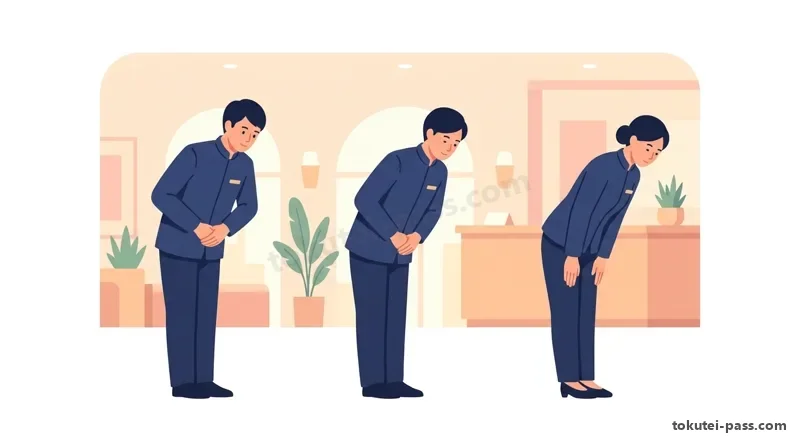
お辞儀は接客するお客様への敬意を形で表す動作です。まずお客様の顔(目)を見てアイコンタクトをとってあいさつし、そのあとにお辞儀をします。場面に応じて3種類のお辞儀を正しく使い分けます。
Bowing (Ojigi) is a physical expression of respect toward customers. First look at the customer's face (make eye contact) while greeting them, and then bow afterwards. It is important to use the three types of bows appropriately depending on the situation.
1つ目の「会釈」は、上体を「約15度前傾」させる軽いお辞儀です。館内の廊下などでお客様とすれ違う時や、食事中のお客様のテーブルに伺った時・テーブルから離れる時などに使います。
The first type, 'Eshaku (Light Bow)', involves tilting the upper body forward about 15 degrees. It is used when passing by a guest in a corridor, or when approaching or leaving the table of a guest who is dining.
2つ目の「敬礼(普通礼)」は、上体を「約30度前傾」させるお辞儀です。お客様をお迎えする時(「いらっしゃいませ」)をはじめとして、接客のさまざまな場面で最も多く使われます。
The second type, 'Keirei / Futsurei (Normal Bow)', involves tilting the upper body forward about 30 degrees. It is the most commonly used bow across various service situations, especially when welcoming guests ('Irasshaimase').
3つ目の「最敬礼」は、上体を「約45度前傾」させる最も丁寧なお辞儀です。お客様がお帰りの際にお見送りする時(深い感謝)や、お客様にお詫び(謝罪)をする時などに使います。
The third type, 'Saikeirei (Most Respectful Bow)', involves tilting the upper body forward about 45 degrees. It is used when seeing guests off upon departure or when apologizing deeply to a customer.
Key points
- お辞儀は最初にお客様の顔(目)を見て接客し、その後に首だけ曲げず腰から上体を傾ける。
Look at the customer's face (eye contact) first while speaking, then bow from the waist with a straight back. - 「会釈(約15度)」はすれ違う時や食事中のテーブルへ伺う時・離れる時に使う。
'Eshaku (about 15° forward tilt)' is used when passing by guests or approaching/leaving a dining table. - 「敬礼/普通礼(約30度)」はお出迎えなど最も多く使い、「最敬礼(約45度)」はお見送りやお詫びの時に使う。
'Keirei / Futsurei (about 30°)' is used most often such as when welcoming guests; 'Saikeirei (about 45°)' is used when seeing guests off or apologizing.
| Word | Meaning |
|---|---|
| 会釈(約15度前傾) | light bow of about 15 degrees (Eshaku) |
| 敬礼・普通礼(約30度前傾) | normal bow of about 30 degrees (Keirei / Futsurei) |
| 最敬礼(約45度前傾) | deepest bow of about 45 degrees (Saikeirei) |
| 敬意とアイコンタクト | showing respect and making eye contact |
接客の際の話し方と3種類の敬語(尊敬語・謙譲語・丁寧語)
Speaking with Customers and the Three Types of Keigo (Honorific, Humble, Polite)
お客様とお話しする際は、目を見て笑顔で、明るくハキハキとした言葉遣いで話します。もしお客様から急なリクエストがあっても、すぐにお断りするのではなく「どうしたらお応えできるか」を考え、自分で判断できなければ上司に相談します。
When speaking with customers, look them in the eye, smile, and speak in a bright, clear tone. Even if a guest makes a sudden request, do not refuse immediately; think about how you can fulfill their request, and if you cannot make a judgment on the spot, consult your supervisor.
日本語の敬語には「尊敬語」「謙譲語」「丁寧語」の3種類があり、場面に応じて適切に使い分けます。「尊敬語」は、目上の人やお客様をうやまい、相手の動作や状態を高めて立てる言葉です(例:いらっしゃる、召し上がる、おっしゃる)。
Japanese polite speech (Keigo) has three categories—'Sonkeigo (Honorific language)', 'Kenjogo (Humble language)', and 'Teineigo (Polite language)'—which must be used properly. 'Sonkeigo' shows respect to superiors or customers by elevating their actions or state (e.g., Irassharu, Meshiagaru, Ossharu).
「謙譲語」は、自分がへりくだる(自分側の動作を低める)ことで相手を立てて敬意を表す言葉です(例:うかがう、申し上げる、拝見する、いたす)。お客様の行動に謙譲語を使わないよう注意します。
'Kenjogo' shows respect by humbling oneself and lowering one's own actions to elevate the other person (e.g., Ukagau, Moshiageru, Haiken suru, Itasu). Be careful never to use humble forms to describe a customer's actions.
「丁寧語」は、語尾に「です」「ます」「ございます」を付けたり、「お料理」「ご宿泊」のように言葉の先頭に「お」「ご」を付けたりして、言い回しを丁寧にする言葉です。また、お断りや依頼の前には「恐れ入りますが」「あいにくですが」などのクッション言葉を添えます。
'Teineigo' makes speech polite by adding 'desu', 'masu', or 'gozaimasu' to the end of sentences, or attaching prefixes 'o-' or 'go-' to nouns such as 'o-ryori (food)' and 'go-shukuhaku (stay)'. Also use cushion phrases like 'Osoreirimasu ga' before requests or refusals.
Key points
- 急なリクエストもすぐに断らず応える方法を考え、判断できないときは必ず上司に相談する。
Do not immediately refuse sudden guest requests; consider how to accommodate them, and consult a supervisor if unsure. - 「尊敬語」は相手(お客様)を高めて立てる言葉、「謙譲語」は自分がへりくだって相手を立てる言葉である。
'Sonkeigo (Honorific)' elevates the customer's actions, while 'Kenjogo (Humble)' lowers your own actions to elevate the customer. - 「丁寧語」は語尾の「です・ます・ございます」や先頭の「お・ご」で丁寧に敬意を表す言葉である。
'Teineigo (Polite)' adds 'desu / masu / gozaimasu' or prefixes 'o- / go-' to make expressions polite.
| Word | Meaning |
|---|---|
| 尊敬語 | Honorific language (Sonkeigo — elevating the guest) |
| 謙譲語 | Humble language (Kenjogo — humbling oneself) |
| 丁寧語 | Polite language (Teineigo — desu, masu, gozaimasu) |
| クッション言葉 | cushion phrases (Cushion kotoba) |
館内誘導・道案内・すれ違い・エレベーターの具体作法
Specific Etiquette for Guiding Guests, Pointing Directions, Passing By, and Elevators
宿泊施設では、お客様に「泊まって良かった」と満足していただく「おもてなし(ホスピタリティ)」の行動が重要です。館内で何か探されている様子のお客様を見かけたら、「何かお探しでしょうか」と自分から声をかけます。
At accommodation facilities, providing heartfelt 'Omotenashi (hospitality)' so guests feel glad they stayed is paramount. If a guest appears to be looking for something in the building, proactively call out, 'Nani ka osagashi desho ka (Are you looking for something?)'.
館内でお客様をご案内(誘導)する際には、お客様の「2〜3歩、左前方」を、お客様の歩調(歩く速さ)に合わせながら歩きます。また地図や方向を示す際は、1本指でささず「手のひらを上に向け4本の指をそろえて」ご案内します。
When guiding a guest through the facility, walk '2 to 3 steps ahead on the left front (Hidarizenpo)', matching the guest's walking pace. When giving directions using a map, point 'with your palm facing up and 4 fingers held neatly together'.
廊下などでお客様とすれ違う時には、歩きながら頭を下げるのではなく、「お客様が前を通過するまで一度立ち止まって会釈」します。お客様に呼び止められた時には「お呼びでございますか」と返事をします。
When passing by a guest in a hallway, do not bow while walking; instead, 'come to a complete stop and perform a light bow (Eshaku) until the guest has passed in front of you'. When a guest calls out to stop you, reply 'Oyobi de gozaimasu ka (May I help you?)'.
お預かりした手荷物は丁寧に扱って客室内までお持ちし、ルームキーを渡す時は相手から見て正面の向きにして両手で渡します。やむを得ず館内エレベーターを使用する際には、常にお客様を優先します。
Carry entrusted guest luggage carefully all the way inside the guest room. When handing over a room key, orient it right-side up from the guest's perspective and hand it over with both hands. Whenever using an in-house elevator, always give priority to guests.
Key points
- 館内でお客様をご案内する際は、「2〜3歩、左前方」をお客様の歩調に合わせて歩く。
When guiding a guest inside the facility, walk '2 to 3 steps ahead on the left front', matching the guest's pace. - 道案内では「手のひらを上に向け4本の指をそろえて」示し、すれ違う時は「一度立ち止まって会釈」する。
Point directions 'with palm up and 4 fingers together'; when passing by a guest, 'stop once and bow (Eshaku) until they pass'. - ルームキーは相手から見て正面に向けて両手で渡し、エレベーターは常にお客様を優先する。
Hand over the room key with both hands facing the guest, and always prioritize guests when using elevators.
| Word | Meaning |
|---|---|
| おもてなし(ホスピタリティ) | heartfelt Japanese hospitality (Omotenashi) |
| 2〜3歩左前方の誘導 | guiding 2–3 steps ahead on the left front |
| 立ち止まって会釈 | stopping and bowing when passing a guest |
| 手のひらを上に向けた指し示し | pointing directions with palm up and fingers together |
和室へのご案内・履物の整え方と上座・下座のマナー
Guiding to Japanese-Style Rooms (Washitsu), Arranging Shoes, and Kamiza / Shimoza
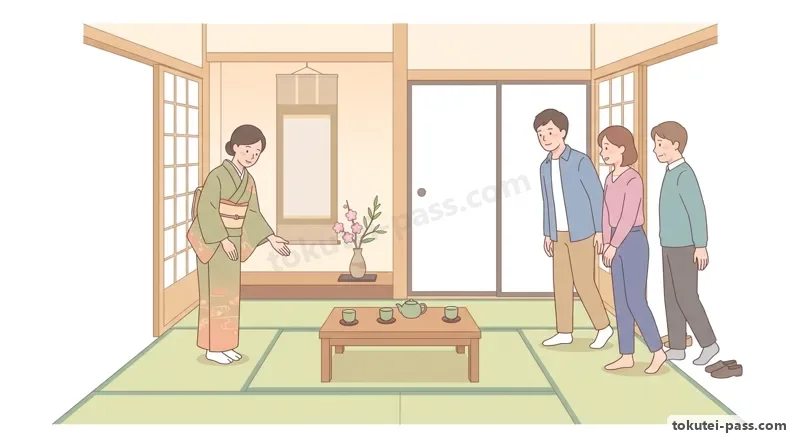
旅館などの和室(畳の部屋)へお客様をご案内する際は、入口の「踏込み(靴を脱ぐ場所)」で履物を脱いでいただきます。お客様が上がられた後、靴のつま先を出入口(外側)に向けて端に揃えて置きます。
When guiding guests into a Japanese-style tatami room (Washitsu) at a ryokan, ask them to remove their shoes at the entrance step ('Fumikomi'). After the guests step up into the room, turn their shoes so the toes point toward the exit (outside) and line them up neatly.
和室の「襖」や「障子」を開閉するときは、立ったまま乱暴に開けず、座って両手を使い静かに開け閉めします。また、畳の縁(ヘリ)や敷居は踏まないのが日本の伝統的な作法です。
When opening or closing sliding 'Fusuma' doors or 'Shoji' paper screens, kneel down and use both hands to open and close them quietly rather than yanking them while standing. Also avoid stepping on tatami borders (Heri) or door thresholds (Shikii).
客室内や宴席・エレベーターには、目上の方や主賓が座る「上座」と、目下の人が座る「下座」があります。和室では掛け軸や花が飾られた「床の間」に最も近い奥の席が上座、出入口に近い席が下座です。
In Japanese rooms, banquet rooms, and elevators, there is a seat of honor ('Kamiza') for the main guest or superior and a lower seat ('Shimoza') near the entrance. In a Washitsu, the seat farthest inside closest to the decorative alcove ('Tokonoma') is the Kamiza, and the seat closest to the entrance is the Shimoza.
おしぼりやお茶・和菓子は上座のお客様から順にお出しします。夜間に和室へ布団を敷きに伺う際も、必ず事前にお客様の都合のよい時間を確認し、入室時はノックして許可を得てから作業します。
Serve wet towels (Oshibori), tea, and sweets starting from the guest seated at the Kamiza. When entering a Washitsu in the evening to lay out futon bedding, confirm a convenient time with the guest in advance and knock to obtain permission before entering.
Key points
- 和室の踏込みで脱がれたお客様の靴は、つま先を出入口(外側)に向けて揃える。
Arrange guests' removed shoes at the Washitsu entrance step with the toes pointing toward the exit. - 和室では「床の間」に近い奥の席が「上座」、出入口に近い席が「下座」であり、畳の縁や敷居は踏まない。
In a Japanese room, the seat closest to the 'Tokonoma' alcove is the seat of honor (Kamiza), and the seat near the door is the Shimoza. - お茶や料理は上座のお客様から順に提供し、布団敷きはお休み前に許可を得て行う。
Do not step on tatami borders or thresholds, and serve tea or dishes starting from the guest in the Kamiza.
| Word | Meaning |
|---|---|
| 踏込みと靴の向き | entrance step (Fumikomi) and shoe orientation |
| 床の間 | decorative alcove in a Japanese room (Tokonoma) |
| 上座と下座 | seat of honor (Kamiza) and lower seat (Shimoza) |
| 襖・障子と敷居 | sliding doors (Fusuma / Shoji) and threshold (Shikii) |
配慮が必要なお客様(車いす・視覚障がい・杖・補助犬)への対応
Assisting Guests with Special Needs (Wheelchairs, Visual Impairment, Canes, Guide Dogs)
ご高齢の方や障がいのある方、妊婦の方、小さなお子様連れなど、サポートが必要なお客様には一人ひとりの状況に寄り添った丁寧な接客(バリアフリー対応)を行います。
For elderly guests, guests with disabilities, pregnant guests, or families with small children, provide attentive barrier-free service tailored to each guest's needs.
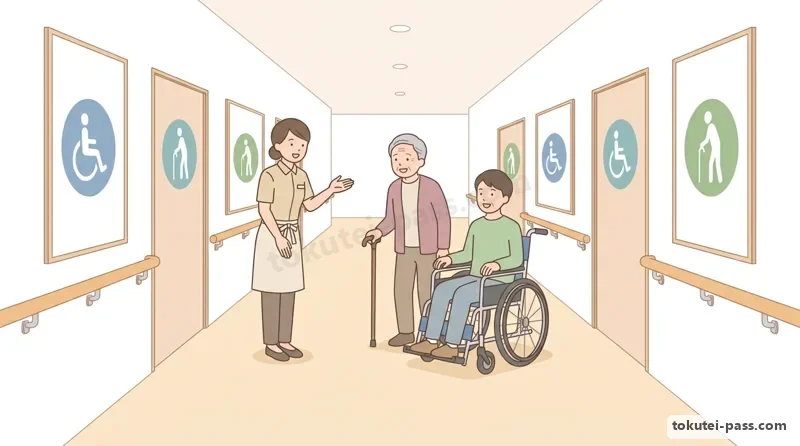
「車いすを使用されているお客様」とコミュニケーションをとる時には、立ったまま見下ろすのではなく、しゃがむなどして「お客様と目の高さ(目線)を合わせて」対応します。段差のないスロープやエレベーターへご案内します。
When communicating with a 'guest using a wheelchair', do not talk while standing and looking down; instead, kneel or crouch to 'match your eye level with the guest's eye level (Me no takasa o awasete)' while speaking.
「視覚障がいのあるお客様」が来館された時には、いきなり腕や体に触れると驚かれるため、まず「何かお手伝いできることがないか、お客様の正面からお声かけ」をします。また盲導犬などの補助犬の同伴は法律で認められており、決して拒否してはいけません。
When a 'visually impaired guest' arrives at the facility, do not touch them suddenly as it may startle them; instead, call out politely from the front asking 'whether there is anything you can assist them with'. Also, if a guest arrives with a guide dog (Modoken), never refuse them—accommodating assistance dogs is required by law.
「杖をついた足の不自由な方」がレストランなどにいらした時には、移動の負担を減らすため、お客様のご希望があれば「出入口に近い席」へご案内します。聴覚障がいのある方には筆談や手話・身振りを交えて丁寧に伝えます。
When a 'guest using a cane who has difficulty walking' comes to a restaurant, guide them to a 'seat close to the entrance/exit (Deiriguchi ni chikai seki)' if they wish, so they do not have to walk far. For guests with hearing impairments, communicate using written notes (Hitsudan) or sign language.
Key points
- 車いすのお客様とお話しする時は、膝を曲げるなどして「お客様と目の高さを合わせて」対応する。
When speaking with a guest in a wheelchair, lower yourself to 'match your eye level with the guest'. - 視覚障がいのあるお客様には、何かお手伝いできることがないか正面からお声かけし、盲導犬の受け入れを断らない。
For a visually impaired guest, call out to ask how you can help, and never refuse a guide dog (Modoken). - 杖をついた足の不自由な方がレストランに来店された時は、ご希望があれば「出入口に近い席」に案内する。
When a guest using a cane visits the restaurant, guide them to a 'seat near the entrance/exit' if they wish.
| Word | Meaning |
|---|---|
| 目の高さを合わせる対応 | matching the customer's eye level |
| 視覚障がいと盲導犬 | visual impairment and guide dogs (Modoken) |
| 出入口に近い席への案内 | guiding to a seat near the entrance/exit |
| バリアフリー対応・筆談 | barrier-free support and written communication (Hitsudan) |
電話対応の4ポイントとクレーム(苦情)対応の3原則
Four Points of Telephone Etiquette and Three Principles of Complaint Handling
宿泊施設には予約や問い合わせなど多くの電話がかかってきます。電話対応の4つの重要ポイントは、①「電話を取る前にメモと筆記用具を用意しておく」、②「電話に出たら、まず施設名と自分の名前を名乗る」ことです。
When working at a lodging facility, you will receive many phone calls including booking inquiries. The 4 key points for phone handling are: (1) 'Prepare a memo pad and writing tools before picking up the phone'; and (2) 'When answering the phone, introduce your facility and yourself first'.
そして③「他の担当者へ電話を取り次ぐ場合は、相手の名前(会社名)を確認する」、④「特にお客様からの電話は、相手が受話器を置いたのを確認してから受話器を置く」ことを徹底します。
(3) 'When transferring a call to another staff member, confirm the caller's name (or company name)'; and (4) 'Especially for calls from customers, make sure the caller has hung up the receiver first before placing your receiver down'.
どんなに心を込めて接客していても、クレーム(苦情)が発生することがあります。クレーム対応の3原則は、①「まず、不快にさせたことをお詫びする」、②「クレームの原因を丁寧に確認する(傾聴する)」、③「責任者に報告する」ことです。
Even when a facility provides heartfelt service, complaints (Kujo / Claims) can still occur. The 3 key principles for handling complaints are: (1) 'First, apologize for causing discomfort to the guest'; (2) 'Carefully listen and confirm the cause of the complaint'; and (3) 'Report the matter to the supervisor / person in charge'.
ここで最も重要なのは、たとえ「自分のミスが原因であることが明らかな場合」であっても、自分一人ですべて解決しようとしないことです。自己判断で隠したり処理したりするとお客様の不満が溜まり更なるクレームにつながるため、必ずすぐ責任者へ報告します。
Most importantly, 'even if the problem is clearly caused by your own mistake', never try to resolve everything on your own. Trying to handle or hide it alone leads to greater dissatisfaction and further complaints, so always report immediately to your supervisor.
Key points
- 電話対応では、メモを用意し、出たらまず名乗り、取り次ぎ時は相手の名前を確認し、相手が切ってから受話器を置く。
Phone etiquette: Prepare memo & pen -> State your name first -> Confirm caller's name when transferring -> Wait for the caller to hang up first. - クレーム対応の3原則は「①まず不快にさせたことをお詫びする→②原因を丁寧に確認する→③責任者に報告する」である。
Complaint handling 3 steps: (1) Apologize first for causing discomfort -> (2) Carefully confirm the cause -> (3) Report to the supervisor. - 自分のミスが原因であることが明らかな場合でも、自分だけで解決しようとせず必ず責任者へ報告する。
Even when a complaint is clearly caused by your own mistake, never try to solve it alone—always report to your supervisor.
| Word | Meaning |
|---|---|
| 電話の取り次ぎ | transferring a phone call (Toritsugi) |
| 受話器 | telephone receiver (Juwaki) |
| クレーム(苦情)対応 | complaint / grievance handling (Claim taio) |
| 責任者への報告 | reporting to the supervisor / person in charge |
試験によく出るポイントと覚え方
Frequently Tested Points and Memory Tips
おじぎの角度と場面の組み合わせは最頻出です。「会釈=約15度(すれ違い・食事中のテーブル訪問)」「敬礼/普通礼=約30度(お出迎え・一般挨拶)」「最敬礼=約45度(お見送り・お詫び)」を数字とセットで暗記しましょう。
The angles and situations for the 3 bows are the most frequently tested items: 'Eshaku = about 15° (passing by a guest, approaching/leaving a dining table)', 'Keirei / Futsurei = about 30° (welcoming guests and general service)', and 'Saikeirei = about 45° (seeing guests off or apologizing)'.
館内案内の数字と方向もよく狙われます。「誘導は2〜3歩・左前方を歩調に合わせて歩く」「すれ違う時は一度立ち止まって会釈」「道案内は手のひらを上に向け4本の指をそろえる」「ルームキーは正面に向けて両手で渡す」が鉄則です。
Memorize the exact numbers and directions for guiding: 'Walk 2–3 steps ahead on the left front matching the guest's pace', 'Stop once and bow (Eshaku) until the guest passes when passing by', 'Point on a map with palm up and 4 fingers together', and 'Hand over the room key with both hands facing the guest'.
配慮が必要なお客様では、「車いす=目の高さを合わせる」「杖・足が不自由=希望があれば出入口に近い席へ案内」「盲導犬=絶対に拒否しない」を押さえます。
For guests needing special care: 'Wheelchair user = Match eye level', 'Guest with a cane in a restaurant = Guide to a seat near the entrance/exit if desired', and 'Guide dog (Modoken) = Never refuse'.
クレーム対応では、「まずお詫び→原因確認→責任者へ報告」の順序と、「自分のミスが明らかな時こそ自分一人で解決しようとせず責任者に報告する」というひっかけ問題に注意してください。
For complaints: remember the order 'Apologize first -> Confirm the cause -> Report to supervisor', and watch out for the classic trap: 'Even if the mistake is clearly your own fault, NEVER try to solve it on your own—report it to your supervisor'.
Key points
- お辞儀3種:会釈15度(すれ違い・卓訪問)、敬礼30度(お出迎え・通常)、最敬礼45度(お見送り・謝罪)。
3 Bows: Eshaku 15° (passing by, table visit); Keirei 30° (welcoming, most common); Saikeirei 45° (seeing off, apologizing). - 基本姿勢:背筋を伸ばし、あごを引き、腹のやや下で右手を下にして重ねる(男性は横に下げてもよい)。
Basic posture: Straight back, chin tucked, hands overlapped below stomach with right hand underneath (men may keep hands at sides). - 誘導と所作:お客様の「2〜3歩・左前方」を歩く、すれ違いは「一度立ち止まって会釈」、手のひらを上に4本指を揃える。
Guiding & gestures: Walk '2–3 steps ahead on the left front'; 'stop and bow' when passing; point with 'palm up and 4 fingers together'. - バリアフリー:車いすは「目の高さを合わせる」、杖の方は希望があれば「出入口に近い席」、盲導犬は拒否禁止。
Special support: Wheelchair = Match eye level; Cane user = Seat near entrance/exit; Guide dog = Never refuse. - 苦情・電話:自分のミスでも一人で解決せず「まずお詫び→原因確認→責任者報告」;電話は相手が切ってから置く。
Complaints & Phone: Even for your own mistake, do not solve alone—report to supervisor; wait for customer to hang up phone first.
| Word | Meaning |
|---|---|
| 会釈15度・敬礼30度・最敬礼45度 | Eshaku (15°), Keirei (30°), and Saikeirei (45°) |
| 2〜3歩左前方の案内 | guiding 2–3 steps ahead on the left front |
| 尊敬語・謙譲語・丁寧語 | Honorific (Sonkeigo), Humble (Kenjogo), and Polite (Teineigo) |
| クレーム対応の3手順 | three steps of complaint handling |
Guest Service
Practice this chapter in the appOfficial references
- 全国旅館ホテル生活衛生同業組合連合会 特定技能1号評価試験(宿泊分野)学習用テキスト 第3章 接客 — https://www.zenryoren.jp/wp/wp-content/uploads/2024/06/240531_TG_manual_Fix2.pdf
- 国土交通省観光庁 宿泊分野特定技能1号評価試験実施要領 — https://www.mlit.go.jp/kankocho/content/001733699.pdf