
Electrical & Mechanical Calculations, Materials, Fuels & Lubricants, and Units
電気・機械の計算、材料・燃料油脂、単位
Automobile Maintenance (SSW 2) · 自動車整備分野(2号) · Written by Tokutei Pass based on the official study texts; not copied verbatim.
電気の計算(オームの法則・直列と並列の合成抵抗・電力計算)
Electrical Calculations (Ohm's Law, Series & Parallel Combined Resistance, Electric Power)
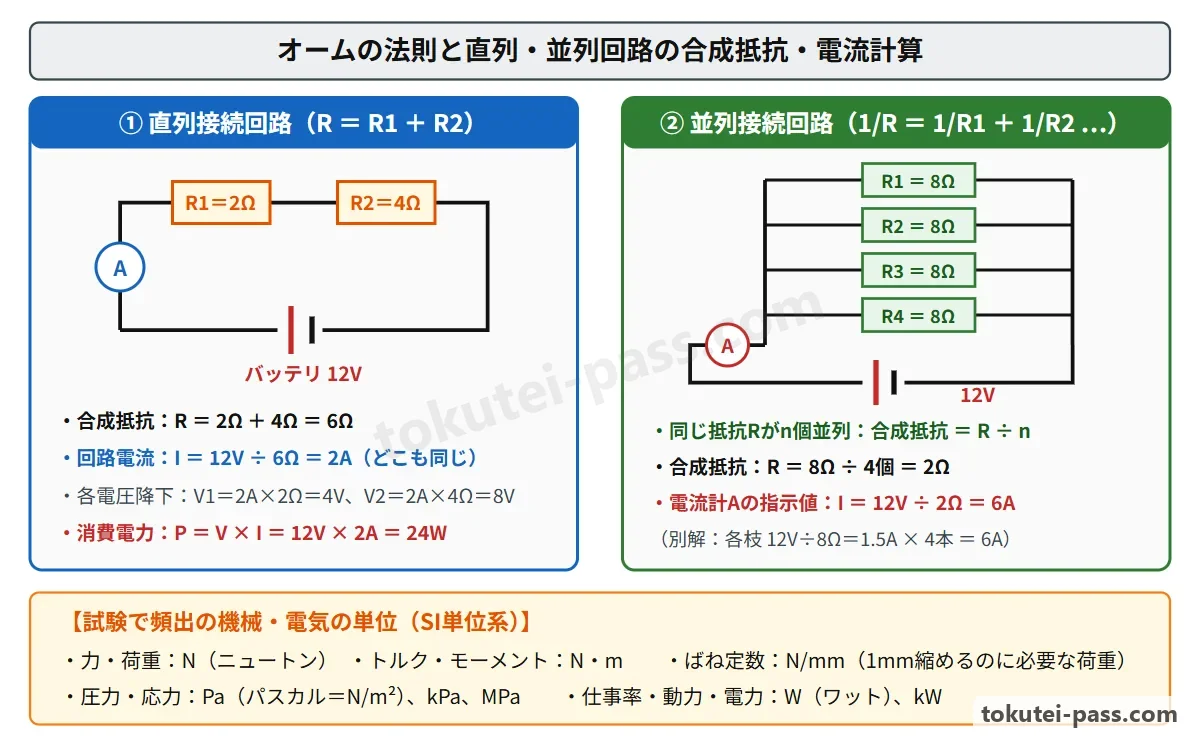
電気回路の基本である「オームの法則」は、電流I(A)=電圧V(V)÷抵抗R(Ω)、電圧V=電流I×抵抗R、抵抗R=電圧V÷電流Iで表される。
'Ohm's law', the foundation of electrical circuits, is expressed as Current I (A) = Voltage V (V) ÷ Resistance R (Ω), Voltage V = Current I × Resistance R, and Resistance R = Voltage V ÷ Current I.
複数の抵抗を1本の道筋につないだ「直列接続」では、各抵抗に流れる電流はすべて等しく、回路全体の合成抵抗Rは各抵抗の和「R=R₁+R₂+R₃」となる。
In a 'series connection' where multiple resistors are connected along a single path, the current flowing through each resistor is equal, and the combined resistance R of the entire circuit is the sum of the individual resistances: 'R = R₁ + R₂ + R₃'.
一方、複数の抵抗を枝分かれしてつないだ「並列接続」では、各抵抗にかかる電圧が電源電圧Vと等しくなり、合成抵抗Rの逆数は「1/R=1/R₁+1/R₂+1/R₃」となる。
Conversely, in a 'parallel connection' where multiple resistors are connected across branches, the voltage across each resistor equals the power supply voltage V, and the reciprocal of the combined resistance R is given by '1/R = 1/R₁ + 1/R₂ + 1/R₃'.
特に2号学科試験で頻出の「同じ抵抗値r(Ω)の抵抗をn個並列に接続した回路」では、合成抵抗Rは「R=r÷n(1個分の抵抗値÷個数)」で簡単に求められ、回路全体の電流Iは「I=V÷R」(または各枝の電流の合計)となる。
In particular, for a 'circuit with n resistors of equal resistance r (Ω) connected in parallel'—which appears frequently on the Type 2 written exam—the combined resistance R is easily found by 'R = r ÷ n (resistance of one resistor ÷ number of resistors)', and the total circuit current I is 'I = V ÷ R' (or the sum of the branch currents).
また、消費される「電力P(W:ワット)」は「電力P=電圧V×電流I」で計算され、電球やヒータに流れる電流は「電流I=電力P÷電圧V」から求めることができる。
Furthermore, consumed 'electric power P (W: watts)' is calculated as 'Power P = Voltage V × Current I', so the current flowing through a bulb or heater can be found from 'Current I = Power P ÷ Voltage V'.
Key points
- オームの法則:電流I=電圧V÷抵抗R、直列合成抵抗R=R₁+R₂+R₃。
Ohm's law: Current I = Voltage V ÷ Resistance R; series combined resistance R = R₁ + R₂ + R₃. - 同じ抵抗値rの抵抗をn個「並列」につないだときの合成抵抗は「R=r÷n」となる。
When n resistors of equal resistance r are connected in 'parallel', the combined resistance is 'R = r ÷ n'. - 電力P(W)=電圧V(V)×電流I(A)であり、電流I=P÷Vで求める。
Electric power P (W) = Voltage V (V) × Current I (A), and current I = P ÷ V. - 【例】12V電源に6Ωの抵抗3個(R₁・R₂・R₃)を並列接続した回路 → 合成抵抗R = 6 ÷ 3 = 2Ω、回路全体に流れる電流I = 12 ÷ 2 = 6A
Example: A circuit with three 6Ω resistors (R₁, R₂, R₃) connected in parallel to a 12V power supply → Combined resistance R = 6 ÷ 3 = 2Ω; total circuit current I = 12 ÷ 2 = 6A - 【例】12V回路に消費電力60Wのヘッドランプを接続したときに流れる電流Iと抵抗R → I = 60 ÷ 12 = 5A、R = 12 ÷ 5 = 2.4Ω
Example: Current I and resistance R when a 60W headlamp is connected to a 12V circuit → I = 60 ÷ 12 = 5A, R = 12 ÷ 5 = 2.4Ω
| Word | Meaning |
|---|---|
| オームの法則(V=I×R) | Ohm's law (V = I × R) |
| 直列接続と並列接続 | series connection and parallel connection |
| 合成抵抗(Ω) | combined resistance (Ω) |
| 消費電力(P=V×I) | power consumption (P = V × I) |
機械の計算(歯車の変速比・総排気量・圧縮比・ばね定数)
Mechanical Calculations (Gear Ratio, Total Displacement, Compression Ratio, Spring Constant)
2つの歯車が噛み合うとき、「変速比(減速比)」は「被駆動歯車(ドリブン・ギヤ)の歯数÷駆動歯車(ドライブ・ギヤ)の歯数」で求められ、出力側の回転速度は「入力回転速度÷変速比」、出力トルクは「入力トルク×変速比」となる。
When two gears mesh, the 'gear ratio (reduction ratio)' is found by 'Number of teeth on driven gear ÷ Number of teeth on drive gear'; output rotational speed equals 'Input speed ÷ Gear ratio', and output torque equals 'Input torque × Gear ratio'.
エンジンの1気筒あたりの「行程容積(排気量)Vh」は、シリンダ内径(ボア)をD、ピストン行程(ストローク)をSとすると、断面積×行程「Vh=(π÷4)×D²×S」で計算され、これに気筒数を掛けたものが「総排気量」である。
An engine's 'stroke volume (displacement per cylinder) Vh', where cylinder bore is D and piston stroke is S, is calculated as Cross-sectional area × Stroke: 'Vh = (π ÷ 4) × D² × S'; multiplying this by the number of cylinders gives 'total engine displacement'.
またエンジンの「圧縮比(ε)」は、下死点時のシリンダ全容積(行程容積Vh+燃焼室容積Vc)を上死点時の燃焼室容積Vcで割った値「圧縮比=(Vh+Vc)÷Vc」で求められる。
Furthermore, an engine's 'compression ratio (ε)' is found by dividing total cylinder volume at bottom dead center (stroke volume Vh + combustion chamber volume Vc) by combustion chamber volume Vc at top dead center: 'Compression ratio = (Vh + Vc) ÷ Vc'.
軸やボルトを回転させる「力のモーメント(トルクT)」は、「作用する力F(N)×回転中心からの直角距離(腕の長さ)L(m)」で表され、単位は「N・m」である。
The 'moment of force (torque T)' that rotates a shaft or bolt is expressed as 'Applied force F (N) × Perpendicular distance from center of rotation (lever arm length) L (m)', with the unit 'N・m'.
さらにフックの法則により、ばねを1mm伸縮させるのに必要な力である「ばね定数k(N/mm)」は、「荷重F(N)÷たわみ量(伸びまたは縮み量)x(mm)」で計算される。
Moreover, by Hooke's law, the force required to extend or compress a spring by 1 mm—the 'spring constant k (N/mm)'—is calculated as 'Load F (N) ÷ Deflection (extension or compression) x (mm)'.
Key points
- 歯車の変速比 = 被駆動歯車(ドリブン)歯数 ÷ 駆動歯車(ドライブ)歯数(出力トルク = 入力トルク × 変速比)。
Gear ratio = Driven gear teeth ÷ Drive gear teeth (Output torque = Input torque × Gear ratio). - 圧縮比 = (行程容積 + 燃焼室容積) ÷ 燃焼室容積である。
Compression ratio = (Stroke volume + Combustion chamber volume) ÷ Combustion chamber volume. - トルク(N・m)= 力(N)× 腕の長さ(m)、ばね定数(N/mm)= 荷重(N)÷ たわみ量(mm)。
Torque (N・m) = Force (N) × Lever arm length (m); Spring constant (N/mm) = Load (N) ÷ Deflection (mm). - 【例】駆動歯車の歯数が20、被駆動歯車の歯数が50で、入力トルクが100N・mのとき → 変速比 = 50 ÷ 20 = 2.5、出力トルク = 100 × 2.5 = 250N・m
Example: When drive gear teeth = 20, driven gear teeth = 50, and input torque = 100N・m → Gear ratio = 50 ÷ 20 = 2.5; Output torque = 100 × 2.5 = 250N・m - 【例】1気筒の行程容積が450cm³、燃焼室容積が50cm³のエンジンの圧縮比 → (450 + 50)÷ 50 = 10.0
Example: Compression ratio of an engine with a single-cylinder stroke volume of 450cm³ and combustion chamber volume of 50cm³ → (450 + 50) ÷ 50 = 10.0
| Word | Meaning |
|---|---|
| 変速比(被駆動歯数÷駆動歯数) | gear ratio (driven teeth ÷ drive teeth) |
| 行程容積と総排気量 | stroke volume and total displacement |
| 圧縮比と燃焼室容積 | compression ratio and combustion chamber volume |
| 力のモーメント(トルク)とばね定数 | moment of force (torque) and spring constant |
エンジン・オイルの添加剤と燃料・潤滑油の性質
Engine Oil Additives and Properties of Fuels and Lubricants
エンジン・オイルには基油(ベース・オイル)に各種の添加剤が配合されている。そのうち「清浄分散剤」は、燃焼で生じた「すす」やオイルの酸化生成物をオイル中に微細に分散させ、金属表面にスラッジとして堆積・付着するのを防ぐ。
Engine oil blends various additives into base oil. Among them, a 'detergent-dispersant' finely disperses combustion soot and oil oxidation products throughout the oil to prevent them from depositing and adhering onto metal surfaces as sludge.
「油性向上剤(摩擦調整剤)」は、高負荷時などの境界潤滑状態において金属表面に強固な吸着膜(油膜)を作り、金属同士の直接接触による摩耗や焼き付きを防止する。
An 'oiliness improver (friction modifier)' forms a strong adsorbed film (oil film) on metal surfaces under boundary lubrication conditions such as heavy loads, preventing wear and seizure caused by direct metal-to-metal contact.
「流動点降下剤」は、低温時にオイル中のワックス分(パラフィン分)が「結晶化・凝固するのを抑制(防止)し」、寒冷時でもオイルの流動性を確保する添加剤である(結晶化を促進させるという記述は誤り)。
A 'pour-point depressant' is an additive that 'inhibits (prevents) wax (paraffin) components in the oil from crystallizing and solidifying at low temperatures', ensuring oil fluidity even in cold weather (statements claiming it promotes crystallization are incorrect).
また「粘度指数向上剤」は、温度変化によるオイル粘度の変化を少なくする添加剤であり、高温時の粘度低下を抑えるとともに低温時の粘度増加を抑える。
Additionally, a 'viscosity index improver' is an additive that reduces oil viscosity changes caused by temperature variations, suppressing viscosity drop at high temperatures as well as viscosity increase at low temperatures.
なお燃料の性質として、ガソリンの「オクタン価」が高いほど自己着火しにくく「アンチノック性(耐ノッキング性)が高く」、ディーゼル軽油の「セタン価」が高いほど自己着火しやすく「着火性が良い(ディーゼル・ノックが起きにくい)」。
Regarding fuel properties, a higher 'octane number' in gasoline means greater resistance to self-ignition and 'higher anti-knock performance', whereas a higher 'cetane number' in diesel fuel means easier self-ignition and 'better ignitability (less diesel knock)'.
Key points
- 流動点降下剤は、低温時にオイル中のワックス分が「結晶化するのを抑制(防止)」して流動性を保つ。
A pour-point depressant 'inhibits (prevents)' wax components in oil from crystallizing at low temperatures to maintain fluidity ('promotes' is false). - 清浄分散剤はすす・酸化生成物を分散させてスラッジ堆積を防ぎ、油性向上剤は金属表面に強い油膜を作る。
Detergent-dispersants disperse soot and oxidation products to prevent sludge deposits, while oiliness improvers form a strong oil film on metal surfaces. - 粘度指数向上剤は温度変化に伴う粘度変化を小さくする。ガソリンはオクタン価、軽油はセタン価で評価する。
Viscosity index improvers minimize viscosity changes across temperature changes. Gasoline is rated by octane number, and diesel fuel by cetane number.
| Word | Meaning |
|---|---|
| 清浄分散剤と油性向上剤 | detergent-dispersant and oiliness improver |
| 流動点降下剤(結晶化の抑制) | pour-point depressant (inhibition of crystallization) |
| 粘度指数向上剤 | viscosity index improver |
| オクタン価(ガソリン)とセタン価(軽油) | octane number (gasoline) and cetane number (diesel fuel) |
金属材料(炭素鋼・鋳鉄)と非金属材料・塗料の成分
Metallic Materials (Carbon Steel, Cast Iron), Non-Metallic Materials, and Paint Components
鉄と炭素の合金のうち、炭素含有量が約0.02%〜2.0%のものを「炭素鋼」といい、炭素量が0.3%以上の「硬鋼」は0.3%未満の「軟鋼」に比べて「炭素の含有量が多い」(硬鋼の炭素量が少ないという記述は誤り)。炭素量が多いほど硬さや引張強さは大きくなるが、伸びや靭性(粘り強さ)は小さくなる。
Among alloys of iron and carbon, those with a carbon content of approx. 0.02% to 2.0% are called 'carbon steel'; 'hard steel (0.3% carbon or more)' has a 'higher carbon content' than 'soft steel (less than 0.3% carbon)' (statements claiming hard steel has less carbon are incorrect). Higher carbon content increases hardness and tensile strength, but reduces elongation and toughness.
炭素含有量が2.0%を超える(約2.0%〜4.5%)「鋳鉄」のうち、「普通鋳鉄(ねずみ鋳鉄)」は鋳造性と耐摩耗性に優れ、シリンダ・ブロック、フライホイール、ブレーキ・ドラムなどに使われる。
Among 'cast irons' with carbon content exceeding 2.0% (approx. 2.0%–4.5%), 'ordinary cast iron (gray cast iron)' excels in castability and wear resistance and is used for cylinder blocks, flywheels, and brake drums.
普通鋳鉄に「クロム(Cr)、モリブデン(Mo)、ニッケル(Ni)などを添加」して強さや耐摩耗性を高めたものを「合金鋳鉄」といい、カムシャフトやシリンダ・ライナに用いられる。
Ordinary cast iron to which 'chromium (Cr), molybdenum (Mo), nickel (Ni), etc. are added' to enhance strength and wear resistance is called 'alloy cast iron', and is used for camshafts and cylinder liners.
一方、「球状黒鉛鋳鉄(ダクタイル鋳鉄)」は、溶けた鋳鉄に「マグネシウム(Mg)やセリウム(Ce)を添加」して片状の黒鉛を球状化させ、鋼に近い強度と靭性を持たせたもので、クランクシャフトやデフ・ケースに使われる(クロム・ニッケルで黒鉛を球状化させるという記述は誤り)。
Conversely, 'spheroidal graphite cast iron (ductile cast iron)' is made by 'adding magnesium (Mg) or cerium (Ce)' to molten cast iron to spheroidize flaky graphite, giving it strength and toughness close to steel for use in crankshafts and diff cases (claiming chromium and nickel are added to spheroidize graphite is incorrect).
また自動車塗装に使われる「塗料の4成分」として、①「樹脂」は顔料をつなぎとめ塗膜に光沢や硬さを与える主成分、②「顔料」は水や溶剤に溶けず色彩を与える粉末、③「溶剤」は樹脂を溶かして塗装しやすくする液体、④「添加剤」は塗装の作業性や塗膜の安定性を向上させる補助成分である。
Regarding the 'four components of automotive paint': (1) 'Resin' is the main component that binds pigment particles and gives the paint film gloss and hardness; (2) 'Pigment' is a powder insoluble in water or solvent that provides color; (3) 'Solvent' is a liquid that dissolves resin to make painting easier; and (4) 'Additives' are auxiliary components that improve painting workability and film stability.
Key points
- 炭素鋼のうち「硬鋼」は「軟鋼」に比べて炭素の含有量が「多い」ため、硬くて引張強さが大きい。
Among carbon steels, 'hard steel' has a 'higher' carbon content than 'soft steel', making it harder with greater tensile strength. - クロム・モリブデン・ニッケルを添加したものは「合金鋳鉄」であり、黒鉛を球状化させた「球状黒鉛鋳鉄」には「マグネシウム(Mg)」などが添加される。
Cast iron with added chromium, molybdenum, and nickel is 'alloy cast iron', while 'spheroidal graphite cast iron' has added 'magnesium (Mg)' to spheroidize graphite. - 塗料の成分において、「樹脂」は顔料をつなぎとめて光沢・硬さを与え、「添加剤」は作業性や塗膜の安定性を向上させる。
In paint components, 'resin' binds pigment and provides gloss and hardness, while 'additives' improve workability and paint film stability.
| Word | Meaning |
|---|---|
| 炭素鋼(硬鋼と軟鋼) | carbon steel (hard steel and soft steel) |
| 普通鋳鉄と合金鋳鉄(Cr・Mo・Ni) | ordinary cast iron and alloy cast iron (Cr, Mo, Ni) |
| 球状黒鉛鋳鉄(マグネシウム添加) | spheroidal graphite cast iron (magnesium addition) |
| 塗料の4成分(樹脂・顔料・溶剤・添加剤) | four paint components (resin, pigment, solvent, additive) |
SI単位(国際単位系:力・トルク・仕事・圧力・仕事率)
SI Units (International System of Units: Force, Torque, Work, Pressure, Power)
自動車整備および試験で用いられる「SI単位(国際単位系)」では、すべての物理量と単位記号の正しい組み合わせを正確に覚えておく必要がある。
In the 'SI units (International System of Units)' used in automotive maintenance and exams, you must accurately memorize the correct pairing between every physical quantity and its unit symbol.
「力・荷重・重力」の単位は「N(ニュートン)」であり、質量1kgの物体に1m/s²の加速度を生じさせる力が1Nである(従来の1kgfは約9.8Nに相当する)。
The unit of 'force, load, and gravity (weight)' is 'N (newton)', where 1 N is the force that gives a 1 kg mass an acceleration of 1 m/s² (1 kgf in conventional units equals approx. 9.8 N).
「力のモーメント」および軸を回す「トルク」の単位は「N・m(ニュートン・メートル)」であり、「仕事・エネルギ・熱量」の単位は「J(ジュール:1J=1N・m)」である。
The unit of 'moment of force' and shaft-turning 'torque' is 'N・m (newton-meter)', while the unit of 'work, energy, and heat quantity' is 'J (joule: 1 J = 1 N・m)'.
単位面積あたりに作用する力である「圧力(タイヤ空気圧や圧縮圧力など)」および材料内部に生じる「応力」の単位は、「Pa(パスカル=N/m²)」、「kPa(キロパスカル)」、「MPa(メガパスカル)」である(MPaを力のモーメントとする選択肢は誤り)。
The unit of 'pressure' (force acting per unit area, such as tire inflation pressure or compression pressure) and internal material 'stress' is 'Pa (pascal = N/m²)', 'kPa (kilopascal)', or 'MPa (megapascal)' (options pairing MPa with moment of force are incorrect).
また単位時間(1秒間)あたりの仕事である「仕事率・動力(エンジン最高出力)・電力」の単位は「W(ワット=J/s)」または「kW(キロワット)」であり、ばね定数は「N/mm」、回転速度は「min⁻¹(またはs⁻¹)」で表す。
Additionally, the unit of 'power (work per second), engine output power, and electric power' is 'W (watt = J/s)' or 'kW (kilowatt)'; spring constant is expressed in 'N/mm'; and rotational speed is expressed in 'min⁻¹ (or s⁻¹)'.
Key points
- 力・荷重 =「N(ニュートン)」、力のモーメント・トルク =「N・m(ニュートン・メートル)」。
Force, Load = 'N (newton)'; Moment of force, Torque = 'N・m (newton-meter)'. - 圧力・応力 =「Pa・kPa・MPa(パスカル)」である(MPaは力のモーメントではない)。
Pressure, Stress = 'Pa, kPa, MPa (pascal)' (MPa is NOT the unit of moment of force). - 仕事・エネルギ・熱量 =「J(ジュール)」、仕事率・出力・電力 =「W・kW(ワット)」。
Work, Energy, Heat = 'J (joule)'; Power, Output, Electric power = 'W, kW (watt)'.
| Word | Meaning |
|---|---|
| ニュートン(N:力・荷重) | newton (N: force, load) |
| ニュートン・メートル(N・m:力のモーメント・トルク) | newton-meter (N・m: moment of force, torque) |
| パスカル(Pa・kPa・MPa:圧力・応力) | pascal (Pa, kPa, MPa: pressure, stress) |
| ジュール(J:仕事・熱量)とワット(W・kW:仕事率) | joule (J: work, heat) and watt (W, kW: power) |
ハイブリッド車(HV)・電気自動車(EV)の高電圧安全作業
High-Voltage Safety Operations for Hybrid (HV) and Electric Vehicles (EV)
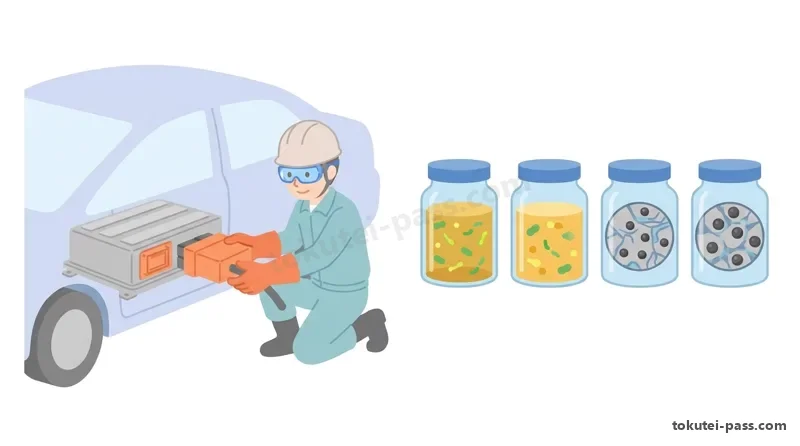
ハイブリッド車(HV)や電気自動車(EV)の駆動用モータやインバータには200V〜650V程度の高電圧が使われており、高電圧回路のワイヤ・ハーネスやコネクタは、12V補機回路と識別するためすべて「オレンジ色」に統一されている。
Traction motors and inverters in hybrid vehicles (HVs) and electric vehicles (EVs) use high voltages of roughly 200V to 650V, and all wire harnesses and connectors of high-voltage circuits are standardized in 'orange' to distinguish them from 12V auxiliary circuits.
高電圧部位の点検・整備を行う際は、感電事故を防ぐため必ず「電気絶縁手袋」を着用する。絶縁手袋は使用前に必ず内部に空気を入れて巻き、「傷・破れ・空気漏れ(ピンホール)がないか点検」してから保護革手袋と重ねて装着する。
When inspecting or servicing high-voltage parts, you must wear 'electrical insulating gloves' to prevent electric shock accidents. Before use, always inflate the insulating gloves with air and roll them up to 'inspect for scratches, tears, or air leaks (pinholes)', and wear them together with leather protector gloves.
高電圧回路を遮断する手順として、まずパワースイッチをOFFにしてスマート・キーを車外の電波が届かない場所に保管し、補機バッテリ(12V)のマイナス端子を切り離す。
As the procedure for shutting off the high-voltage circuit, first turn the power switch OFF, store the smart key outside the vehicle out of radio range, and disconnect the negative (−) terminal of the 12V auxiliary battery.
次に絶縁手袋を着用して駆動用高電圧バッテリの「サービス・プラグ(安全プラグ)」を取り外し、他の作業者が誤って取り付けないよう外したサービス・プラグは作業者自身がポケットなどに入れて携帯(または施錠保管)する。
Next, wearing insulating gloves, remove the 'service plug (safety plug)' of the high-voltage traction battery; the technician must carry the removed service plug in their own pocket (or lock it away) so another worker cannot accidentally reinstall it.
サービス・プラグを抜いた後も、インバータ内部の「高電圧コンデンサ」に電荷が残っているため、完全に放電するまで「メーカ規定の時間(例:5〜10分間以上)待ち」、サーキット・テスタで高電圧端子間が0Vであることを確認してから作業を行う。
Even after pulling out the service plug, electric charge remains in the 'high-voltage capacitor' inside the inverter; therefore, 'wait for the manufacturer-specified time (e.g., 5 to 10 minutes or more)' until it discharges completely, and verify 0V across the high-voltage terminals with a circuit tester before starting work.
Key points
- HV・EVの高電圧ハーネス・コネクタは「オレンジ色」で識別されており、作業時は「空気漏れ点検済みの絶縁手袋」を着用する。
HV/EV high-voltage harnesses and connectors are identified by 'orange' color, and 'insulating gloves inspected for air leaks' must be worn during work. - 高電圧遮断時はパワースイッチOFF・12Vマイナス端子切り離し後、「サービス・プラグ」を取り外して作業者自身が管理する。
When shutting off high voltage: after turning the power switch OFF and disconnecting the 12V negative terminal, remove the 'service plug' and keep it under the technician's own control. - サービス・プラグ取り外し後は、インバータ内のコンデンサが放電するまで「規定時間(5〜10分以上)待ち」、0Vを確認してから触れる。
After removing the service plug, 'wait the specified time (5–10 minutes or more)' for the inverter capacitor to discharge and verify 0V before touching.
| Word | Meaning |
|---|---|
| オレンジ色ハーネス(高電圧回路) | orange harness (high-voltage circuit) |
| 電気絶縁手袋(空気漏れ点検) | electrical insulating gloves (air-leak inspection) |
| サービス・プラグ | service plug |
| インバータ内コンデンサの放電待ち時間 | inverter capacitor discharge waiting time |
試験によく出るポイントと覚え方
Common Exam Points and How to Remember Them
基礎工学・材料・単位分野は、2号学科試験の第30問〜第35問あたりで毎年6問前後が出題される「確実に満点を狙える得点源」である。
The basic engineering, materials, and units section accounts for around 6 questions every year (around Questions 30 to 35) on the Type 2 written exam, making it a 'reliable scoring source where you can aim for full marks'.
計算問題では、「同じ抵抗rのn個並列=r÷n(例:6Ωが3個並列なら6÷3=2Ω、12Vなら電流I=12÷2=6A)」「圧縮比=(行程容積+燃焼室容積)÷燃焼室容積」を暗算できるようにしておこう。
For calculation problems, practice mental math for: 'n equal resistors of r in parallel = r ÷ n (e.g., three 6Ω resistors in parallel give 6 ÷ 3 = 2Ω; at 12V, current I = 12 ÷ 2 = 6A)' and 'Compression ratio = (Stroke volume + Combustion chamber volume) ÷ Combustion chamber volume'.
添加剤と材料では、「流動点降下剤=低温時のワックス結晶化を抑制(促進は誤り)」「硬鋼=軟鋼より炭素量が多い」「球状黒鉛鋳鉄=マグネシウム添加(クロム・ニッケルは合金鋳鉄)」「塗料の樹脂=顔料をつなぎ光沢・硬さを与える、添加剤=作業性・安定性向上」が頻出ひっかけパターンである。
For additives and materials, the most frequent trap patterns are: 'Pour-point depressant = inhibits low-temp wax crystallization (promotes is false)', 'Hard steel = more carbon than soft steel', 'Spheroidal graphite cast iron = magnesium added (Cr/Ni is alloy cast iron)', 'Paint resin = binds pigment and gives gloss/hardness; additive = improves workability/stability'.
SI単位では、「力・荷重=N」「力のモーメント・トルク=N・m」「圧力・応力=Pa・kPa・MPa」「仕事・熱量=J」「仕事率・電力=W・kW」の対応表を試験直前まで見直そう。
For SI units, review the matching table right up until the exam: 'Force/Load = N', 'Moment of force/Torque = N・m', 'Pressure/Stress = Pa, kPa, MPa', 'Work/Heat = J', 'Power/Electric power = W, kW'.
Key points
- 並列回路:6Ωの抵抗3個並列なら合成抵抗=6÷3=2Ω、12V電源なら全電流=12÷2=6A。
Parallel circuit: three 6Ω resistors in parallel give combined resistance = 6 ÷ 3 = 2Ω; with a 12V supply, total current = 12 ÷ 2 = 6A. - オイル添加剤:流動点降下剤は低温時のワックス分の結晶化を「抑制」する(「促進」は誤り)。
Oil additives: a pour-point depressant 'inhibits' wax crystallization at low temperatures ('promotes' is false). - 鉄鋼材料:硬鋼は軟鋼より炭素量が「多い」。球状黒鉛鋳鉄は「マグネシウム」を添加する。
Iron & steel materials: hard steel has 'more' carbon than soft steel. Spheroidal graphite cast iron has 'magnesium' added. - 塗料とSI単位:光沢・硬さを与えるのは「樹脂」。MPaは「圧力・応力」の単位であり、力のモーメントは「N・m」。
Paint & SI units: 'resin' gives gloss and hardness. MPa is the unit of 'pressure and stress', whereas moment of force is 'N・m'.
| Word | Meaning |
|---|---|
| 並列合成抵抗(R=r÷n) | parallel combined resistance (R = r ÷ n) |
| 流動点降下剤(結晶化の抑制) | pour-point depressant (crystallization inhibition) |
| 硬鋼・合金鋳鉄・球状黒鉛鋳鉄 | hard steel, alloy cast iron, and spheroidal graphite cast iron |
| SI単位(N・N・m・Pa・J・W) | SI units (N, N・m, Pa, J, W) |
Electrical & Mechanical Calculations, Materials, Lubricants & Units
Practice this chapter in the appOfficial references
- 国土交通省「自動車整備分野特定技能2号評価試験実施要領」および日本自動車整備振興会連合会(JASPA)学科試験サンプル問題 — https://www.mlit.go.jp/jidosha/jidosha_fr10_000041.html