
Body Electrical, Communication Networks, Air Conditioning, and Safety Systems
ボデー電装・通信・空調・安全装置
Automobile Maintenance (SSW 2) · 自動車整備分野(2号) · Written by Tokutei Pass based on the official study texts; not copied verbatim.
SRSエアバッグ及びシートベルト・プリテンショナの構造と取扱い上の注意
SRS Airbag and Seatbelt Pretensioner Structure and Handling Precautions
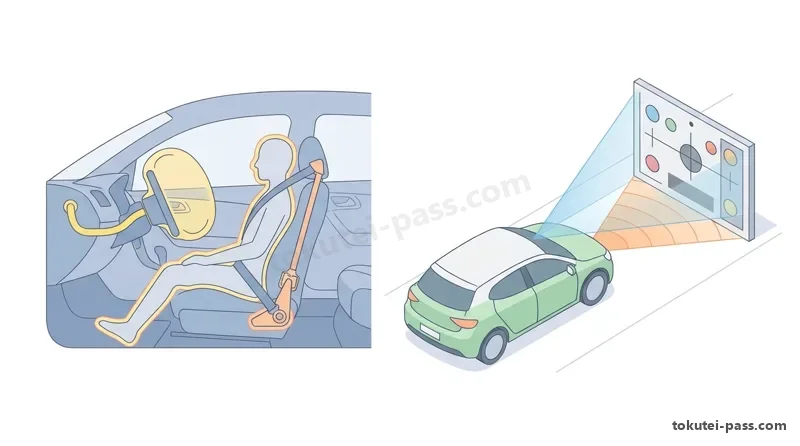
「SRSエアバッグ(補助拘束装置)」はシートベルトの補助装置であり、車両前方の「フロント・インパクト・センサ」が前面衝突時の減速度(衝撃)を検出すると、その信号をSRSユニット(ECU)内部の「衝突判定回路」に入力する。
The 'SRS airbag (Supplemental Restraint System)' is a supplemental device to the seatbelt; when the 'front impact sensor' at the front of the vehicle detects deceleration (impact) during a frontal collision, it inputs that signal to the 'collision judgment circuit' inside the SRS unit (ECU).
SRSユニット内部には誤作動防止用の「セーフィング・センサ」が直列に設けられており、衝突判定回路とセーフィング・センサの両方が同時にONになったときのみ、インフレータ(ガス発生器)の点火剤(スクイブ)に通電してエアバッグおよびシートベルト・プリテンショナを作動させる。
Inside the SRS unit, a 'safing sensor' for preventing accidental activation is connected in series; only when both the collision judgment circuit and the safing sensor turn ON simultaneously is current supplied to the squib (igniter) of the inflator (gas generator) to deploy the airbag and activate the seatbelt pretensioner.
衝突時にバッテリやケーブルが破損しても作動できるよう、SRSユニットには「バックアップ電源(コンデンサ)」が内蔵されている。そのため整備作業前には、バッテリのマイナス端子を切り離してから「規定時間(例:90秒以上)経過した後」に作業を開始しなければならない。
So that the system can operate even if the battery or cables are damaged in a collision, the SRS unit contains a built-in 'backup power source (capacitor)'. Therefore, before performing maintenance work, you must disconnect the negative (−) battery terminal and 'wait until the specified time (e.g., 90 seconds or more) has elapsed' before starting work.
またエアバッグ・システム用のコネクタには、コネクタを抜いた(外した)際に静電気などによる不意の展開(暴発)を防止するため、内部の「すべての端子間を自動的に短絡(ショート)させる機構(短絡バー)」が組み込まれている。
Additionally, connectors used in the airbag system incorporate a 'mechanism (shorting bar) that automatically shorts all internal terminals together' when the connector is unplugged, preventing accidental deployment caused by static electricity.
なお、インフレータ(スクイブ)単体の抵抗をサーキット・テスタで直接測定すると、テスタ内部電池の測定電流によってエアバッグが爆発・展開する危険があるため、「絶対にサーキット・テスタで抵抗を測定してはならない」。
Furthermore, directly measuring the resistance of an inflator (squib) alone with a circuit tester risks exploding and deploying the airbag via the measuring current from the tester's internal battery; therefore, 'you must NEVER measure inflator resistance with a circuit tester'.
Key points
- フロント・インパクト・センサは衝突時の衝撃を検出し、SRSユニット内の「衝突判定回路」に信号を入力する。
The front impact sensor detects collision impact and inputs a signal to the 'collision judgment circuit' inside the SRS unit. - エアバッグ用コネクタは、取り外したときに静電気による誤作動を防ぐため「端子間を短絡(ショート)させる構造」になっている。
Airbag connectors have a 'structure that shorts the terminals together' when unplugged to prevent accidental activation from static electricity. - インフレータの抵抗はテスタ電流で暴発する危険があるため「サーキット・テスタで絶対に測定してはならない」。
Inflator resistance 'must NEVER be measured with a circuit tester' due to the danger of accidental detonation from tester current. - 作業前はバッテリ・マイナス端子を外し、バックアップ電源(コンデンサ)が放電するまで「規定時間以上待つ」。
Before work, disconnect the negative battery terminal and 'wait at least the specified time' for the backup power capacitor to discharge.
| Word | Meaning |
|---|---|
| フロント・インパクト・センサと衝突判定回路 | front impact sensor and collision judgment circuit |
| セーフィング・センサとバックアップ電源 | safing sensor and backup power source |
| インフレータ(ガス発生器・スクイブ) | inflator (gas generator / squib) |
| 端子間短絡機構(ショート・バー) | terminal shorting mechanism (shorting bar) |
CAN(コントローラ・エリア・ネットワーク)通信の構造と信号波形
CAN (Controller Area Network) Communication Structure and Signal Waveforms
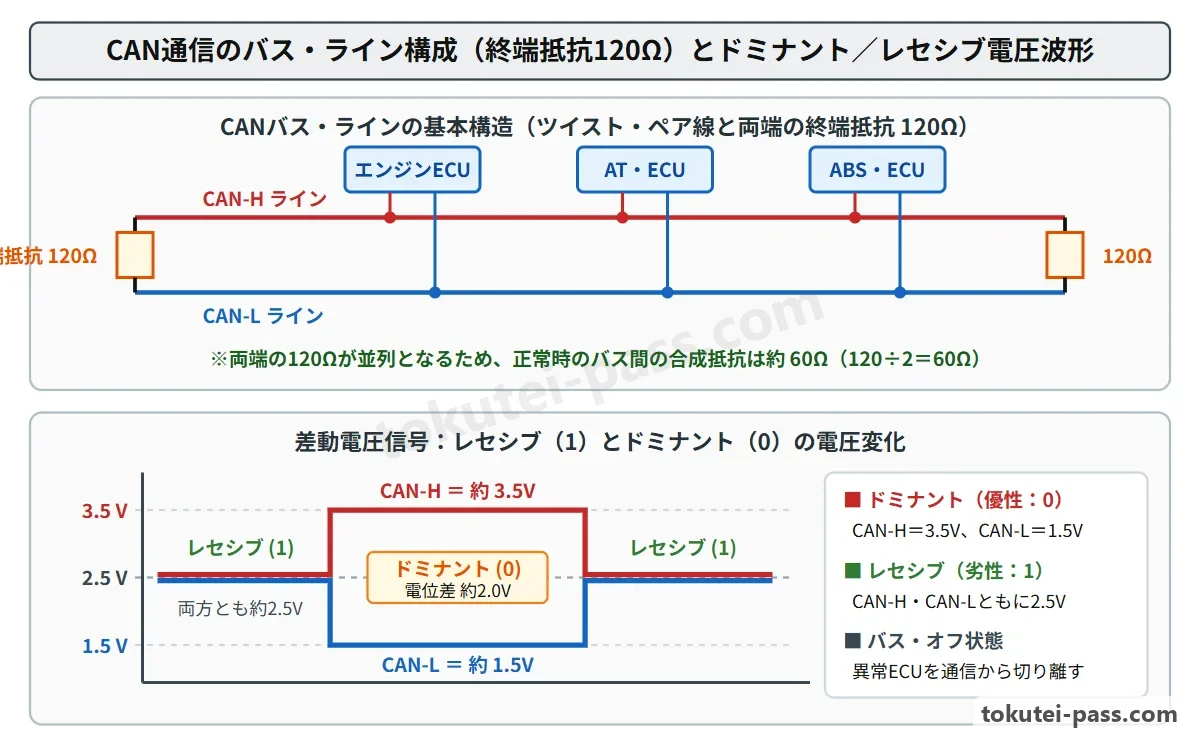
車載ネットワークの主流である「CAN通信」は、CAN-H線とCAN-L線の2本をより合わせた「ツイスト・ペア線(バス・ライン)」を用いて外部ノイズを打ち消し、バス・ラインの両端には信号の反射を防ぐため「120Ωの終端抵抗が2個(両端に1個ずつ)」並列に設けられている。
'CAN communication', the mainstream in-vehicle network, uses a 'twisted-pair line (bus line)' consisting of twisted CAN-H and CAN-L wires to cancel external noise, with 'two 120Ω terminating resistors (one at each end)' connected in parallel at both ends of the bus line to prevent signal reflection.
CAN通信の信号電圧は、非駆動状態の「レセシブ(論理1)」ではCAN-H・CAN-Lともに「約2.5V(電位差0V)」であり、駆動状態の「ドミナント(論理0)」ではCAN-Hが「約3.5V」、CAN-Lが「約1.5V」となって「約2.0Vの電位差」が生じる。
Regarding CAN signal voltages: in the un-driven 'recessive (logic 1)' state, both CAN-H and CAN-L are at 'approx. 2.5V (0V potential difference)'; in the driven 'dominant (logic 0)' state, CAN-H is at 'approx. 3.5V' and CAN-L is at 'approx. 1.5V', creating an 'approx. 2.0V potential difference'.
1つのデータ・フレームで送信しきれない大容量のデータを送る場合は、データを複数のフレームに分割して送信する「マルチフレーム送信」が行われる。
When transmitting a large volume of data that cannot be sent in a single data frame, 'multi-frame transmission' is performed by splitting the data across multiple frames.
またバス・ライン上のデータは、接続されている「複数のECUが同時に受信」して必要なデータのみを取り込むことができ、複数のECUが同時に送信を開始した際は、ID(識別子)による「調停(アービトレーション)」によって優先度の高いデータが先に送信される。
Furthermore, data on the bus line can be 'received simultaneously by multiple connected ECUs' so each takes in only the data it needs; if multiple ECUs start transmitting simultaneously, 'arbitration' by ID (identifier) ensures that higher-priority data is transmitted first.
なお、あるECUの送信エラー・カウンタが255を超えて「バス・オフ状態」になった場合は、「その異常なECUのみが通信への参加を停止し、正常な他のECU間の通信はそのまま継続される」(すべてのECUが通信を停止するという記述は誤り)。
Note that if an ECU's transmit error counter exceeds 255 and enters the 'Bus-Off state', 'only that faulty ECU stops participating in communication, while communication among the other normal ECUs continues uninterrupted' (statements claiming all ECUs stop communicating are false).
Key points
- CANバス・ラインの両端には「120Ωの終端抵抗が2個」並列に入っており、電源OFF時の正常な合成抵抗値は「約60Ω」である。
Both ends of the CAN bus line have 'two 120Ω terminating resistors' in parallel, giving a normal combined resistance of 'approx. 60Ω' when power is OFF. - レセシブ(1)は両方2.5V(差0V)、ドミナント(0)はCAN-Hが3.5V・CAN-Lが1.5V(電位差2.0V)となる。
Recessive (1) puts both lines at 2.5V (0V difference); Dominant (0) puts CAN-H at 3.5V and CAN-L at 1.5V (2.0V potential difference). - バス・オフ状態(エラー・カウンタ255超)になったときは、「異常なECUのみが通信を停止」し、他の正常なECUは通信を続ける。
When entering the Bus-Off state (error counter > 255), 'only the faulty ECU stops communicating', while other normal ECUs continue communicating. - 【例】電源OFF状態でDLCのCAN-H端子とCAN-L端子間の抵抗を測定(120Ωの終端抵抗2個が並列) → 合成抵抗 = 120 ÷ 2 = 60Ω
Example: Measuring resistance between DLC CAN-H and CAN-L terminals with power OFF (two 120Ω terminating resistors in parallel) → Combined resistance = 120 ÷ 2 = 60Ω - 【例】ドミナント(論理0)出力時、CAN-H電圧が3.5V、CAN-L電圧が1.5Vのときのバス間電位差 → 3.5 − 1.5 = 2.0V
Example: During Dominant (logic 0) output when CAN-H voltage is 3.5V and CAN-L voltage is 1.5V, the inter-bus voltage difference → 3.5 − 1.5 = 2.0V
| Word | Meaning |
|---|---|
| ツイスト・ペア線(CAN-H・CAN-L) | twisted-pair wires (CAN-H and CAN-L) |
| 終端抵抗(120Ω×2=60Ω) | terminating resistor (120Ω × 2 = 60Ω) |
| ドミナント(0)とレセシブ(1) | dominant (0) and recessive (1) |
| マルチフレーム送信とバス・オフ状態 | multi-frame transmission and Bus-Off state |
ボデー及びフレームの構造(モノコック・ボデーとトラックのラダー・フレーム)
Body and Frame Structure (Monocoque Body and Truck Ladder Frame)
乗用車に広く採用されている「モノコック・ボデー(張殻構造)」は、独立したフレームを持たず「フレームとボデーを一体構造」にすることで、外部からの荷重をボデー全体のパネルに分散して受け止めるため、「軽量で剛性(強度)が高く、室内空間を広く取れる」利点がある。
A 'monocoque body (unitized shell structure)' widely adopted in passenger cars has no separate frame, instead integrating the 'frame and body into a single structure' so external loads are dispersed across the panels of the entire body, offering the advantages of being 'lightweight, highly rigid (strong), and providing a spacious cabin'.
しかしモノコック・ボデーは、フレーム付きボデー(非モノコック構造)に比べて路面やエンジンからの「振動や騒音が車室内全体に伝わりやすい」という短所があるため、各部に防振・遮音材が配置されている(騒音が伝わりにくいという記述は誤り)。
However, compared to a body-on-frame (non-monocoque) structure, a monocoque body has the disadvantage that 'vibrations and noise from the road surface and engine are more easily transmitted throughout the cabin', so vibration-damping and sound-insulating materials are placed in various areas (claiming noise is less easily transmitted is incorrect).
また「衝突安全ボデー」は、衝突時にボデー前後の部分が効率よく潰れて衝撃エネルギを吸収する「クラッシャブル・ゾーン」と、乗員の生存空間を守る高強度な「セーフティ・キャビン」を組み合わせている。
Additionally, a 'collision safety body' combines 'crushable zones' at the front and rear that crumple efficiently in a collision to absorb impact energy with a high-strength 'safety cabin' that protects the occupant survival space.
一方、トラックなどに用いられる「ラダー・フレーム(はしご形フレーム)」は、車両の「前後方向(縦方向)に通る左右2本のサイド・メンバ」と、それらを「左右方向(横方向)につなぐ複数のクロス・メンバ」をリベットやボルトで結合して構成される。
Conversely, a 'ladder frame' used on trucks is constructed by joining 'two left and right side members running in the longitudinal (front-to-rear) direction' and 'multiple cross members connecting them in the transverse (left-to-right) direction' using rivets or bolts.
トラックのフレームを補強する際は、境界部への応力集中による亀裂を防ぐため、補強板の板厚は「フレームの板厚と同等またはそれより薄いもの」を使用し、補強板の端部は急激な剛性変化を避けるため斜め(テーパ状)にカットする。
When reinforcing a truck frame, to prevent cracking due to stress concentration at the boundary, the thickness of the reinforcement plate must be 'equal to or thinner than the frame plate thickness', and the ends of the reinforcement plate are cut diagonally (tapered) to avoid abrupt rigidity changes.
Key points
- モノコック・ボデーはフレームとボデーが一体で軽量・高剛性だが、フレーム型に比べて「振動や騒音が伝わりやすい」。
A monocoque body integrates frame and body for light weight and high rigidity, but 'transmits vibration and noise more easily' than a frame-type body. - トラックのフレームは、前後方向の2本の「サイド・メンバ」と、左右方向(横方向)の複数の「クロス・メンバ」で構成される。
A truck frame consists of two longitudinal 'side members' (front-to-rear) and multiple transverse 'cross members' (left-to-right). - フレーム補強板の厚さは、応力集中を防ぐため「フレームの板厚以下(同等または薄いもの)」にする(厚いものという記述は誤り)。
Frame reinforcement plate thickness must be 'equal to or thinner than the frame thickness' to prevent stress concentration (claiming thicker plates are used is false).
| Word | Meaning |
|---|---|
| モノコック・ボデー(張殻構造) | monocoque body (unitized structure) |
| クラッシャブル・ゾーンとセーフティ・キャビン | crushable zone and safety cabin |
| サイド・メンバ(前後)とクロス・メンバ(左右) | side members (longitudinal) and cross members (transverse) |
| フレーム補強板と応力集中 | frame reinforcement plate and stress concentration |
エアコンディショナ(冷凍サイクル・斜板式コンプレッサ・エアミックス方式)
Air Conditioner (Refrigeration Cycle, Swash-Plate Compressor, and Air-Mix System)
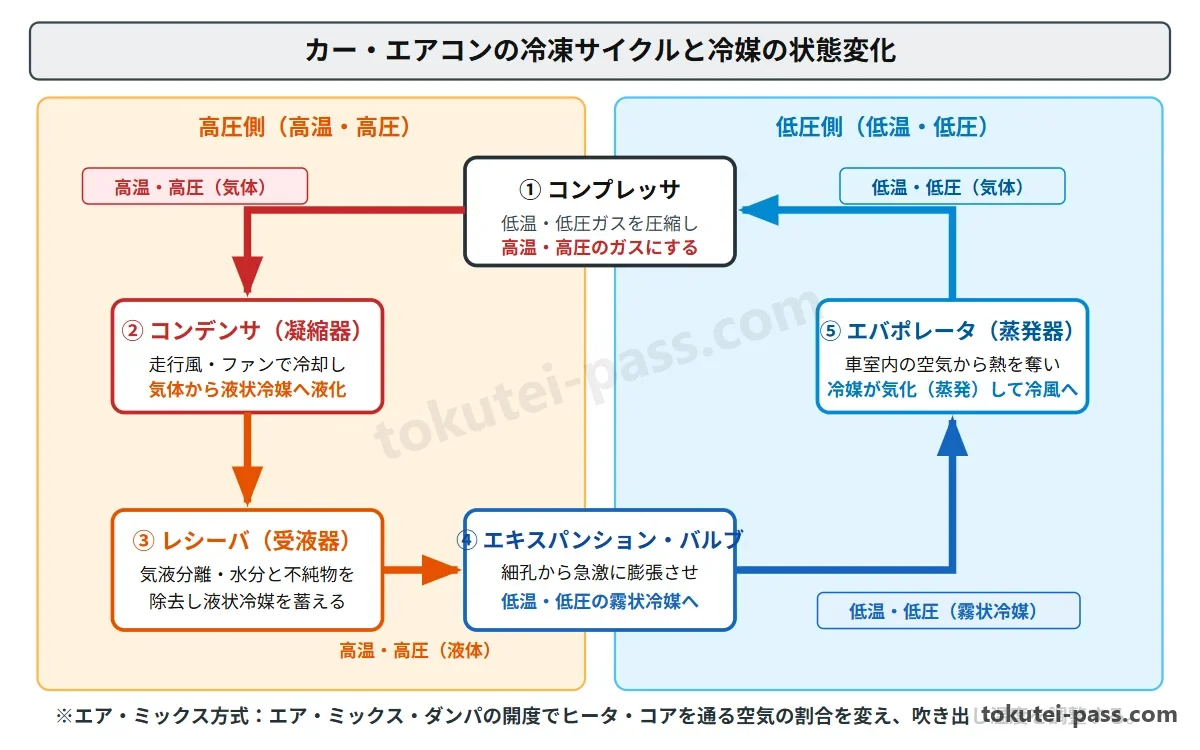
カー・エアコンの「冷凍サイクル」において、「コンプレッサ」はエバポレータから送られてきた低温・低圧のガス冷媒(HFC-134aやHFO-1234yf)を吸入・圧縮し、「高温・高圧のガス冷媒」にしてコンデンサへ圧送する。
In a car air conditioner's 'refrigeration cycle', the 'compressor' draws in and compresses low-temperature, low-pressure gas refrigerant (HFC-134a or HFO-1234yf) sent from the evaporator, turning it into 'high-temperature, high-pressure gas refrigerant' and pumping it to the condenser.
このうち「斜板式コンプレッサ」は、シャフトに傾斜して取り付けられた斜板(スワッシュ・プレート)の回転によってピストンを軸方向に「往復運動」させ、冷媒の吸入・圧縮を行う(ピストンが回転運動するという記述は誤り)。
Among compressor types, a 'swash-plate compressor' converts the rotation of an inclined swash plate mounted on the shaft into axial 'reciprocating motion' of the pistons to draw in and compress refrigerant (statements claiming the pistons perform rotary motion are incorrect).
「コンデンサ(凝縮器)」は高温・高圧のガス冷媒を外気で冷却して「高温・高圧の液冷媒」に液化させ、続く「レシーバ(受液器)」が気液分離および乾燥剤・ストレーナによる水分・不純物の除去を行う。
The 'condenser' cools the high-temperature, high-pressure gas refrigerant with outside air to liquefy it into 'high-temperature, high-pressure liquid refrigerant', and the following 'receiver (liquid tank)' separates gas from liquid and removes moisture and impurities via a desiccant and strainer.
「エキスパンション・バルブ(膨張弁)」は、レシーバからの高温・高圧の液冷媒を微小な孔(オリフィス)から噴射させて急激に膨張させ、「低温・低圧の霧状の冷媒」にしてエバポレータへ送り込むとともに、冷房負荷に応じて冷媒流量を調整する。
The 'expansion valve' sprays the high-temperature, high-pressure liquid refrigerant from the receiver through a tiny orifice so it expands rapidly into a 'low-temperature, low-pressure mist refrigerant' fed into the evaporator, while regulating refrigerant flow according to cooling load.
「エバポレータ(蒸発器)」では霧状冷媒が蒸発する際に周囲の空気から気化熱を奪って冷風を作る。吹き出し温度を調整する「エアミックス方式」は、エアミックス・ダンパの開度によって「エバポレータを通過した冷風とヒータ・コアを通過する温風の混合割合」を変える方式である。
In the 'evaporator', as the mist refrigerant evaporates, it absorbs latent heat of vaporization from the surrounding air to produce cool air. The 'air-mix system' for regulating outlet air temperature varies the opening of the air-mix damper to change the 'mixing ratio of cool air that passed through the evaporator and warm air passing through the heater core'.
Key points
- 斜板式コンプレッサは、シャフトの斜板の回転をピストンの「往復運動」に変えて冷媒を圧縮する。
A swash-plate compressor converts rotation of the shaft swash plate into 'reciprocating motion' of the pistons to compress refrigerant. - エキスパンション・バルブは、高温・高圧の液冷媒を急激に膨張させて「低温・低圧の霧状冷媒」にする。
The expansion valve rapidly expands high-temperature, high-pressure liquid refrigerant into a 'low-temperature, low-pressure mist refrigerant'. - エアミックス方式は、エアミックス・ダンパで「冷風とヒータ・コアを通る温風の割合」を調整して温度を制御する。
The air-mix system controls temperature by using the air-mix damper to adjust the 'ratio of cool air and warm air passing through the heater core'.
| Word | Meaning |
|---|---|
| 斜板式コンプレッサ(ピストンの往復運動) | swash-plate compressor (piston reciprocating motion) |
| コンデンサとレシーバ(気液分離・水分除去) | condenser and receiver (gas-liquid separation, moisture removal) |
| エキスパンション・バルブ(低温・低圧の霧状冷媒) | expansion valve (low-temperature, low-pressure mist refrigerant) |
| エバポレータとエアミックス・ダンパ | evaporator and air-mix damper |
先進安全自動車(ASV)と特定整備・エーミング作業
Advanced Safety Vehicles (ASV), Specific Maintenance, and Aiming Calibration
近年の「先進安全自動車(ASV)」には、前方の車両や歩行者を検知して警報や自動制動を行う「衝突被害軽減ブレーキ(AEB)」や、白線を認識してステアリングを制御する「車線維持支援装置(LKAS)」が搭載されている。
Modern 'Advanced Safety Vehicles (ASVs)' are equipped with 'Autonomous Emergency Braking (AEB / collision damage mitigation braking)', which detects vehicles or pedestrians ahead to issue warnings and apply automatic braking, and 'Lane Keep Assist Systems (LKAS)', which recognize lane markings to control steering.
外界認識センサとして、「ミリ波レーダ」は電波を用いるため雨や霧・夜間などの悪天候に強く先行車までの距離と相対速度を高精度に測定でき、「カメラ(単眼・ステレオ)」は車線(白線)や標識・歩行者の形状識別に優れている。
Regarding external recognition sensors, 'millimeter-wave radar' uses radio waves so it is resilient against bad weather such as rain, fog, and nighttime, accurately measuring distance and relative speed to preceding vehicles, whereas 'cameras (monocular or stereo)' excel at identifying lane lines, road signs, and pedestrian shapes.
道路運送車両法における「特定整備」には、従来の分解整備に加えて、自動運行装置や衝突被害軽減ブレーキ用のカメラ・レーダ等の取り外し・取付角度変更、およびそれらが付いたフロント・ガラスやバンパの脱着を行う「電子制御装置整備」が含まれる。
Under the Road Transport Vehicle Act, 'Specific Maintenance' includes traditional disassembly maintenance plus 'Electronic Control System Maintenance': removing, installing, or changing the mounting angle of cameras and radars for automated driving or AEB, as well as removing or installing windshields or bumpers carrying those sensors.
カメラやミリ波レーダを脱着・交換した際やフロント・ガラス交換後には、センサが正しく前方を認識できるよう、水平な作業場で専用のターゲット(標板)やリフレクタと外部診断器(スキャン・ツール)を用いて光軸・基準値を校正する「エーミング作業」が必須となる。
After removing, installing, or replacing a camera or millimeter-wave radar, or after replacing a windshield, 'aiming work (calibration)' using dedicated targets or reflectors and an external diagnostic tester (scan tool) in a level workspace is mandatory to calibrate the optical axis and reference values so the sensor accurately recognizes the road ahead.
Key points
- 衝突被害軽減ブレーキ(AEB)などのカメラ・ミリ波レーダの脱着やフロント・ガラス交換は「電子制御装置整備(特定整備)」に該当する。
Removing/installing cameras or millimeter-wave radars for AEB or replacing windshields falls under 'Electronic Control System Maintenance (Specific Maintenance)'. - ミリ波レーダは悪天候や夜間に強く、カメラは白線(車線)や歩行者・標識の識別に優れている。
Millimeter-wave radar excels in bad weather and at night, while cameras excel at recognizing lane markings, pedestrians, and traffic signs. - センサやフロント・ガラスの脱着・交換後には、ターゲットと外部診断器を用いた「エーミング(校正)作業」を行う。
After removing/replacing sensors or windshields, 'aiming (calibration) work' using targets and an external scan tool must be performed.
| Word | Meaning |
|---|---|
| 衝突被害軽減ブレーキ(AEB) | Autonomous Emergency Braking (AEB) |
| ミリ波レーダと単眼・ステレオ・カメラ | millimeter-wave radar and monocular/stereo camera |
| 電子制御装置整備(特定整備) | Electronic Control System Maintenance (Specific Maintenance) |
| エーミング作業とターゲット | aiming work and target board |
試験によく出るポイントと覚え方
Common Exam Points and How to Remember Them
ボデー電装・通信・空調分野では、SRSエアバッグ、CAN通信、モノコック・ボデーとトラック・フレーム、およびエアコンの冷凍サイクルから毎年4〜5問が出題される。
In the body electrical, communication, and air conditioning section, 4 to 5 questions appear every year from SRS airbags, CAN communication, monocoque bodies & truck frames, and the A/C refrigeration cycle.
SRSエアバッグは、「フロント・インパクト・センサ→SRSユニットの衝突判定回路へ入力」「コネクタを抜くと端子間が短絡(ショート)して静電気暴発を防止」「インフレータ抵抗はテスタ測定厳禁」の3点を押さえよう。
For SRS airbags, lock in three points: 'Front impact sensor → inputs signal to collision judgment circuit in SRS unit', 'Unplugging the connector shorts the terminals together to prevent static deployment', 'Measuring inflator resistance with a circuit tester is strictly prohibited'.
CAN通信は、「終端抵抗120Ω×2個=合成60Ω」「ドミナント(0)=CAN-H 3.5V・CAN-L 1.5V(差2.0V)、レセシブ(1)=両方2.5V」「マルチフレーム分割送信・同時受信」「バス・オフ(エラー255超)=異常なECUのみ通信停止(全ECU停止は誤り)」が必出である。
For CAN communication, the must-know points are: 'Two 120Ω terminating resistors = 60Ω combined', 'Dominant (0) = CAN-H 3.5V & CAN-L 1.5V (2.0V diff); Recessive (1) = both 2.5V', 'Multi-frame split transmission & simultaneous reception', 'Bus-Off (error > 255) = only the faulty ECU stops communicating (all ECUs stopping is false)'.
ボデーとエアコンは、「モノコック=軽量だが振動・騒音が伝わりやすい」「トラック=前後2本のサイド・メンバと左右のクロス・メンバ、補強板はフレーム板厚以下」「斜板式コンプレッサ=ピストン往復運動」「膨張弁=低温・低圧の霧状冷媒に膨張」と覚えよう。
For body and A/C, memorize: 'Monocoque = lightweight but transmits vibration/noise more easily', 'Truck frame = 2 longitudinal side members and transverse cross members, reinforcement plate ≤ frame thickness', 'Swash-plate compressor = piston reciprocating motion', 'Expansion valve = expands into low-temp, low-pressure mist refrigerant'.
Key points
- SRSエアバッグ:コネクタを抜くと「端子間が短絡」し、インフレータ抵抗のテスタ測定は厳禁。
SRS airbag: unplugging the connector 'shorts the terminals together'; measuring inflator resistance with a circuit tester is strictly prohibited. - CAN通信:終端抵抗120Ω×2個(60Ω)、バス・オフ時は「異常なECUのみ」通信を停止し他のECUは通信を継続する。
CAN communication: two 120Ω terminating resistors (60Ω); during Bus-Off, 'only the faulty ECU' stops communicating while other ECUs continue. - ボデー・フレーム:モノコックは騒音が伝わりやすい。トラックは前後サイド・メンバと左右クロス・メンバで、補強板はフレーム板厚以下。
Body & frame: Monocoque transmits noise more easily; truck frames have longitudinal side members and transverse cross members, with reinforcement plates ≤ frame thickness. - エアコン:斜板式コンプレッサのピストンは「往復運動」し、エキスパンション・バルブは冷媒を「低温・低圧の霧状」にする。
Air conditioner: swash-plate compressor pistons perform 'reciprocating motion', and the expansion valve turns refrigerant into a 'low-temp, low-pressure mist'.
| Word | Meaning |
|---|---|
| SRSエアバッグ(短絡機構) | SRS airbag (terminal shorting mechanism) |
| CANバス・オフ状態と終端抵抗 | CAN Bus-Off state and terminating resistor |
| モノコック・ボデーとサイド・クロス・メンバ | monocoque body and side/cross members |
| 斜板式コンプレッサと膨張弁 | swash-plate compressor and expansion valve |
Body Electrical, Networks, A/C & Safety
Practice this chapter in the appOfficial references
- 国土交通省「自動車整備分野特定技能2号評価試験実施要領」および日本自動車整備振興会連合会(JASPA)学科試験サンプル問題 — https://www.mlit.go.jp/jidosha/jidosha_fr10_000041.html