
Road Transport Vehicle Act, Safety Standards, and Inspection Standards
道路運送車両法・保安基準・点検基準
Automobile Maintenance (SSW 2) · 自動車整備分野(2号) · Written by Tokutei Pass based on the official study texts; not copied verbatim.
道路運送車両法の目的と自動車の種別(5種類)
Purpose of the Road Transport Vehicle Act and Vehicle Classifications (5 Types)
「道路運送車両法」は、道路運送車両に関し、①所有権についての公証等を行い、②安全性の確保および公害の防止その他の環境保全を図り、ならびに③整備についての技術の向上を図り、あわせて自動車の整備事業の健全な発達に資することを目的としている。
The 'Road Transport Vehicle Act' aims, with regard to road transport vehicles, to (1) publicly authenticate ownership, (2) ensure safety, prevent pollution, and conserve the environment, and (3) improve maintenance technology while contributing to the sound development of the automotive maintenance business.
同法第3条において、自動車は構造や原動機の総排気量・車体の大きさにより、「普通自動車」「小型自動車」「軽自動車」「大型特殊自動車」「小型特殊自動車」の「5種類」に区分されている。
Under Article 3 of the Act, motor vehicles are classified into 'five categories' according to structure, total engine displacement, and body dimensions: 'Ordinary motor vehicle', 'Small-sized motor vehicle', 'Light motor vehicle (Kei)', 'Large-sized special motor vehicle', and 'Small-sized special motor vehicle'.
ここで最も重要な試験ポイントは、道路運送車両法の自動車の種別には「大型自動車」や「中型自動車」という区分は存在しないことである(大型自動車は運転免許を定める道路交通法の区分であり、車両法では普通自動車に含まれる)。
The single most important exam point here is that the vehicle classifications of the Road Transport Vehicle Act do NOT include 'Large-sized motor vehicle (大型自動車)' or 'Medium-sized motor vehicle (中型自動車)' (Large-sized motor vehicle is a driver's license classification under the Road Traffic Act, and falls under Ordinary motor vehicle in the Road Transport Vehicle Act).
四輪の「小型自動車」の基準は、全長4.70m以下、全幅1.70m以下、全高2.00m以下、ガソリン車の総排気量2,000cm³(2.0L)以下であり、これを超えるものは「普通自動車」となる。
The criteria for a four-wheeled 'Small-sized motor vehicle' are: overall length 4.70 m or less, overall width 1.70 m or less, overall height 2.00 m or less, and total engine displacement 2,000 cm³ (2.0 L) or less for gasoline vehicles; any vehicle exceeding these limits becomes an 'Ordinary motor vehicle'.
また「軽自動車」の基準は、全長3.40m以下、全幅1.48m以下、全高2.00m以下、総排気量660cm³(0.66L)以下と定められている。
Furthermore, the criteria for a 'Light motor vehicle (Kei car)' are specified as: overall length 3.40 m or less, overall width 1.48 m or less, overall height 2.00 m or less, and total engine displacement 660 cm³ (0.66 L) or less.
Key points
- 道路運送車両法における自動車の種別は、「普通・小型・軽・大型特殊・小型特殊」の5種類のみである。
Motor vehicle classifications under the Road Transport Vehicle Act consist solely of five types: 'Ordinary, Small-sized, Light, Large-sized special, and Small-sized special'. - 「大型自動車」や「中型自動車」は道路運送車両法の種別には含まれない(2号試験の最頻出ひっかけ)。
'Large-sized motor vehicle' and 'Medium-sized motor vehicle' are NOT included in the classifications of the Road Transport Vehicle Act (the #1 trap on the Type 2 exam). - 軽自動車は排気量660cm³以下(長さ3.40m・幅1.48m・高さ2.00m以下)、小型自動車はガソリン2,000cm³以下(長さ4.70m・幅1.70m・高さ2.00m以下)。
Light motor vehicles have displacement ≤ 660 cm³ (length ≤ 3.40 m, width ≤ 1.48 m, height ≤ 2.00 m); Small-sized gasoline vehicles have displacement ≤ 2,000 cm³ (length ≤ 4.70 m, width ≤ 1.70 m, height ≤ 2.00 m).
| Word | Meaning |
|---|---|
| 道路運送車両法 | Road Transport Vehicle Act |
| 自動車の種別(5種類) | motor vehicle classifications (5 types) |
| 普通自動車・小型自動車・軽自動車 | Ordinary, Small-sized, and Light motor vehicles |
| 大型特殊自動車・小型特殊自動車 | Large-sized special and Small-sized special motor vehicles |
保安基準:灯火装置(後退灯・前照灯・方向指示器・制動灯)
Safety Standards: Lighting Devices (Backup Lamps, Headlamps, Turn Signals, Stop Lamps)
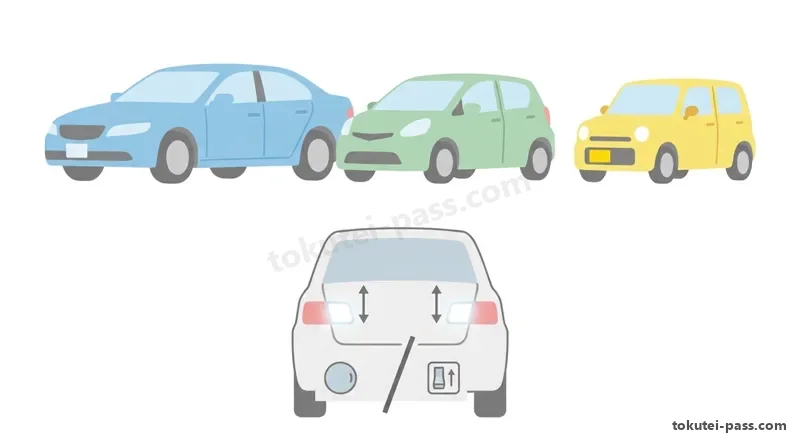
道路運送車両の保安基準において、自動車が後退していることを後方に示す「後退灯(バックアップ・ランプ)」の備え付け個数は「1個または2個」であり、灯光の色は「白色」と定められている。
Under the Road Transport Vehicle Safety Standards, the required number of 'backup lamps (reversing lamps)' indicating to the rear that a vehicle is backing up is '1 or 2', and the light color is specified as 'white'.
後退灯の取付位置は、照明部の「上縁の高さが地上1.2m以下」、「下縁の高さが地上0.25m以上」であり、「昼間その後方100mの距離から点灯を確認できるもの」でなければならない。
Regarding the mounting position of backup lamps, the 'height of the upper edge of the illuminated surface must be 1.2 m or less above the ground', the 'height of the lower edge must be 0.25 m or more above the ground', and 'illumination must be recognizable in daytime from a distance of 100 m behind the vehicle'.
さらに後退灯は、変速装置を「後退(リバース)の位置に操作している場合にのみ点灯する構造」であり、主光軸は下向きで、後方の他の交通を妨害(眩惑)しないものでなければならない。
Furthermore, backup lamps must have a 'structure that illuminates only when the transmission is shifted into the reverse position', with the main beam aimed downward so as not to dazzle or obstruct other traffic behind the vehicle.
一方、「走行用前照灯(ハイ・ビーム)」は白色で夜間前方「100m」の障害物を確認できること、「すれ違い用前照灯(ロー・ビーム)」は夜間前方「40m」の障害物を確認できることが求められる。
Meanwhile, 'driving headlamps (high beams)' must be white and enable recognition of obstacles '100 m' ahead at night, while 'passing headlamps (low beams)' must enable recognition of obstacles '40 m' ahead at night.
また「方向指示器(ウインカ)」および「非常点滅表示灯(ハザード)」の灯光の色は「橙色」で、毎分「60回以上120回以下」の一定周期で点滅すること、「制動灯(ストップ・ランプ)」と「尾灯」は「赤色」、「番号灯」は「白色」で運転者席で消灯できない構造であることが定められている。
Additionally, 'direction indicators (turn signals)' and 'hazard warning lamps' must emit 'orange (amber)' light and flash at a constant rate of '60 to 120 times per minute'; 'stop lamps' and 'tail lamps' must be 'red'; and 'license plate lamps' must be 'white' with a structure that cannot be switched off from the driver's seat.
Key points
- 後退灯の基準:個数「1個または2個」、色「白色」、高さ「上縁1.2m以下・下縁0.25m以上」、視認距離「昼間後方100m」。
Backup lamp standards: number '1 or 2', color 'white', height 'upper edge ≤ 1.2 m & lower edge ≥ 0.25 m', visibility distance '100 m behind in daytime'. - 前照灯の基準:色は「白色」、夜間前方の照射確認距離は走行用が「100m」、すれ違い用が「40m」。
Headlamp standards: color 'white', nighttime forward obstacle visibility distance is '100 m' for high beams and '40 m' for low beams. - 方向指示器は「橙色」で点滅回数は「毎分60〜120回」、制動灯・尾灯は「赤色」、番号灯は「白色(消灯不可)」。
Direction indicators are 'orange' with a flash rate of '60–120 times/min'; stop and tail lamps are 'red'; license plate lamps are 'white (cannot be switched off)'.
| Word | Meaning |
|---|---|
| 後退灯(白色・1個または2個・後方100m) | backup lamp (white, 1 or 2 lamps, 100 m behind) |
| 上縁1.2m以下・下縁0.25m以上 | upper edge ≤ 1.2 m and lower edge ≥ 0.25 m |
| 走行用前照灯(100m)とすれ違い用前照灯(40m) | driving headlamp (100 m) and passing headlamp (40 m) |
| 方向指示器(橙色・毎分60〜120回) | direction indicator (orange, 60–120 flashes/min) |
保安基準:かじ取・制動・走行・燃料装置
Safety Standards: Steering, Braking, Running (Tires), and Fuel Systems
保安基準において、かじ取車輪(前輪)を直進状態で走行させたときの「サイド・スリップ量(横滑り量)」は、サイド・スリップ・テスタで測定した際に「走行1mについてインまたはアウトに5mm以内」でなければならない。
Under the Safety Standards, when the steered wheels (front wheels) travel straight ahead, the 'side slip amount' measured by a side-slip tester must be 'within 5 mm (inward or outward) per 1 m of travel'.
また「走行装置(タイヤ)」の基準として、タイヤに亀裂やコードの露出がなく、接地部の滑り止め「溝の深さが1.6mm以上(大型特殊・小型特殊・二輪車を除く四輪自動車)」でなければならない(1.6mm未満になるとスリップ・サインが現れる)。
As a standard for the 'running system (tires)', tires must have no cracks or exposed cords, and the anti-skid 'tread groove depth in the contact area must be 1.6 mm or more' for four-wheeled motor vehicles (excluding large/small special vehicles and motorcycles; slip signs appear below 1.6 mm).
液体燃料(ガソリン・軽油)を使用する自動車の「燃料装置」では、燃料タンクおよび配管は強固で振動・衝撃により損傷しないよう確実に取り付けられ、かつ「車体の最外側より突出しないこと」が定められている。
In the 'fuel system' of motor vehicles using liquid fuel (gasoline or diesel), the fuel tank and piping must be robust, securely mounted so as not to be damaged by vibration or impact, and 'must not protrude beyond the outermost side of the vehicle body'.
さらに火災防止のため、燃料タンクの「注入口およびガス抜き口」は、排気管の開口方向になく、かつ「排気管の開口部から300mm以上離れていること」が必要である。
Furthermore, to prevent fire, the fuel tank 'filler port and gas vent port' must not be in the discharge direction of the exhaust pipe and must be 'separated by 300 mm or more from the open end of the exhaust pipe'.
同時に、燃料タンクの注入口およびガス抜き口は、火花を発するおそれのある「露出した電気端子および電気開閉器(スイッチ)から200mm以上離れていること」と定められている。
At the same time, the fuel tank filler port and gas vent port must be 'separated by 200 mm or more from exposed electrical terminals and electrical switches' that could produce sparks.
Key points
- かじ取車輪のサイド・スリップ量は「走行1mについて5mm以内」、四輪自動車のタイヤ溝の深さは「1.6mm以上」である。
Steered wheel side slip must be 'within 5 mm per 1 m of travel', and tire tread groove depth on four-wheeled vehicles must be '1.6 mm or more'. - 燃料タンクの注入口・ガス抜き口は、「排気管の開口部から300mm以上」離れていなければならない。
The fuel tank filler port and gas vent port must be separated by '300 mm or more from the exhaust pipe outlet'. - 燃料タンクの注入口・ガス抜き口は、「露出した電気端子および電気開閉器から200mm以上」離れていなければならない。
The fuel tank filler port and gas vent port must be separated by '200 mm or more from exposed electrical terminals and electrical switches'.
| Word | Meaning |
|---|---|
| サイド・スリップ量(走行1mにつき5mm以内) | side slip amount (within 5 mm per 1 m of travel) |
| タイヤ溝の深さ(1.6mm以上・スリップ・サイン) | tire tread groove depth (1.6 mm or more / slip sign) |
| 排気管開口部からの距離(300mm以上) | distance from exhaust pipe outlet (300 mm or more) |
| 露出電気端子・開閉器からの距離(200mm以上) | distance from exposed electrical terminals/switches (200 mm or more) |
自動車点検基準:日常点検と自家用乗用車の1年・2年定期点検
Automobile Inspection Standards: Daily Inspection vs. 1-Year & 2-Year Periodic Inspections
自動車の使用者は、運行前や走行距離に応じて行う「日常点検」と、一定期間ごとに行う「定期点検(自家用乗用車・軽乗用車は1年ごとおよび2年ごと)」を実施する義務がある。
Users of motor vehicles are obligated to perform 'Daily Inspections' prior to operation or according to driving distance, as well as 'Periodic Inspections' at fixed intervals (every 1 year and every 2 years for private passenger cars and light passenger cars).
「日常点検」の主な項目は、外回りと運転席・エンジンルームで目視確認できる項目であり、「ブレーキ液の量」「冷却水の量」「エンジン・オイルの量」「バッテリの液量」「ウインド・ウォッシャ液の量」「タイヤの空気圧・亀裂・溝の深さ」「ランプ類の点灯・点滅」などである。
Main items of the 'Daily Inspection' are those visually verifiable around the exterior, from the driver's seat, and in the engine room: 'brake fluid level', 'coolant level', 'engine oil level', 'battery fluid level', 'windshield washer fluid level', 'tire inflation pressure, cracks, and groove depth', and 'lighting/flashing of lamps'.
一方、「自家用乗用自動車の1年定期点検項目」には、「ブレーキ・ホースおよびパイプの液漏れ・損傷」「ブレーキ・ドラムとライニングとのすき間、ライニングの摩耗」「ブレーキ・ディスクとパッドとのすき間、パッドの摩耗」が含まれる。
Conversely, '1-Year Periodic Inspection items for private passenger cars' include: 'fluid leaks and damage of brake hoses and pipes', 'clearance between brake drums and linings, and lining wear', and 'clearance between brake discs and pads, and pad wear'.
さらに1年定期点検には、「ファン・ベルトの緩み・損傷」「スパーク・プラグの状態」「バッテリのターミナル部の接続状態(緩み・腐食)」「トランスミッションの油漏れ・油量」「エキゾースト・パイプおよびマフラの取付の緩み・損傷」「ホイール・ナットおよびボルトの緩み」が含まれる。
Furthermore, the 1-Year Periodic Inspection includes: 'looseness and damage of the fan belt', 'spark plug condition', 'connection condition of battery terminals (looseness and corrosion)', 'transmission oil leaks and oil level', 'mounting looseness and damage of exhaust pipes and mufflers', and 'looseness of wheel nuts and bolts'.
ここで2号試験の重要なひっかけとして、「バッテリの液量」は日常点検項目であり、「バッテリの液の比重」は2年定期点検項目であるため、どちらも自家用乗用車の「1年定期点検項目には含まれない」(1年点検にあるバッテリ項目はターミナル部の緩み・腐食のみ)。
As a critical trap on the Type 2 exam, 'battery fluid level' is a Daily Inspection item and 'battery fluid specific gravity' is a 2-Year Periodic Inspection item; therefore, neither is included in the '1-Year Periodic Inspection items for private passenger cars' (the only battery item in the 1-year inspection is terminal looseness/corrosion).
Key points
- 「バッテリの液量」は日常点検項目、「バッテリ液の比重」は2年定期点検項目であり、1年定期点検項目ではない。
'Battery fluid level' is a Daily Inspection item and 'battery fluid specific gravity' is a 2-Year Periodic Inspection item; neither is a 1-Year Periodic Inspection item. - 自家用乗用車の1年定期点検にあるバッテリ項目は「ターミナル部の緩み・腐食」である。
The battery item included in the 1-Year Periodic Inspection for private passenger cars is 'looseness and corrosion of the terminals'. - ブレーキ・ホースの液漏れ・損傷、ライニング・パッドのすき間と摩耗、ファン・ベルトの緩み・損傷は1年定期点検項目である。
Brake hose leaks/damage, lining/pad clearance and wear, and fan belt looseness/damage are 1-Year Periodic Inspection items.
| Word | Meaning |
|---|---|
| 自動車点検基準 | Automobile Inspection Standards |
| 日常点検(バッテリの液量・ブレーキ液量) | Daily Inspection (battery fluid level, brake fluid level) |
| 1年定期点検(ターミナル部の緩み・パッド摩耗) | 1-Year Periodic Inspection (terminal looseness, pad wear) |
| 2年定期点検(バッテリ液の比重) | 2-Year Periodic Inspection (battery fluid specific gravity) |
特定整備(分解整備・電子制御装置整備)・認証工場・点検整備記録簿
Specific Maintenance (Disassembly & Electronic Control), Certified Garages, and Record Books
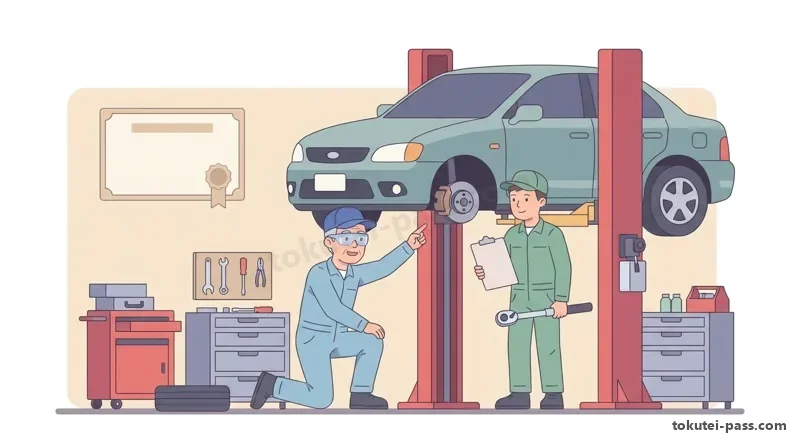
道路運送車両法における「特定整備」とは、重要部位を取り外して行う従来の「分解整備」と、先進安全装置(AEBや自動運行装置)のカメラ・レーダ等を整備する「電子制御装置整備」を合わせたものである。
'Specific Maintenance' under the Road Transport Vehicle Act combines traditional 'Disassembly Maintenance' performed by removing critical assemblies with 'Electronic Control System Maintenance' for servicing cameras and radars of advanced safety systems (AEB and automated driving systems).
分解整備の対象となる「7装置」は、①原動機、②動力伝達装置(クラッチ・ミッション・デフ等)、③走行装置(アクスル・ハブ等)、④かじ取装置(ギヤ・ボックス・タイロッド・ナックル等)、⑤制動装置(マスタ・シリンダ・キャリパ・ドラム・シュー等)、⑥緩衝装置(ばね等)、⑦連結装置(カプラ等)を取り外して行う整備である。
The '7 systems' subject to Disassembly Maintenance are: (1) Engine (removing engine), (2) Power transmission system (removing clutch, transmission, propeller shaft, differential, etc.), (3) Running gear (front axle, hub, etc.), (4) Steering system (gearbox, tie rod, knuckle, etc.), (5) Braking system (master cylinder, caliper, brake drum, shoes, etc.), (6) Suspension/buffer system (leaf, coil, or air springs), and (7) Coupling device (tractor fifth-wheel coupler, etc.).
特定整備を事業として行うには「地方運輸局長の認証」を受けなければならず、認証を受けた事業場(認証工場)には1級または2級の自動車整備士等から「整備主任者」を選任して届け出る義務がある。
Operating a Specific Maintenance business requires 'certification by the Director of the Regional Transport Bureau', and a certified workplace (Certified Garage) is obligated to appoint and register a 'Chief Automobile Maintenance Engineer' from among Level 1 or Level 2 certified mechanics.
さらに認証工場のうち、完成検査用の検査設備と「自動車検査員」を備えて地方運輸局長の指定を受けた「指定自動車整備事業場(指定工場・民間車検場)」では、検査員が保安基準適合証を交付することで運輸支局への現車提示が省略される。
Furthermore, among certified garages, at a 'Designated Automobile Maintenance Business (Designated Garage / private inspection station)' equipped with completion inspection equipment and an 'Automobile Inspector' and designated by the Regional Transport Bureau Director, when the inspector issues a Security Standards Conformity Certificate, physical presentation of the vehicle at the Transport Branch Office is waived.
また自動車には「点検整備記録簿」を備え置き、特定整備や定期点検を実施した際は遅滞なく記載しなければならない。記録簿の保存期間は、自家用乗用車では「2年間」、事業用自動車や自家用貨物車では「1年間」である。
Additionally, an 'Inspection and Maintenance Record Book' must be kept in the vehicle and recorded promptly whenever Specific Maintenance or periodic inspection is performed. The retention period for the record book is '2 years' for private passenger cars and '1 year' for commercial vehicles and private cargo trucks.
Key points
- 特定整備 =「分解整備(7装置)」+「電子制御装置整備」であり、地方運輸局長の「認証」が必要である。
Specific Maintenance = 'Disassembly Maintenance (7 systems)' + 'Electronic Control System Maintenance', requiring 'certification' by the Regional Transport Bureau Director. - 指定工場(民間車検場)では、自動車検査員が検査し「保安基準適合証」を交付すると国の検査場への現車持ち込みが省略できる。
At a Designated Garage, when an Automobile Inspector inspects the vehicle and issues a 'Security Standards Conformity Certificate', physical presentation at the government inspection station can be omitted. - 点検整備記録簿は自動車に備え置き、保存期間は自家用乗用車が「2年間」、事業用・貨物車が「1年間」である。
The Inspection and Maintenance Record Book must be kept in the vehicle, with a retention period of '2 years' for private passenger cars and '1 year' for commercial/cargo vehicles.
| Word | Meaning |
|---|---|
| 特定整備(分解整備7装置・電子制御装置整備) | Specific Maintenance (Disassembly Maintenance 7 systems & Electronic Control System Maintenance) |
| 地方運輸局長の認証(認証工場) | certification by the Director of the Regional Transport Bureau (Certified Garage) |
| 指定自動車整備事業場と自動車検査員 | Designated Automobile Maintenance Business and Automobile Inspector |
| 点検整備記録簿と保安基準適合証 | Inspection and Maintenance Record Book and Security Standards Conformity Certificate |
自動車整備分野特定技能2号評価試験の概要と受験資格
Overview and Eligibility for the Type 2 (2号) Auto Maintenance Evaluation Exam
「自動車整備分野特定技能2号」は、熟練した技能を持つ外国人整備人材を対象とする在留資格であり、在留期間の更新上限がなく、要件を満たせば家族(配偶者・子)の帯同も可能となる。
'Specified Skilled Worker Type 2 (Tokutei Ginou 2号) in the Automotive Maintenance Field' is a residence status for foreign maintenance personnel possessing advanced skills; it has no cap on residence period renewals and allows family members (spouse and children) to accompany the worker if requirements are met.
「特定技能2号評価試験」は「自動車整備士技能検定3級と同等水準」で実施され、「学科試験」と「実技試験」の両方に合格する必要がある。
The 'Specified Skilled Worker Type 2 Evaluation Exam' is conducted at a 'level equivalent to the Level 3 National Automobile Mechanic Skill Test', and candidates must pass both the 'Written Exam' and the 'Practical Exam'.
「学科試験」は4肢択一の真偽法で「全40問・試験時間80分」(構造機能15問・点検修理故障診断15問・基礎材料油脂5問・法規5問)、「実技試験」はイラストや数値を用いたペーパー(またはCBT)方式で「3課題計21問・試験時間30分」であり、合格基準はどちらも「総得点の60%以上」である。
The 'Written Exam' uses a 4-choice True/False format with '40 questions in 80 minutes' (Structure/Function: 15, Inspection/Repair/Diagnosis: 15, Basics/Materials/Lubricants: 5, Laws: 5), while the 'Practical Exam' uses a paper (or CBT) format with illustrations and numerical values consisting of '3 tasks totaling 21 questions in 30 minutes'; the passing standard for both is '60% or more of total points'.
受験資格(および在留資格申請要件)として、試験日時点で満17歳以上(インドネシア国籍は満18歳以上)であることに加え、「地方運輸局長の認証を受けた事業場(認証工場)における3年以上の実務経験」が必要であり、在籍事業場が証明した「実務経験証明書(第12号様式)」を提出する。
As eligibility requirements (and residence status application requirements), in addition to being at least 17 years old on the exam date (at least 18 for Indonesian nationals), candidates must have 'at least 3 years of practical work experience at a workplace certified by the Director of the Regional Transport Bureau (Certified Garage)' and submit a 'Practical Work Experience Certificate (Form No. 12)' certified by their employer.
なお、「自動車整備士技能検定2級(または1級)」の合格者、あるいは「3級整備士合格+外国人技能養成講習の修了+認証工場での実務経験3年以上」を満たす者は、特定技能2号評価試験が免除される。
Note that candidates who have passed the 'National Level 2 (or Level 1) Automobile Mechanic Exam', or those who satisfy 'Level 3 Mechanic pass + completion of the Foreign National Skills Training Course + 3 or more years of practical experience at a Certified Garage', are exempt from the Type 2 Evaluation Exam.
Key points
- 特定技能2号評価試験は、「学科40問(80分)」と「実技3課題21問(30分)」で行われ、合格基準はともに「60%以上」である。
The Type 2 Evaluation Exam consists of a 'Written Exam of 40 questions (80 min)' and a 'Practical Exam of 3 tasks / 21 questions (30 min)', both requiring '60% or more' to pass. - 受験には「地方運輸局長の認証を受けた事業場(認証工場)での3年以上の実務経験」と「実務経験証明書(第12号様式)」が必要である。
Taking the exam requires 'at least 3 years of practical work experience at a workplace certified by the Regional Transport Bureau Director (Certified Garage)' and a 'Practical Work Experience Certificate (Form No. 12)'. - 「2級自動車整備士」合格者、または「3級整備士+外国人技能養成講習修了+実務3年以上」で2号評価試験が免除される。
Passing the 'Level 2 Automobile Mechanic Exam', or holding 'Level 3 Mechanic + Foreign National Skills Training Course completion + 3 years practical experience', exempts the candidate from the Type 2 Evaluation Exam.
| Word | Meaning |
|---|---|
| 特定技能2号評価試験(学科40問・実技21問) | Specified Skilled Worker Type 2 Evaluation Exam (Written 40 Qs, Practical 21 Qs) |
| 地方運輸局長の認証を受けた事業場(3年以上) | workplace certified by the Director of the Regional Transport Bureau (3+ years) |
| 実務経験証明書(第12号様式) | Practical Work Experience Certificate (Form No. 12) |
| 外国人技能養成講習と2級自動車整備士 | Foreign National Skills Training Course and Level 2 Automobile Mechanic |
試験によく出るポイントと覚え方
Common Exam Points and How to Remember Them
法規分野は、2号学科試験の第36問〜第40問の5問として毎年ほぼ同じパターンで出題されるため、数値と分類を丸暗記すれば確実に5問全問正解できる。
The laws and regulations section appears every year as the final 5 questions (Questions 36 to 40) of the Type 2 written exam with nearly identical patterns, so memorizing the numbers and classifications guarantees a perfect 5 out of 5.
第36問(自動車の種別)は、「普通・小型・軽・大型特殊・小型特殊の5種類」であり、「大型自動車」と書かれた選択肢を見つけたら即座に「誤り(×)」と判定しよう。
For Question 36 (Vehicle Classifications), there are only '5 types: Ordinary, Small-sized, Light, Large-sized special, and Small-sized special'; the instant you spot an option containing 'Large-sized motor vehicle (大型自動車)', mark it 'False (×)'.
第37問(1年定期点検)は、「バッテリの液量(日常点検)」や「バッテリの比重(2年点検)」が1年定期点検に混ぜて出題される。1年点検のバッテリ項目は「ターミナル部の緩み・腐食」だけである。
For Question 37 (1-Year Periodic Inspection), 'battery fluid level (Daily Inspection)' or 'battery specific gravity (2-Year Inspection)' is mixed in as a trap. The only battery item in the 1-year inspection is 'terminal looseness and corrosion'.
第38〜40問(保安基準)は、「後退灯=1個または2個、白色、上縁1.2m以下・下縁0.25m以上、昼間後方100m」「サイド・スリップ=走行1mにつき5mm以内」「燃料注入口・ガス抜き口=排気管開口部から300mm以上、露出電気端子・スイッチから200mm以上」の数字を確実に覚えよう。
For Questions 38–40 (Safety Standards), memorize the exact numbers: 'Backup lamp = 1 or 2, white, upper edge ≤ 1.2 m & lower edge ≥ 0.25 m, daytime visibility 100 m behind', 'Side slip = within 5 mm per 1 m of travel', 'Fuel filler & vent ports = ≥ 300 mm from exhaust outlet, ≥ 200 mm from exposed electrical terminals & switches'.
Key points
- 自動車の種別5種:普通・小型・軽・大型特殊・小型特殊(「大型自動車」は存在しない)。
5 vehicle classifications: Ordinary, Small-sized, Light, Large-sized special, Small-sized special ('Large-sized motor vehicle' does NOT exist). - 点検基準:「バッテリの液量」は日常点検であり、自家用乗用車の1年定期点検項目ではない。
Inspection standards: 'Battery fluid level' is a Daily Inspection item, NOT a 1-Year Periodic Inspection item for private passenger cars. - 後退灯:1個または2個、白色、上縁1.2m以下・下縁0.25m以上、昼間後方100mから確認できること。
Backup lamp: 1 or 2 lamps, white, upper edge ≤ 1.2 m & lower edge ≥ 0.25 m, recognizable from 100 m behind in daytime. - 保安基準数値:サイド・スリップは「1mにつき5mm以内」、燃料注入口は「排気管から300mm以上・電気端子から200mm以上」。
Safety standard numbers: side slip 'within 5 mm per 1 m'; fuel filler port '≥ 300 mm from exhaust pipe & ≥ 200 mm from electrical terminals'.
| Word | Meaning |
|---|---|
| 自動車の種別(大型自動車は誤り) | vehicle classifications (Large-sized motor vehicle is false) |
| バッテリの液量(日常点検) | battery fluid level (Daily Inspection) |
| 後退灯の基準(1.2m・0.25m・100m) | backup lamp standards (1.2 m, 0.25 m, 100 m) |
| 燃料注入口の離隔距離(300mm・200mm) | fuel filler port separation distances (300 mm, 200 mm) |
Road Transport Vehicle Act, Safety Standards & Inspection
Practice this chapter in the appOfficial references
- 国土交通省「自動車整備分野特定技能2号評価試験実施要領」および日本自動車整備振興会連合会(JASPA)学科試験サンプル問題 — https://www.mlit.go.jp/jidosha/jidosha_fr10_000041.html
- e-Gov法令検索「道路運送車両の保安基準」「自動車点検基準」 — https://laws.e-gov.go.jp/