
Materials, Fuels, Lubricants, and Vehicle Body
材料・燃料油脂・ボデー
Automobile Maintenance · 自動車整備分野 · Written by Tokutei Pass based on the official study texts; not copied verbatim.
金属材料(鉄鋼材料と熱処理・非鉄金属)
Metallic Materials (Ferrous Materials, Heat Treatment, and Non-Ferrous Metals)
自動車に最も多く使われる鉄鋼材料は、鉄(Fe)に炭素(C)を含んだ合金です。
Ferrous materials, which are used most extensively in automobiles, are alloys of iron (Fe) containing carbon (C).
炭素含有量が約 0.02〜2.14% のものを「炭素鋼(スチール)」、約 2.14〜6.67% のものを「鋳鉄(キャスト・アイアン)」といいます。炭素鋼は炭素量が増えるほど「硬さ」と「引張り強さ」が大きくなりますが、「伸び」や「粘り強さ(靭性)」が減り、溶接しにくくなります。
Alloys with a carbon content of about 0.02~2.14% are called carbon steel, while those with about 2.14~6.67% carbon are called cast iron. In carbon steel, as the carbon content increases, hardness and tensile strength increase, but elongation and toughness (tenacity) decrease and weldability worsens.
鋳鉄は融点が低く複雑な形に鋳造しやすく、耐摩耗性や振動吸収性に優れるため、シリンダ・ブロックやブレーキ・ドラム、ディスク・ロータなどに使われます。
Cast iron has a low melting point, is easy to cast into complex shapes, and excels in wear resistance and vibration absorption, so it is used for cylinder blocks, brake drums, and disc rotors.
また、炭素鋼にクロムやモリブデン、ニッケルなどを加えた「合金鋼(特殊鋼)」は、クランクシャフトやコンロッド、歯車、サスペンションのばね鋼、排気管のステンレス鋼などに使われます。
Furthermore, alloy steels (special steels) made by adding chromium, molybdenum, or nickel to carbon steel are used for crankshafts, connecting rods, gears, suspension spring steel, and stainless steel exhaust pipes.
鋼の性質を変える「熱処理」には、高温に加熱してから水や油で急冷して硬くする「焼き入れ」、焼き入れ後に再加熱して脆さを取り除き粘り強さを与える「焼き戻し」、内部のひずみを除いて軟らかくする「焼きなまし」、およびギヤやシャフトの表面だけを硬くする「高周波焼き入れ・浸炭焼き入れ」があります。
Heat treatments that alter the properties of steel include quenching (heating to a high temperature and rapidly cooling in water or oil to harden), tempering (reheating after quenching to remove brittleness and impart toughness), annealing (relieving internal strain and softening), and induction hardening / carburizing (hardening only the surface of gears and shafts).
非鉄金属の「アルミニウム合金」は、比重が約 2.7 で鉄(約 7.8)の約 1/3 と軽く、熱伝導率が高く放熱性に優れるため、ピストン、シリンダ・ヘッド、ラジエータ、アルミ・ホイールなどに広く使われています。
Aluminum alloy, a non-ferrous metal, has a specific gravity of about 2.7—light at roughly 1/3 that of iron (about 7.8)—and features high thermal conductivity and heat dissipation, so it is widely used for pistons, cylinder heads, radiators, and aluminum wheels.
Key points
- 炭素鋼は炭素含有量が増えるほど「硬さ」と「引張り強さ」が増すが、「伸び」や「靭性(粘り強さ)」は低下する
In carbon steel, a higher carbon content increases hardness and tensile strength, but reduces elongation and toughness - 焼き入れは急冷して鋼を硬くする処理であり、焼き戻しは焼き入れ後の脆さを減らして粘り強さ(靭性)を与える処理である
Quenching hardens steel by rapid cooling, whereas tempering reduces post-quenching brittleness and gives the steel toughness - アルミニウム合金は比重が鉄の約 1/3 と軽く熱伝導性(放熱性)に優れるため、ピストンやシリンダ・ヘッド、ラジエータに使われる
Aluminum alloy has a specific gravity about 1/3 that of iron and excellent thermal conductivity (heat dissipation), so it is used for pistons, cylinder heads, and radiators
| Word | Meaning |
|---|---|
| 炭素鋼と鋳鉄 | Carbon steel and cast iron (Iron-carbon alloys classified by carbon percentage) |
| 焼き入れと焼き戻し | Quenching and tempering (Quenching hardens steel via rapid cooling; tempering restores toughness) |
| 靭性(粘り強さ) | Toughness (tenacity) (Resistance of a material to fracturing when stressed or impacted) |
| アルミニウム合金 | Aluminum alloy (Lightweight metal (~1/3 the weight of iron) with high heat conductivity) |
非金属材料(ガラス・樹脂・ゴム)と燃料(ガソリン・軽油)
Non-Metallic Materials (Glass, Resin, Rubber) and Fuels (Gasoline, Diesel)
自動車のウインド・ガラスには安全ガラスが使われています。フロント・ガラス(前面ガラス)には、2枚のガラスの間に強靭な透明プラスチック中間膜を挟み、衝撃でひびが入っても貫通や飛散を防いで視界を確保する「合わせガラス(laminated glass)」の使用が義務付けられています。
Safety glass is used for automobile window glass. For the front windshield, law mandates the use of laminated glass, which sandwiches a tough transparent plastic interlayer between two sheets of glass to prevent penetration and shattering and maintain visibility even if cracked by an impact.
一方、ドア・ガラスやリヤ・ガラスには、割れると細かい粒状になって大きな怪我を防ぐ「強化ガラス(tempered glass)」が多く使われます。
On the other hand, door glass and rear glass mostly use tempered glass, which crumbles into fine blunt granules when broken to prevent severe injury.
合成樹脂(プラスチック)には、加熱すると軟らかくなり冷やすと固まる「熱可塑性樹脂(バンパや内装部品に使われるポリプロピレン等)」と、加熱すると化学反応で硬まり再び軟らかくならない「熱硬化性樹脂」があります。また、オイル・シールやホース類には耐油性や耐熱性に優れた「合成ゴム(ニトリル・ゴム等)」が使われます。
Synthetic resins (plastics) include thermoplastic resins (such as polypropylene used for bumpers and interior parts) that soften when heated and harden when cooled, and thermosetting resins that harden permanently through a chemical reaction when heated. Additionally, oil-resistant and heat-resistant synthetic rubbers (such as nitrile rubber) are used for oil seals and hoses.
燃料の「ガソリン」は、揮発性が高く引火点が -40℃以下と極めて低いため、冬の氷点下でも火気があればただちに引火します。また、ガソリンの蒸気は空気より3〜4倍重いため、作業場の床面やピット(くぼみ)の底に溜まりやすく、静電気や電気火花による爆発・火災に厳重な注意が必要です。
Gasoline fuel is highly volatile with an extremely low flash point of -40 degrees C or below, meaning it ignites immediately in the presence of an open flame even in sub-zero winter temperatures. Moreover, gasoline vapor is 3 to 4 times heavier than air and easily accumulates on workshop floors and at the bottom of pits, requiring strict precautions against explosions and fires caused by static electricity or electrical sparks.
ジーゼル用燃料の「軽油」は、ガソリンより引火点は高い(+45℃以上)ものの、自己着火温度(発火点)はガソリンより低く、セタン価で着火性を表します。軽油は低温になるとパラフィン(ワックス分)が白く固まって燃料フィルタを詰まらせるため、寒冷地では凍結しにくい寒冷地用軽油を使用します。
Diesel fuel (light oil) has a higher flash point than gasoline (+45 degrees C or above), but its auto-ignition temperature (fire point) is lower than gasoline, and its ignitability is expressed by the cetane number. Because paraffin (wax) in diesel fuel solidifies white at low temperatures and clogs the fuel filter, cold-weather diesel fuel that resists freezing is used in cold regions.
Key points
- フロント・ガラスには割れても飛散せず視界を保つ「合わせガラス」が使われ、ドア・ガラスなどには割れると細粒状になる「強化ガラス」が使われる
Laminated glass is used for the front windshield so it does not scatter and maintains visibility when cracked, while tempered glass that breaks into small granules is used for door glass - ガソリンは引火点が -40℃以下と非常に低く、蒸気は空気より重いため床面のくぼみ(ピット)に滞留しやすい
Gasoline has an extremely low flash point (-40 degrees C or below) and its vapor is heavier than air, so it easily collects in floor pits - 軽油は低温時にワックス分が析出して燃料フィルタが目詰まりしやすいため、冬季・寒冷地では流動点の低い寒冷地用軽油を使う
Because wax precipitates in diesel fuel at low temperatures and clogs the fuel filter, cold-region diesel fuel with a low pour point is used in winter and cold climates
| Word | Meaning |
|---|---|
| 合わせガラスと強化ガラス | Laminated glass and tempered glass (Windshields must use laminated glass; side/rear windows use tempered glass) |
| 熱可塑性樹脂と熱硬化性樹脂 | Thermoplastic resin and thermosetting resin (Thermoplastics soften on heating; thermosets cure permanently) |
| 引火点と発火点 | Flash point and auto-ignition point (Gasoline has a very low flash point (below -40 degrees C)) |
| 耐油性ゴム | Oil-resistant rubber (Synthetic rubber used for seals and hoses exposed to oil and fuel) |
エンジン・オイルの作用・規格とギヤ・オイル・グリース
Functions and Standards of Engine Oil, Gear Oil, and Grease
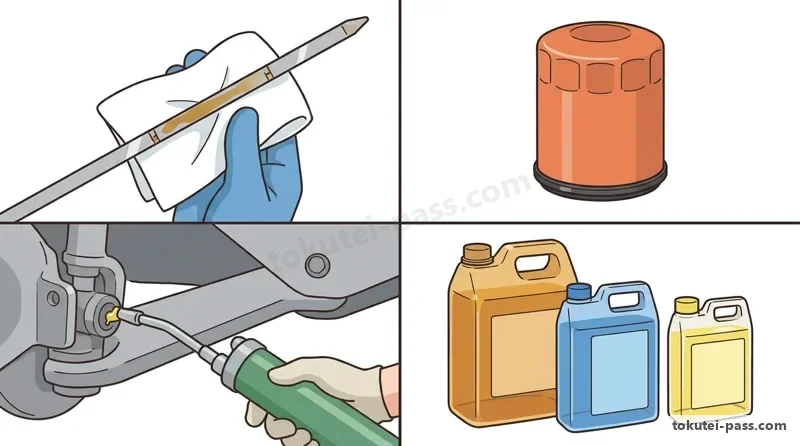
エンジン・オイルには主に5つの重要な作用があります。①金属同士の直接接触を防いで摩擦と摩耗を減らす「潤滑作用(減摩作用)」、②燃焼熱や摩擦熱を吸収して運び去る「冷却作用」、③ピストン・リングとシリンダ壁のすき間をふさいでガス漏れを防ぐ「密封作用」です。
Engine oil performs 5 major functions. (1) Lubrication (friction reduction): prevents direct metal-to-metal contact to reduce friction and wear; (2) Cooling: absorbs and carries away combustion heat and friction heat; (3) Sealing: seals the gap between piston rings and the cylinder wall to prevent gas leakage.
さらに、④エンジン内部で発生したスラッジ(燃えかす)やカーボンを洗い流してオイル中に分散させる「清浄分散作用」、⑤金属表面を油膜で覆って酸や水分による錆を防ぐ「防錆(防食)作用」(および衝撃を和らげる応力分散作用)があります。
Furthermore, it provides: (4) Cleaning and dispersion (detergency): washes away sludge and carbon generated inside the engine and disperses them in the oil; and (5) Rust (corrosion) prevention: coats metal surfaces with an oil film to prevent rust caused by acid and moisture (along with stress dispersion to cushion impacts).
エンジン・オイルの粘度(硬さ)は「SAE粘度分類」で表されます。「5W-30」や「0W-20」のようなマルチグレード・オイルでは、「W(Winter:冬用)」の前の数字が小さいほど低温時に軟らかく冷間始動性に優れ、後ろの数字(30や20)が大きいほど高温時の粘度が高く油膜を保持しやすいことを表します。
Engine oil viscosity (thickness) is expressed by the SAE viscosity classification. In multigrade oils such as 5W-30 or 0W-20, a smaller number before the W (Winter) indicates softer oil at low temperatures and better cold-start performance, while a larger number after the hyphen (30 or 20) indicates higher viscosity at high temperatures for better oil-film retention.
また、品質(API分類)はガソリン車用が「S(SPなど)」、ジーゼル車用が「C(CK-4など)」で始まります。
In addition, API quality classifications begin with S (such as SP) for gasoline engines and C (such as CK-4) for diesel engines.
トランスミッションやディファレンシャルに使う「ギヤ・オイル」は、歯面に高い圧力がかかるため極圧添加剤が含まれ、エンジン・オイルより粘度番号(75W-90など)が大きくなります。
Gear oil used in transmissions and differentials contains extreme-pressure (EP) additives because high pressure acts on gear tooth surfaces, and has larger viscosity numbers (such as 75W-90) than engine oil.
また、グリース(半固体状潤滑剤)は使用部位に応じてシャシ・グリース、ホイール・ベアリング・グリース、ゴムを侵さないラバー・グリース(ブレーキ用)を使い分けます。
Furthermore, greases (semi-solid lubricants) are selected according to application: chassis grease, wheel bearing grease, and rubber grease (for brakes) that does not attack rubber.
Key points
- エンジン・オイルの5大作用は「潤滑作用」「冷却作用」「密封作用」「清浄分散作用」「防錆作用」(+応力分散作用)である
The 5 major functions of engine oil are Lubrication, Cooling, Sealing, Cleaning/dispersion, and Rust prevention (plus stress dispersion) - SAE粘度表示「5W-30」の「W」は冬(Winter)用を意味し、Wの前の数字が小さいほど低温始動性が良く、後ろの数字が大きいほど高温時の粘度が高い
In SAE viscosity rating 5W-30, W stands for Winter; a smaller number before W gives better low-temperature starting, and a larger second number gives higher high-temperature viscosity - ブレーキのゴム部品(カップやブーツ)には、鉱油系グリースではなくゴムを膨潤させないブレーキ用ラバー・グリースを使用する
For rubber brake parts (cups and boots), use brake rubber grease that does not swell rubber rather than mineral-oil-based grease
| Word | Meaning |
|---|---|
| エンジン・オイルの5大作用 | Five major functions of engine oil (Lubrication, cooling, sealing, cleaning/dispersion, and rust prevention) |
| SAE粘度分類(マルチグレード・オイル) | SAE viscosity classification (multigrade oil) (Viscosity grading system such as 5W-30 or 0W-20) |
| 極圧添加剤 | Extreme-pressure (EP) additive (Additive in gear oil that prevents metal seizure under heavy tooth loads) |
| ラバー・グリース(rubber grease) | Rubber grease (Non-mineral grease safe for rubber brake cups and boots) |
ブレーキ液(ブレーキ・フルード)とLLC(ロング・ライフ・クーラント)
Brake Fluid and LLC (Long Life Coolant)
油圧ブレーキに使われる「ブレーキ液(ブレーキ・フルード:DOT3、DOT4など)」は、グリコール・エーテル系の非鉱油系液体です。沸点が高くゴムや金属を侵しにくい性質がありますが、「空気中の水分を吸収しやすい(吸湿性が高い)」という大きな特徴があります。
Brake fluid (DOT3, DOT4, etc.) used in hydraulic brakes is a glycol-ether-based non-mineral liquid. It has a high boiling point and does not deteriorate rubber or metal, but has the major characteristic of easily absorbing moisture from the air (high hygroscopicity).
ブレーキ液が水分を吸収すると沸点が大幅に低下し、下り坂での制動時に沸騰して気泡が生じる「ベーパ・ロック現象」を起こしやすくなります。
When brake fluid absorbs moisture, its boiling point drops significantly, making it prone to boiling during downhill braking and generating air bubbles—causing vapor lock.
そのため、ブレーキ液は保管時にフタを固く閉め、車検ごと(2年ごと)などに定期交換します。また、塗装面を侵すためボデーに付着したら直ちに水で洗い流し、鉱油(エンジン・オイル等)はゴム・カップを膨潤させるため絶対に混ぜてはなりません。
Therefore, keep the brake fluid container tightly capped during storage and replace the fluid periodically (such as every 2 years at vehicle inspection). Also, because brake fluid attacks paint, wash it off immediately with water if spilled on the body, and never mix mineral oil (such as engine oil) as it causes rubber cups to swell.
冷却水に加える「LLC(ロング・ライフ・クーラント:長寿命不凍液)」は、エチレングリコールを主成分とし、それに防錆剤や消泡剤を加えたものです。冷却水が冬に凍ってエンジン・ブロックやラジエータが破損するのを防ぐ「不凍作用」と、冷却水通路の錆を防ぐ「防錆作用」があります。
LLC (Long Life Coolant) added to cooling water consists mainly of ethylene glycol mixed with rust inhibitors and anti-foaming agents. It provides an antifreeze effect that prevents coolant from freezing in winter and cracking the engine block or radiator, and an anti-rust effect that prevents corrosion in coolant passages.
LLCは軟水(水道水や精製水)と混ぜて、地域の最低気温に応じた濃度(通常 30〜60% の範囲)に調整します。濃度を高くするほど凍結温度は下がりますが、60% を超えると逆に凍りやすくなるため、30〜60% の適正濃度で使用します。必要なLLC原液量は「冷却装置の全容量 × LLC濃度(%)」で計算します。
LLC is mixed with soft water (tap water or purified water) to adjust the concentration (typically 30~60%) according to the region's lowest temperature. Higher concentration lowers the freezing temperature, but exceeding 60% actually makes it freeze more easily, so it is used within the proper 30~60% range. Required undiluted LLC volume is calculated by: Total cooling system capacity × LLC concentration (%).
Key points
- ブレーキ液(グリコール系)は吸湿性があり、水分を吸うと沸点が下がってベーパ・ロック現象を起こしやすくなるため定期交換が必要である
Brake fluid (glycol-based) is hygroscopic; absorbing moisture lowers its boiling point and causes vapor lock, so periodic replacement is necessary - ブレーキ液に鉱油(エンジン・オイル等)が混入するとゴム・カップが膨潤して液漏れを起こし、塗装に付くと塗膜が剥がれるため直ちに水洗いする
Contamination of brake fluid with mineral oil (engine oil, etc.) swells rubber cups and causes leaks, and brake fluid on paint strips the coating so wash it off immediately with water - LLC(エチレングリコール主成分)は冷却水の凍結防止と冷却系統の防錆・消泡を行い、濃度 30〜60% の範囲で使用する
LLC (mainly ethylene glycol) prevents coolant freezing, rust, and foaming in the cooling system, and is used at a concentration of 30~60% - 【例】冷却水の全容量が 6.0 L のエンジンで、LLC濃度を 40% にしたい場合、必要なLLC原液量 = 6.0 × 0.40 = 2.4 L(水は 6.0 - 2.4 = 3.6 L)となる
Example: In an engine with a total coolant capacity of 6.0 L, to achieve a 40% LLC concentration, required undiluted LLC = 6.0 × 0.40 = 2.4 L (water = 6.0 - 2.4 = 3.6 L) - 【例】全容量 8.0 L の冷却装置に LLC原液が 2.4 L 入っているとき、LLC濃度 = (2.4 ÷ 8.0) × 100 = 30% となる
Example: When a cooling system with a total capacity of 8.0 L contains 2.4 L of undiluted LLC, the LLC concentration = (2.4 / 8.0) × 100 = 30%
| Word | Meaning |
|---|---|
| ブレーキ液(ブレーキ・フルード) | Brake fluid (Glycol-based hydraulic fluid (DOT3/DOT4) with a high boiling point) |
| 吸湿性 | Hygroscopicity (moisture absorption) (Property of brake fluid absorbing atmospheric moisture, lowering its boiling point) |
| LLC(ロング・ライフ・クーラント) | LLC (Long Life Coolant) (Antifreeze and anti-rust coolant concentrate) |
| エチレングリコール(ethylene glycol) | Ethylene glycol (Primary chemical ingredient in LLC) |
ボデー・フレーム構造(モノコック・衝突安全)と塗装
Body and Frame Structure (Monocoque, Collision Safety) and Painting
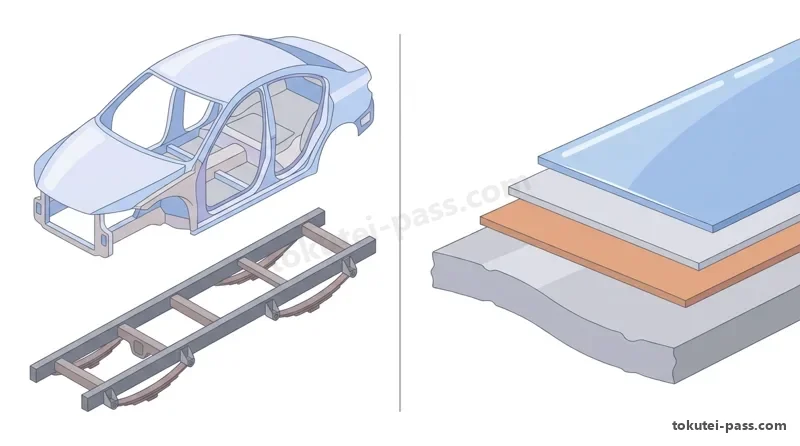
自動車の車体(ボデー)構造は、大きく「フレーム付構造」と「モノコック・ボデー(フレームレス構造)」に分けられます。トラックやクロスカントリー型4WD車に使われる「フレーム付構造(ラダー・フレーム等)」は、強固なはしご形フレームの上にボデーを載せるため、重い荷物や悪路のねじれに強い特徴があります。
Automobile body structures are broadly divided into frame-type structures and monocoque bodies (frameless structures). Frame-type structures (such as ladder frames) used in trucks and cross-country 4WD vehicles mount the body on a rigid ladder-shaped frame, making them strong against heavy loads and rough-road twisting.
一方、乗用車の主流である「モノコック・ボデー(張殻構造)」は、フレームとボデーを一体化し、屋根・ピラー(柱)・フロア・外板パネル全体が殻(シェル)のように荷重を分担して支える構造です。軽量でねん回・曲げ剛性が高く、室内空間を広く取ることができます。
On the other hand, the monocoque body (stressed-skin structure)—mainstream in passenger cars—integrates the frame and body so the roof, pillars, floor, and outer panels share loads together like a shell. It is lightweight, has high torsional and bending rigidity, and allows a spacious cabin.
現代の「衝突安全ボデー」では、高張力鋼板(ハイテン材)を適材適所に配置しています。万一の衝突時に、エンジン・ルームなどの車体前後部はあえて潰れやすくして衝撃エネルギーを吸収する「クラッシャブル・ゾーン」とし、乗員が乗る室内(キャビン)は強固な「セーフティ・ゾーン(高剛性キャビン)」として変形を防ぎます。
Modern collision-safety bodies place high-tensile steel sheets in optimal locations. In a collision, the front and rear sections such as the engine compartment are designed as crushable zones that deform easily to absorb impact energy, while the passenger cabin forms a rigid safety zone (high-rigidity cabin) that resists deformation.
また、ボデーの塗装(ペイント)は、金属の錆(腐食)を防ぐ「防錆」と、美しい外観を保つ「美観・保護」のために行われます。
Additionally, body painting is performed for rust (corrosion) prevention of metal and for aesthetics and surface protection.
基本は、①鉄板への密着性と防錆力を持つ「下塗り(プライマ/電着塗装)」→ ②細かい凹凸を埋めて上塗りの付着を良くする「中塗り(サーフェーサ)」→ ③色とツヤ・耐候性を出す「上塗り(トップ・コート)」の3層構造になっています。
Basically, automotive paint has a 3-coat structure: (1) Undercoat (primer / electrodeposition coat) providing adhesion to steel and rust prevention -> (2) Intermediate coat (surfacer) filling minor unevenness and improving topcoat adhesion -> (3) Topcoat providing color, gloss, and weather resistance.
Key points
- モノコック・ボデー(張殻構造)はフレームとボデーを一体化してボデー全体で外力を受け止めるため、軽量で剛性が高く乗用車に広く使われる
A monocoque body integrates the frame and body to absorb external forces across the entire shell, making it lightweight and highly rigid for passenger cars - 衝突安全ボデーは、車体前後のクラッシャブル・ゾーンが潰れて衝撃エネルギーを吸収し、高剛性キャビンが乗員の生存空間を守る
In a collision-safety body, front and rear crushable zones deform to absorb impact energy while a high-rigidity cabin protects passenger survival space - ボデー塗装は「下塗り(プライマ:防錆・密着)→ 中塗り(サーフェーサ:下地整備)→ 上塗り(トップ・コート:色・ツヤ・耐候性)」の順に行う
Body painting is applied in order: Undercoat (primer: rust prevention/adhesion) -> Intermediate coat (surfacer: surface prep) -> Topcoat (color, gloss, weather resistance)
| Word | Meaning |
|---|---|
| モノコック・ボデー(monocoque body) | Monocoque body (Unitized frame-and-body shell structure used in most passenger cars) |
| クラッシャブル・ゾーン(crushable zone) | Crushable zone (Deformable front/rear body sections that absorb crash energy) |
| 高張力鋼板(ハイテン材) | High-tensile steel sheet (Strong, lightweight steel used to reinforce collision-safety bodies) |
| プライマ・サーフェーサ・トップ・コート | Primer, surfacer, and topcoat (The three sequential layers of automotive body paint) |
整備作業場の安全衛生とジャッキ・リフト作業
Workshop Safety and Hygiene, and Jack / Lift Operations
整備工場における安全と品質の基本は「5S活動」です。5Sとは「整理(いらない物を捨てる)」「整頓(必要な物をすぐ取り出せるよう定位置に置く)」「清掃(ゴミや床の油汚れをきれいに掃除する)」「清潔(整理・整頓・清掃を維持する)」「しつけ(決められた安全ルールを正しく守る習慣)」の5つです。
The foundation of safety and quality in a maintenance shop is the 5S activity: Seiri (Sort: discard unnecessary items), Seiton (Set in order: keep needed items in designated places for quick retrieval), Seiso (Shine: clean up trash and oil stains on the floor), Seiketsu (Standardize: maintain Sort, Set in order, and Shine), and Shitsuke (Sustain: build the habit of following safety rules).
作業着は袖口や裾が締まった適正サイズを着用し、ボデーを傷つけたり回転部に巻き込まれたりしないよう、ベルトのバックルや時計・指輪は外します。また、屋内でエンジンを始動する際は、排気ガス中の無色・無臭で猛毒の「一酸化炭素(CO)中毒」を防ぐため、必ず排気ダクト(ホース)をつなぎ換気を行います。
Wear properly fitted work clothes with snug cuffs and hems, and remove belt buckles, watches, and rings so they do not scratch vehicle bodies or get caught in rotating parts. Also, when starting an engine indoors, always attach an exhaust duct (hose) and ventilate the area to prevent poisoning from colorless, odorless, highly toxic carbon monoxide (CO) in exhaust gas.
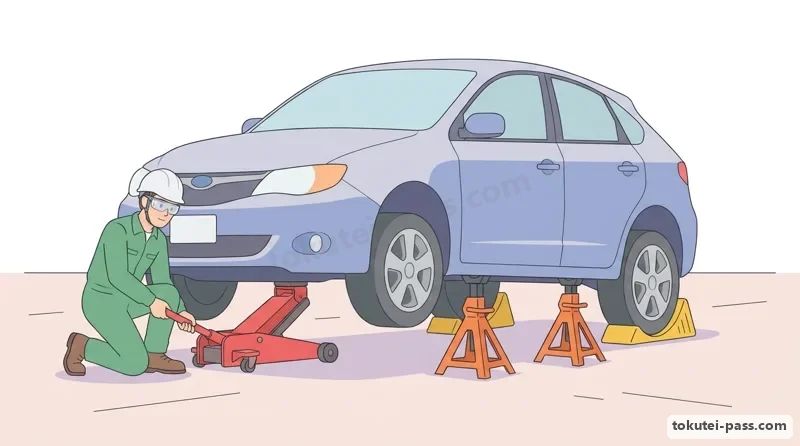
ガレージ・ジャッキで車両を持ち上げる(ジャッキアップする)ときは、平らで硬い床面で行い、接地している残りのタイヤに必ず「輪止め(ストッパ)」を掛けます。そしてメーカー指定の「ジャッキアップ・ポイント」に正確に当てて持ち上げます。
When lifting a vehicle with a garage jack (jacking up), work on a flat, hard floor, always place wheel chocks (stoppers) against the remaining grounded tires, and position the jack accurately on the manufacturer-specified jack-up point.
車体の下に入って作業する場合は、油圧ジャッキだけで支えたまま作業することは落下の危険があるため絶対に禁止です。
When working underneath a raised vehicle, working while supported only by a hydraulic jack is strictly prohibited due to the danger of the vehicle falling.
必ず「リジッド・ラック(うま:車体保持具)」を指定の保持ポイントに設置して車体を預けてから作業します。2柱リフトなどを使うときも、一度タイヤが地面から少し浮いた高さで一旦停止し、車体を揺すって安定していることを確認してから所定の高さまで上げます。
Always place rigid racks (jack stands) under the specified support points to hold the vehicle before working underneath. Likewise, when using a two-post lift, pause once the tires are slightly off the ground and shake the vehicle to confirm stability before raising it to the working height.
Key points
- 屋内でエンジンをかけたまま作業する際は、一酸化炭素(CO)中毒を防ぐため必ず十分な換気を行う
When working indoors with the engine running, always provide sufficient ventilation to prevent carbon monoxide (CO) poisoning - ジャッキアップした車両の下に入って作業するときは、ジャッキだけで支えず必ず「リジッド・ラック(うま)」で車体を保持し、接地輪に輪止めをかける
When working under a jacked-up vehicle, never rely on the jack alone; always support the body with rigid racks (jack stands) and chock the grounded wheels - リフトアップする際は、タイヤが床から少し浮いた位置で一旦停止し、支持位置のずれや不安定がないか確認してから上昇させる
When lifting a vehicle on a lift, pause once the tires clear the floor slightly to check for support misalignment or instability before raising further
| Word | Meaning |
|---|---|
| 5S(整理・整頓・清掃・清潔・しつけ) | 5S (Seiri, Seiton, Seiso, Seiketsu, Shitsuke) (Five workplace organization principles for safety and efficiency) |
| 一酸化炭素(CO)中毒 | Carbon monoxide (CO) poisoning (Deadly poisoning from colorless, odorless exhaust gas indoors) |
| リジッド・ラック(rigid rack:うま) | Rigid rack (jack stand) (Mechanical stand required to support a raised vehicle safely) |
| 輪止め(wheel chock) | Wheel chock (stopper) (Wedge placed against tires to prevent vehicle rolling during jacking) |
廃油・廃液・フロン類と環境保全ルール
Waste Oil, Waste Fluids, Fluorocarbons, and Environmental Protection Rules
自動車整備で排出される廃エンジン・オイル、廃ブレーキ液、廃LLC(不凍液)、廃バッテリ(希硫酸・鉛)、廃タイヤなどは、そのまま下水や土壌に流したり不法投棄したりすることは法律で厳しく禁止されています。種類ごとに専用のタンクや容器に分別して保管し、許可を受けた産業廃棄物処理業者(またはリサイクル業者)に引き渡します。
Waste engine oil, waste brake fluid, waste LLC (antifreeze), waste batteries (dilute sulfuric acid and lead), and waste tires generated during automotive maintenance are strictly prohibited by law from being poured into sewers or soil or illegally dumped. Separate and store them in dedicated tanks or containers by type, and hand them over to licensed industrial waste disposal (or recycling) contractors.
カー・エアコン(冷房装置)の冷媒に使われているフロン類(HFC-134a や HFO-1234yf など)は、大気中に放出すると地球温暖化に大きな影響を与えます。そのため、エアコン修理などで配管を外す際は、大気中に逃がさず必ず専用の「フロン回収装置」を用いて回収しなければなりません。
Fluorocarbons (such as HFC-134a and HFO-1234yf) used as refrigerants in car air conditioners have a major impact on global warming if released into the atmosphere. Therefore, when disconnecting AC pipes for repair, never vent refrigerant into the air; always recover it using a dedicated fluorocarbon recovery machine.
また、エアバッグ(SRS)やシート・ベルト・プリテンショナのインフレータ(ガス発生器)には火薬が使われています。取扱いを誤ると不意に展開(爆発)して重大な事故になるため、整備解説書の手順に従ってバッテリのマイナス端子を外して所定時間経過後に作業し、単体で保管する際はパッド面(展開面)を必ず「上向き」にして置きます。
Additionally, explosives (pyrotechnics) are used in the inflators (gas generators) of SRS airbags and seat belt pretensioners. Because mishandling can cause accidental deployment (explosion) and serious injury, follow the service manual by disconnecting the negative battery terminal and waiting the specified time before working, and always store a removed airbag module with its pad surface (deployment side) facing upward.
ハイブリッド車(HV)や電気自動車(EV)には、数百ボルトの「高電圧回路(オレンジ色のハーネスで識別される)」が搭載されています。感電事故を防ぐため、高電圧部位の整備では絶縁手袋を着用して「サービス・プラグ(安全プラグ)」を引き抜き、電源遮断後に所定時間待って電圧が 0 V であることを確認してから作業します。
Hybrid vehicles (HVs) and electric vehicles (EVs) are equipped with high-voltage circuits of several hundred volts (identified by orange wiring harnesses). To prevent electric shock, wear insulated gloves when servicing high-voltage parts, pull out the service plug (safety plug), wait the specified time after shutting off power, and verify that voltage is 0 V before working.
Key points
- 廃オイル・廃LLC・廃ブレーキ液などは下水に流さず分別保管し、カー・エアコンのフロン類は大気放出せず回収装置で回収する
Never pour waste oil, waste LLC, or waste brake fluid into sewers; store them separately, and recover car AC refrigerants with a recovery machine rather than venting to the air - 取り外したエアバッグ・モジュールを置くときは、万一作動したときに本体が飛び上がらないよう必ずパッド面(表面)を「上向き」にする
When placing a removed airbag module down, always place it with the pad surface (front face) facing upward so the unit will not launch into the air if accidentally deployed - HV・EVの高電圧配線は「オレンジ色」で識別されており、整備時は絶縁手袋を着用してサービス・プラグを抜く
High-voltage wiring in HVs and EVs is identified by its orange color; wear insulated gloves and remove the service plug before maintenance
| Word | Meaning |
|---|---|
| 産業廃棄物 | Industrial waste (Regulated waste (oil, fluids, batteries) that must go to licensed processors) |
| フロン回収装置 | Fluorocarbon recovery unit (Equipment required to capture AC refrigerant without atmospheric release) |
| SRSエアバッグ(パッド面上向き保管) | SRS airbag (store pad-side up) (Always store removed airbag modules with the deployment pad facing upward) |
| 高電圧配線(オレンジ色)・サービス・プラグ | High-voltage wiring (orange) and service plug (Orange harnesses denote HV circuits; wear insulated gloves to pull the service plug) |
試験によく出るポイントと覚え方
High-Frequency Exam Points and How to Remember Them
材料分野では、「炭素鋼は炭素量が増えるほど硬く強くなるが、伸び・靭性(粘り)が減る」「焼き入れ=急冷して硬くする、焼き戻し=粘り強さを与える」「アルミ合金=鉄の約1/3の重さで熱伝導性が良い」「フロント・ガラス=合わせガラス(強化ガラスは×)」が定番問題です。
In the materials section, classic exam items are: Carbon steel becomes harder and stronger as carbon increases, but elongation and toughness decrease; Quenching = rapid cooling to harden, Tempering = imparts toughness; Aluminum alloy = about 1/3 the weight of iron with good thermal conductivity; Front windshield = laminated glass (tempered glass is False).
燃料と油脂では、「ガソリン蒸気は空気より重く低い場所に溜まる」「エンジン・オイル 5W-30 のW=冬用(前の数字が小さいほど低温始動性が良い)」「ブレーキ液=グリコール系・吸湿性があり水分を吸うと沸点が下がる・塗装を侵す」「LLC=エチレングリコール主成分・不凍と防錆」を確実に覚えましょう。
For fuels and lubricants, memorize thoroughly: Gasoline vapor is heavier than air and collects in low places; W in 5W-30 engine oil = Winter (smaller first number means better cold starting); Brake fluid = glycol-based, hygroscopic (boiling point drops when it absorbs water), damages paint; LLC = mainly ethylene glycol, provides antifreeze and anti-rust protection.
ボデーと塗装では、「乗用車の主流=フレームとボデーが一体のモノコック・ボデー」「衝突安全=前後は潰れて衝撃吸収(クラッシャブル・ゾーン)、室内は高剛性キャビン」「塗装の順=下塗り(プライマ)→中塗り(サーフェーサ)→上塗り(トップ・コート)」を押さえます。
For body and painting, remember: Passenger car mainstream = unitized monocoque body; Collision safety = front and rear crushable zones absorb impact, passenger compartment is a high-rigidity cabin; Painting order = Undercoat (primer) -> Intermediate coat (surfacer) -> Topcoat.
安全作業では、「ジャッキだけで車体の下に入るのは絶対禁止(必ずリジッド・ラックを使う)」「屋内エンジン始動は一酸化炭素(CO)中毒防止のため換気」「外したエアバッグはパッド面を上向きに置く」「HV・EVの高電圧配線はオレンジ色」が頻出ポイントです。
For workshop safety, frequent exam points are: Never get under a vehicle supported only by a jack (always use rigid racks); Ventilate indoors when running an engine to prevent CO poisoning; Store a removed airbag with the pad facing upward; High-voltage wiring in HVs/EVs is orange.
Key points
- 炭素鋼=炭素が増えると硬くなるが靭性が減る / 焼き入れ=硬くする、焼き戻し=粘り強さを与える / フロント・ガラス=合わせガラス
Carbon steel = more carbon increases hardness but lowers toughness / Quenching = hardens, Tempering = adds toughness / Windshield = laminated glass - ガソリン蒸気は空気より重く床に溜まる / 5W-30のW=冬用(数字が小さいほど低温始動性良好)
Gasoline vapor is heavier than air and pools on the floor / W in 5W-30 = Winter (smaller number = better cold starting) - ブレーキ液は吸湿すると沸点が下がりベーパ・ロックの原因になる / LLC量=全冷却水量×濃度(%)
Brake fluid absorbs moisture, lowering boiling point and causing vapor lock / LLC volume = Total coolant capacity × Concentration (%) - モノコック・ボデーはフレームとボデーが一体 / 塗装は「下塗り(プライマ)→中塗り(サーフェーサ)→上塗り」の順
Monocoque body integrates frame and body / Paint order: Undercoat (primer) -> Intermediate coat (surfacer) -> Topcoat - 車体下の作業は必ずリジッド・ラックで支える / 外したエアバッグはパッド面を上向き / HV高電圧配線はオレンジ色
Always support under-vehicle work with rigid racks / Place removed airbags pad-side up / HV high-voltage harnesses are orange
| Word | Meaning |
|---|---|
| モノコック(張殻構造) | Monocoque (stressed-skin structure) (Frameless body construction where the body shell carries structural loads) |
| 膨潤 | Swelling (of rubber) (Deformation of brake rubber cups caused by mineral oil contamination) |
| 不凍・防錆作用 | Antifreeze and anti-rust action (The two primary functions of Long Life Coolant (LLC)) |
Materials, Fuels, Lubricants & Body
Practice this chapter in the appOfficial references
- 一般社団法人 日本自動車整備振興会連合会(JASPA)「自動車整備分野特定技能評価試験 学習用テキスト(三級自動車整備士講習用テキスト準拠)」 — https://www.jaspa.or.jp/
- 国土交通省 物流・自動車局「自動車整備分野特定技能1号評価試験 試験実施要領」 — https://www.mlit.go.jp/jidosha/jidosha_fr10_000041.html