
Laws and Regulations on the Safety of General Electrical Installations
一般用電気工作物等の保安に関する法令
Class 2 Electrician 第二種電気工事士 (written exam) · 第二種電気工事士(学科試験) · Written by Tokutei Pass based on the official study texts; not copied verbatim.
電気工事士法①:電気工事士でなければできない作業
Electricians Act ①: Work That Only a Licensed Electrician May Perform
「電気工事士法」は、電気工事の欠陥による災害の発生を防止するため、電気工事に従事する者の資格および義務を定めた法律です。資格を持たずにこれらの作業を行うと、罰則の対象になります。
The Electricians Act (電気工事士法) establishes the qualifications and obligations of persons engaging in electrical construction work in order to prevent disasters caused by defective electrical work. Doing this work without the licence is subject to penalties.
「一般用電気工作物等(家庭や小規模店舗など)」の電気工事は、「第一種電気工事士」または「第二種電気工事士」の免状を持つ人でなければ作業に従事できません。
Electrical construction work on General Electrical Installations (such as private homes and small shops) may only be performed by persons holding a First-Class Electrician or Second-Class Electrician license.
なお、「自家用電気工作物(最大電力500kW未満の工場・ビルなど)」の工事は、原則として「第一種電気工事士」または「認定電気工事従事者(低圧部分のみ)」でなければ従事できません。
Note that construction work on Private Electrical Installations (such as factories and buildings with a maximum power under 500kW) may in principle only be performed by a First-Class Electrician or a Certified Electrical Construction Worker (for the low-voltage portion only).
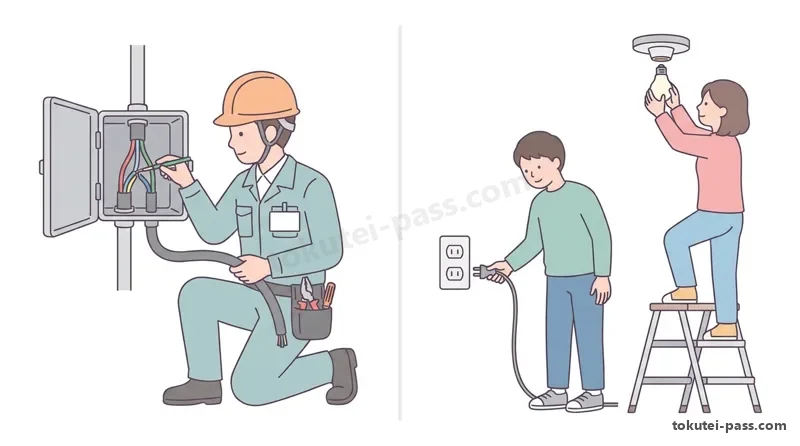
電気工事士でなければ絶対にできない代表的な作業は、①電線相互を接続する作業、②電線を造営材(柱・壁)に直接固定する作業、③電線管・ダクト・モールに電線を収める作業です。
Representative tasks that only a licensed electrician may perform include: ① Connecting electrical wires to one another; ② Fastening electrical wires directly to building structures (pillars, walls); ③ Installing wires inside conduits, ducts, or raceways (moldings).
さらに、④アウトレットボックスや配電盤・分電盤を造営材に取り付ける作業、⑤電線管を曲げたり接続したり建物を貫通させたりする作業、⑥接地極を地面に埋設する作業も必ず資格が必要です。
Furthermore: ④ Mounting outlet boxes, switchboards, or distribution boards to building structures; ⑤ Bending or joining conduits or passing conduits through building walls/floors; and ⑥ Burying grounding electrodes in the earth all strictly require an electrician's license.
Key points
- 一般用電気工作物等の工事は、第一種または第二種電気工事士でなければできない
Electrical work on general electrical installations may only be performed by a First-Class or Second-Class Electrician - 電線相互の接続、電線管への電線収容、ボックス・分電盤の取付は有資格者のみ
Splicing wires together, pulling wires into conduits, and mounting boxes or distribution boards require a license - 電線管の曲げ・接続・貫通工事や、接地極を地面に埋設する作業も資格が必要
Bending, joining, or penetrating walls with conduits and burying grounding electrodes in the ground also require a license
| Word | Meaning |
|---|---|
| 電気工事士法 | Electricians Act |
| 一般用電気工作物等 | General Electrical Installations (homes, small shops, etc.) |
| 自家用電気工作物 | Private Electrical Installations (factories, large buildings) |
| 免状 | license (official certificate) |
電気工事士法②:軽微な工事(6種類)と免状の義務
Electricians Act ②: Minor Work (6 Categories) and License Obligations
危険性が少ない「軽微な工事(6種類)」は、電気工事士の資格がなくても誰でも行うことができます。試験で毎年必ず出題される最重要ポイントです。
Six categories of low-risk Minor Work (軽微な工事) may be performed by anyone without an electrician's license. This is a top-priority topic tested every single year.
軽微な工事の①〜③は、「電圧600V以下で使用する」次の作業です。①差込接続器(コンセント・プラグ)やねじ込み接続器(ソケット)に「コードまたはキャブタイヤケーブル」を接続する工事(壁の埋込コンセント自体の交換は資格が必要です)。
Categories ① to ③ of Minor Work apply to work used at 600V or less: ① Connecting flexible cords or cabtyre cables to attachment plugs/receptacles or screw sockets (note that replacing a flush-mounted wall receptacle itself requires a license).
②電気機器(開閉器を除く)や蓄電池の端子に電線(コードを含む)を「ねじ止め」する工事。③電力量計(WHM)、電流制限器、ヒューズを取り付け・取り外しする工事です。
② Screwing wires (including cords) onto the terminals of electrical equipment (excluding switches/breakers) or storage batteries. ③ Installing or removing watt-hour meters (WHM), current limiters, or fuses.
軽微な工事の④〜⑥は、④インターホンやベルなど最大電圧「36V以下」の小勢力回路の電線工事、⑤電線を支持する柱や腕木を設置する工事、⑥地中電線用の暗渠(トラフ)や管を設置する工事です。
Categories ④ to ⑥ of Minor Work are: ④ Wiring work for small-power circuits such as intercoms or bells with a maximum voltage of 36V or less; ⑤ Installing poles or crossarms that support wires; and ⑥ Installing underground troughs (culverts) or pipes for underground cables.
電気工事士免状は「都道府県知事」が交付します。工事士は作業中に免状を「携帯」する義務があります。また、「氏名」が変わったときは書換え申請が必要ですが、「住所」が変わったときは書換え申請は不要です(超頻出のひっかけです)。
An electrician's license is issued by the Prefectural Governor (都道府県知事). An electrician is obligated to carry the license on their person while performing electrical work. Additionally, an application for re-inscription is required when your Name changes, but NO application is required when your Address changes (a classic exam trap).
Key points
- 600V以下の差込接続器へのコード接続、機器(開閉器除く)へのねじ止めは「資格不要」
Connecting cords to plugs/sockets and screwing wires to equipment terminals (excluding switches) at 600V or less require NO license - 電力量計・ヒューズの取付取外し、および36V以下のインターホン等の配線も「資格不要」
Attaching/removing watt-hour meters or fuses and wiring intercoms/bells at 36V or less also require NO license - 免状は「都道府県知事」が交付し、電気工事の作業中は必ず「携帯」しなければならない
The license is issued by the Prefectural Governor and must be carried on your person while performing electrical work - 免状の「氏名変更」は書換え申請が必要だが、「住所変更」は書換え不要
A Name change requires a license rewrite application, whereas an Address change does NOT require rewriting
| Word | Meaning |
|---|---|
| 軽微な工事 | minor work (work not requiring an electrician's license) |
| 都道府県知事 | Prefectural Governor |
| 携帯義務 | obligation to carry one's license while working |
| 書換え申請 | application to rewrite/update license details |
電気事業法:一般用電気工作物等の定義と調査の義務
Electricity Business Act: Definition of General Electrical Installations and Inspection Duties
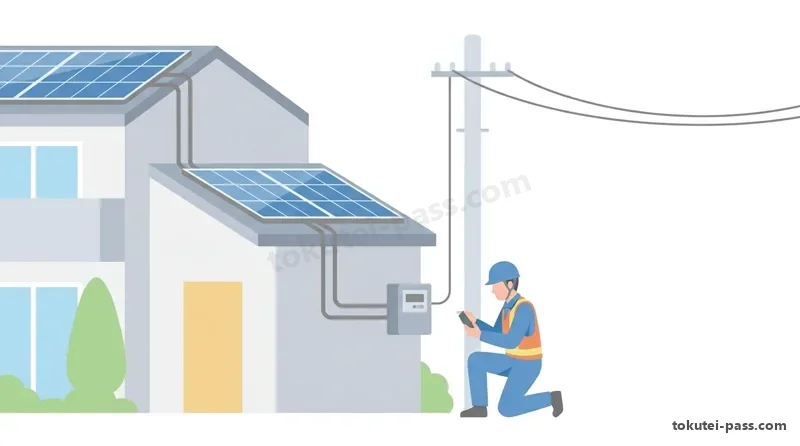
「電気事業法」では、一般家庭や商店などの電気設備を「一般用電気工作物」として定義しています。その条件は、「低圧(交流600V以下・直流750V以下)」で受電し、受電構内以外と電線路でつながっていないものです。
Under the Electricity Business Act (電気事業法), electrical installations in ordinary homes and small shops are defined as General Electrical Installations (一般用電気工作物). They must receive power at Low Voltage (600V AC or less, 750V DC or less) and have no power lines extending outside the premises.
構内に小出力発電設備がある場合、太陽電池発電設備は「出力50kW未満」(10kW以上50kW未満は小規模事業用電気工作物)、風力・水力発電は「20kW未満」、内燃力(エンジン)は「10kW未満」で、合計50kW未満のものが一般用電気工作物等に含まれます(火薬類工場や炭鉱は除く)。
When small-output power generation equipment is installed on the premises, the limits are: solar power generation under 50kW (10kW to under 50kW is classified as a Small-Scale Business Electrical Installation), wind or hydro power under 20kW, internal combustion engines under 10kW, and a combined total output under 50kW (excluding explosives factories and coal mines).
一般用電気工作物の所有者には電気主任技術者の選任義務はありません。その代わり、そこに電気を供給する者(一般送配電事業者等)または登録調査機関(電気保安協会など)に、技術基準に適合しているか「調査(点検)」を行う義務があります。
Owners of general electrical installations are not required to appoint a Chief Electrical Engineer. Instead, the electricity supplier (general transmission and distribution utility, etc.) or a Registered Inspection Body (such as an Electrical Safety Inspection Association) is obligated to inspect whether the installation conforms to technical standards.
この調査は、設置・変更が完了したときのほか、原則「4年に1回以上」行われます。なお、電気工事業を営むには「電気工事業法」に基づく登録と主任電気工事士(実務3年以上の第二種または第一種)の設置が必要です。
This periodic inspection is conducted upon completion of installation or modification and, in principle, at least once every 4 years (or once every 1 or 5 years depending on conditions). Furthermore, operating an electrical construction business requires registration under the Electrical Construction Business Act and the appointment of a Chief Electrician (a Second-Class Electrician with at least 3 years of practical experience, or a First-Class Electrician).
Key points
- 一般用電気工作物は「低圧(AC600V以下・DC750V以下)」で受電する家庭・商店などの設備
General electrical installations receive power at Low Voltage (600V AC or less, 750V DC or less) in homes, shops, etc. - 小出力発電の上限は、太陽電池50kW未満・風力20kW未満・内燃力10kW未満(合計50kW未満)
Small-output generation limits: solar under 50kW, wind under 20kW, internal combustion under 10kW (total under 50kW) - 一般用電気工作物の調査は、電気供給者または登録調査機関が原則「4年に1回以上」行う
Inspections of general electrical installations are performed by the power utility or registered body at least once every 4 years in principle - 電気工事業の主任電気工事士になるには、第二種免状取得後「3年以上」の実務経験(または第一種)が必要
Becoming a Chief Electrician for a contractor requires at least 3 years of practical experience after obtaining a Second-Class license (or a First-Class license)
| Word | Meaning |
|---|---|
| 電気事業法 | Electricity Business Act |
| 小出力発電設備 | small-output power generation equipment |
| 登録調査機関 | registered inspection body |
| 主任電気工事士 | Chief Electrician (supervising electrician at a contractor) |
電気用品安全法(PSEマーク):特定電気用品とそれ以外
Electrical Appliances and Materials Safety Act (PSE Mark): Specified vs. Non-Specified
「電気用品安全法」は、粗悪な電気製品による火災や感電を防ぐ法律です。対象となる電気用品には「PSEマーク」の表示が義務づけられており、電気工事士はPSEマークのない電気用品を工事に使用してはなりません。
The Electrical Appliances and Materials Safety Act (電気用品安全法) prevents fires and electric shocks caused by substandard electrical products. Regulated products must display the PSE mark, and electricians are strictly prohibited from using regulated electrical materials that lack the PSE mark in construction work.
電気用品は2種類に分かれます。特に危険性が高く第三者検査機関の適合性検査が必要な「特定電気用品」には、「ひし形のPSEマーク(<PS>E)」が付きます。
Regulated items are divided into two categories. Specified Electrical Appliances and Materials (特定電気用品), which pose higher risks and require conformity inspection by a third-party body, bear the diamond-shaped PSE mark <PS>E.
特定電気用品(ひし形<PS>E)の代表例は、①電線類(IV・HIV電線、断面積22mm²以下のVVF・VVR・CVケーブル、ビニルコード、キャブタイヤケーブル)、②ヒューズ類(管形ヒューズ・配線用ヒューズ)です。
Representative Specified Electrical Appliances and Materials (diamond <PS>E) include: ① Wires and cables (IV and HIV wires; VVF, VVR, and CV cables with a cross-section of 22mm² or less; vinyl cords; cabtyre cables); and ② Fuses (cartridge fuses, wiring fuses).
さらに、③定格電流100A以下の配線器具・遮断器(タンブラスイッチ、タイムスイッチ、コンセント、差込形コネクタ、配線用遮断器、漏電遮断器)、④小型単相変圧器(チャイム用やリモコン変圧器)もすべて「特定電気用品(ひし形)」です。
Furthermore: ③ Wiring devices and circuit breakers rated at 100A or less (tumbler switches, time switches, receptacles, push-in connectors, molded-case circuit breakers, earth leakage breakers); and ④ Small single-phase transformers (bell and remote-control transformers) are all Specified items (diamond <PS>E).
一方、「特定電気用品以外」には「丸形のPSEマーク((PS)E)」が付きます。代表例は、①電線管・ボックス類(金属管、VE・PF・CD管等)、②カバー付ナイフスイッチ、電磁開閉器、③換気扇、LEDランプ、蛍光灯、三相誘導電動機、進相コンデンサなどです(リングスリーブは対象外=JIS品)。
Conversely, Non-Specified Electrical Appliances and Materials carry the round PSE mark (PS)E. Representative examples include: ① Conduits and boxes (metal conduits, VE, PF, and CD conduits, outlet boxes); ② Covered knife switches and electromagnetic contactors; ③ Ventilating fans, LED lamps, fluorescent lamps, three-phase induction motors, and power capacitors (note: ring sleeves are outside the scope of the PSE Act and carry the JIS mark instead).
Key points
- 特定電気用品は「ひし形<PS>E」、特定電気用品以外は「丸形(PS)E」のマークが付く
Specified items carry the diamond <PS>E mark; Non-Specified items carry the round (PS)E mark - ひし形(特定):電線・ケーブル(22mm²以下)・コード、ヒューズ、スイッチ・コンセント・コネクタ、配線用遮断器・漏電遮断器
Diamond <PS>E (Specified): wires, cables (22mm² or less), cords, fuses, switches, outlets, push-in connectors, MCCBs, and ELBs - 丸形(特定以外):電線管(金属管・VE管・PF管)・ボックス類、カバー付ナイフスイッチ、換気扇・LED照明・モータ
Round (PS)E (Non-Specified): conduits (metal, VE, PF), boxes, covered knife switches, ventilating fans, LED lights, and motors - 電気工事士は、所定のPSEマークが付いていない電気用品を電気工事に使用してはならない
Electricians must never use regulated electrical materials lacking the required PSE mark in electrical construction
| Word | Meaning |
|---|---|
| 電気用品安全法 | Electrical Appliances and Materials Safety Act (PSE Act) |
| 特定電気用品 | Specified Electrical Appliances and Materials (diamond <PS>E) |
| 適合性検査 | conformity assessment / inspection |
電気設備に関する技術基準を定める省令(電圧区分と保安原則)
Ministerial Ordinance on Technical Standards for Electrical Equipment (Voltage Classes & Safety)
「電気設備に関する技術基準を定める省令(電技省令)」では、電圧を「低圧」「高圧」「特別高圧」の3つに区分しています。
The Ministerial Ordinance on Technical Standards for Electrical Equipment (電技省令) classifies voltages into three categories: Low Voltage (低圧), High Voltage (高圧), and Extra-High Voltage (特別高圧).
「低圧」は、「直流にあっては750V以下、交流にあっては600V以下」のものです。「高圧」は、低圧を超え「7,000V以下(交直とも)」のものです。「特別高圧」は、「7,000Vを超える」ものです。「直流の方が750Vで交流600Vより少し高い」という点が頻出です。
Low Voltage is 750V or less for DC, and 600V or less for AC. High Voltage exceeds Low Voltage up to 7,000V or less (for both AC and DC). Extra-High Voltage exceeds 7,000V. The fact that DC Low Voltage extends up to 750V while AC is 600V is a frequent exam question.
保安の原則として、①電線や電気機械器具を施設する際は、通常の使用状態において「人に危険を及ぼすおそれがないよう」に施設しなければなりません。
As fundamental safety principles: ① Wires and electrical equipment must be installed so that they pose no risk of danger to persons under normal operating conditions.
②電路の「中性線(単相3線式の白線)」や「接地線(アース線)」には、いかなる場合も過電流遮断器(ヒューズや単極ブレーカ)を取り付けてはなりません(中性線が切れると100V機器に200Vがかかり焼損するためです)。
② Overcurrent circuit breakers (such as fuses or single-pole breakers) must never under any circumstances be installed in the neutral wire (white wire of a single-phase 3-wire circuit) or the grounding wire (because an open neutral applies 200V across 100V appliances and burns them out).
③高圧または特別高圧の電路と低圧の電路を結合する変圧器には、混触による危険を防ぐため、低圧側の中性点(または1端子)に「B種接地工事」を施さなければなりません。
③ On transformers coupling a High-Voltage (or Extra-High-Voltage) circuit with a Low-Voltage circuit, Class B grounding work must be applied to the neutral point (or one terminal) on the low-voltage side to prevent danger from high/low-voltage contact.
Key points
- 低圧は「直流750V以下・交流600V以下」、高圧は低圧を超え「7,000V以下」、特別高圧は「7,000V超」
Low Voltage: 750V DC or less, 600V AC or less; High Voltage: over Low Voltage up to 7,000V; Extra-High Voltage: over 7,000V - 中性線および接地線には、過電流遮断器(ヒューズ等)を絶対に施設してはならない
Never install overcurrent breakers (fuses, etc.) in a neutral wire or grounding wire - 高圧と低圧の混触による危険を防ぐため、変圧器の低圧側には「B種接地工事」を施す
Apply Class B grounding to the low-voltage side of a transformer to prevent danger from high-to-low voltage contact
| Word | Meaning |
|---|---|
| 低圧 | Low Voltage (<= 750V DC, <= 600V AC) |
| 高圧 | High Voltage (above Low Voltage up to <= 7,000V) |
| 特別高圧 | Extra-High Voltage (above 7,000V) |
| 混触 | contact / fault between higher and lower voltage circuits |
外国人受験者のための受験ガイド:筆記方式と「ふりがな(ルビ)対応」申請
Exam Guide for Foreign Examinees: Paper Exam vs. CBT and Applying for Furigana (Ruby)
第二種電気工事士の学科試験は、上期と下期の年2回実施され、パソコン画面で受験する「CBT方式」と、紙の問題用紙・マークシートで受験する「筆記方式」のどちらかを選ぶことができます。
The Second-Class Electrician written exam is held twice a year (first half and second half), and examinees can choose between the computer-based CBT format and the paper-and-mark-sheet Written (Paper) format (筆記方式).
ここで外国人受験者にとって一番大切な情報があります。一般財団法人電気技術者試験センターでは、漢字の読み書きが苦手な外国人などのために、問題文のすべての漢字に「ふりがな(ルビ)」が振られた問題用紙を配布する「援助措置(ルビ対応)」を実施しています。
Here is the most important piece of information for foreign examinees: the Electrical Engineers Examination Center (ECTC) offers Special Assistance (援助措置 - ルビ対応) that provides a question booklet with furigana (phonetic ruby readings) printed above every single kanji character for foreign examinees who find reading kanji difficult.
ただし、パソコンを使う「CBT方式」では画面の仕様上、漢字にふりがな(ルビ)を振ることができません。そのため、ふりがな付きの問題で受験したい場合は、インターネット申込のときからCBT方式に変更せず、必ず紙の「筆記方式」を選択してください。
However, due to system display limitations, furigana CANNOT be displayed on the computer screen in the CBT format. Therefore, if you wish to take the exam with full furigana readings, do not switch to CBT when applying online—you must select the paper-based Written format (筆記方式).
申込受付期間中に電気技術者試験センターのマイページから「援助措置申請(ルビ対応)」を手続きすれば、試験当日に全漢字ふりがな付きの問題冊子で受験できます。また、学科試験に一度合格すれば、万一その回の技能試験で不合格になっても、次回の試験では「学科試験が免除」され技能試験から再受験できます。
By submitting the Special Assistance Application (Ruby Support / 援助措置申請・ルビ対応) through My Page on the Examination Center website during the application window, you will receive a full-furigana question booklet on exam day. Furthermore, once you pass the written exam, even if you fail the practical skill exam in that session, you are exempt from the written exam in the next session and can retry from the practical exam.
Key points
- 学科試験にはパソコンで受ける「CBT方式」と紙で受ける「筆記方式」がある
The written exam offers two formats: computer-based CBT (CBT方式) and paper-based Written format (筆記方式) - CBT方式では漢字にふりがな(ルビ)を振ることができないため、ふりがな希望者は必ず「筆記方式」を選ぶ
Because the CBT format cannot display furigana on kanji, examinees who want furigana must select the paper Written format (筆記方式) - 申込時にマイページから「援助措置申請(ルビ対応)」を行えば、全漢字ふりがな付き問題用紙で受験できる
Applying for Special Assistance (Ruby support / 援助措置申請) on My Page provides a question booklet with furigana on all kanji - 学科試験に合格すれば、その回の技能試験が不合格でも次回は「学科試験免除」となる
Passing the written exam grants an exemption from the written exam in the next session if you fail the practical exam
| Word | Meaning |
|---|---|
| 筆記方式 | paper-based written exam format |
| CBT方式 | Computer-Based Testing (CBT) format |
| 援助措置申請 | application for special assistance (furigana/ruby booklet request) |
| 学科試験免除 | written exam exemption (for the following exam session) |
試験によく出るポイントと覚え方
Frequent Exam Points and Memory Tricks
電気工事士法の「軽微な工事(資格不要)」は、「①差込・ねじ込み接続器にコード接続、②機器(開閉器除く)端子にねじ止め、③電力量計・ヒューズ着脱、④36V以下のベル等配線、⑤柱・トラフ設置」だけ覚え、電線相互の接続・ボックス取付・接地極埋設はすべて「資格必要」と判別します。
Law and regulation questions (4 to 5 questions every year) require the least memorization and are the easiest place to score full marks. For Minor Work (no license needed), just memorize five patterns: ① Connecting cords to plugs/sockets, ② Screwing wires to equipment terminals (except switches), ③ Attaching/removing watt-hour meters or fuses, ④ Wiring bells/intercoms at 36V or less, and ⑤ Setting poles or underground troughs; everything else—splicing wires together, mounting boxes, burying ground electrodes—requires a license.
PSEマークは、「電線・ケーブル・コード・ヒューズ・スイッチ・コンセント・ブレーカ・コネクタ」の『主役パーツ』が「特定電気用品=ひし形<PS>E」、『電線管(VE・PF・金属管)・ボックス・カバー付ナイフスイッチ・換気扇・モータ・コンデンサ』が「特定以外=丸形(PS)E」と分けると一発で解けます。
To distinguish PSE marks instantly: Core current-carrying parts that easily generate heat—Wires, cables, cords, fuses, switches, outlets, breakers, and push-in connectors—are Specified items with the diamond <PS>E mark; whereas enclosures and appliances—Conduits (VE, PF, metal), boxes, covered knife switches, fans, motors, and capacitors—are Non-Specified items with the round (PS)E mark.
免状のルールは「知事が交付・作業中は携帯・氏名変更は書換え必要・住所変更は書換え不要」、低圧の範囲は「直流750V以下・交流600V以下」と確実に押さえましょう。
For license rules, lock in: Issued by the Prefectural Governor, carry while working, Name change requires rewrite, Address change does NOT require rewrite; and Low Voltage is 750V DC or less, 600V AC or less.
Key points
- 資格不要(軽微な工事):プラグへのコード接続、機器端子へのねじ止め、WHM・ヒューズの着脱、36V以下の配線
No license needed (Minor Work): connecting cords to plugs, screwing wires to terminals, attaching/removing WHM or fuses, wiring <= 36V - 免状ルール:都道府県知事が交付、作業中は携帯義務、氏名変更は書換え必要、「住所変更は書換え不要」
License rules: issued by Prefectural Governor, must carry while working, Name change requires rewrite, Address change does NOT - ひし形<PS>E(特定):IV線・VVFケーブル(22mm²以下)・コード、ヒューズ、スイッチ・コンセント・ブレーカ・差込形コネクタ
Diamond <PS>E (Specified): IV wires, VVF cables (<= 22mm²), cords, fuses, switches, outlets, breakers, push-in connectors - 丸形(PS)E(特定以外):電線管(金属管・VE管・PF管)・ボックス、カバー付ナイフスイッチ、換気扇・LED・モータ
Round (PS)E (Non-Specified): conduits (metal, VE, PF), boxes, covered knife switches, ventilating fans, LEDs, motors - 低圧の定義:直流750V以下・交流600V以下(一般用電気工作物の太陽電池は50kW未満・風力20kW未満)
Low Voltage definition: <= 750V DC, <= 600V AC (general installations allow solar < 50kW, wind < 20kW)
| Word | Meaning |
|---|---|
| ひし形PSEマーク | diamond PSE mark <PS>E (Specified items) |
| 丸形PSEマーク | round PSE mark (PS)E (Non-Specified items) |
| 住所変更 | change of address (does not require rewriting the license) |
Electrical Safety Laws
Practice this chapter in the appOfficial references
- 経済産業省「電気工事士法」「電気事業法」「電気用品安全法」「電気工事業の業務の適正化に関する法律」 — https://www.meti.go.jp/policy/safety_security/industrial_safety/sangyo/electric/
- 一般財団法人 電気技術者試験センター「第二種電気工事士試験 受験案内・援助措置申請(ルビ対応)」 — https://www.shiken.or.jp/