
Cost Management Fundamentals
原価管理基礎
Production Management Planning Grade 3 生産管理プランニング (BC検定) · ビジネス・キャリア検定 生産管理プランニング3級 · Written by Tokutei Pass based on the official study texts; not copied verbatim.
1. 原価管理の体系(原価企画・原価維持・原価改善)と原価計算の目的
1. The Cost Management System (Target Costing, Cost Maintenance, Cost Kaizen) and Purposes of Cost Accounting
「原価(コスト)」とは、企業が製品を生産・販売するために消費した経済価値(財貨やサービス)を貨幣額で表したものです。
"Cost" is the monetary expression of the economic value (goods and services) consumed by a company in order to produce and sell products.
「原価管理」とは、単に過去の実際原価を計算するだけでなく、目標となる「標準原価(目標原価)」を設定し、「実際原価」との差異を分析してムダを排除し、原価を引き下げる一連のPDCA活動を指します。
"Cost Management" is not merely calculating past actual costs; it refers to the continuous PDCA cycle of setting a target "Standard Cost (Target Cost)," analyzing variances against "Actual Cost," and eliminating waste to reduce costs.
現代の総合的な原価管理は、①新製品の企画・設計段階で原価を作り込む「原価企画」、②量産段階で標準原価を達成・維持する「原価維持」、③量産段階でさらなる原価低減のため標準そのものを改定・引き下げる「原価改善」の3段階で構成されます。
Modern comprehensive cost management consists of three stages: ① "Target Costing (Genka Kikaku)," which builds cost into the product at the new-product planning and design stage; ② "Cost Maintenance (Genka Iji)," which achieves and maintains standard cost during mass production; and ③ "Cost Improvement (Genka Kaizen)," which revises and lowers the standard itself for further cost reduction.
なお「原価計算の目的」には、①財務諸表(損益計算書・貸借対照表)の作成、②価格決定(売価の算定)、③原価管理(コストコントロール)、④予算編成および予算統制、⑤経営の基本計画の意思決定(設備投資や内外製区分など)の5つがあります。
The "Five Purposes of Cost Accounting" are: ① Preparing financial statements (Income Statement and Balance Sheet), ② Determining selling prices, ③ Cost control (cost management), ④ Budgeting and budgetary control, and ⑤ Basic management decision-making (such as equipment investment or make-or-buy decisions).
Key points
- 原価管理=標準(目標)原価の設定→実際原価との差異分析→改善処置というPDCAサイクルの活動。
Cost Management = a PDCA cycle activity that sets standard (target) costs, analyzes variances against actual costs, and takes corrective action. - 原価管理の3本柱:①原価企画(設計・開発段階)→②原価維持(量産時の標準遵守)→③原価改善(量産時の標準引き下げ)。
Three pillars of Cost Management: ① Target Costing (design/development stage) → ② Cost Maintenance (adhering to standards in mass production) → ③ Cost Kaizen (lowering standards in mass production). - 製品原価の約8割は企画・設計段階で決まるため、上流の「原価企画」が最も重視される。
Because roughly 80% of a product's cost is determined during planning and design, upstream "Target Costing" is considered most critical.
| Word | Meaning |
|---|---|
| 原価企画・原価維持・原価改善 | Target Costing (Genka Kikaku), Cost Maintenance, and Cost Improvement |
| 標準原価と実際原価 | Standard Cost and Actual Cost |
| 原価計算の5つの目的 | Five Purposes of Cost Accounting |
2. 原価の分類(形態別3要素・経費の4分類・直接費と間接費・変動費と固定費)
2. Classification of Costs (3 Cost Elements, 4 Expense Categories, Direct vs. Indirect, Variable vs. Fixed)
製造原価は発生形態(何を消費したか)によって、「材料費(物品の消費)」「労務費(労働力の消費:賃金・給料・賞与・法定福利費など)」「経費(材料費・労務費以外)」の3要素に分けられます。
By natural form of occurrence (what was consumed), manufacturing costs are divided into three elements: "Material Cost (consumption of goods)," "Labor Cost (consumption of labor: wages, salaries, bonuses, statutory welfare expenses, etc.)," and "Expenses (costs other than material and labor)."
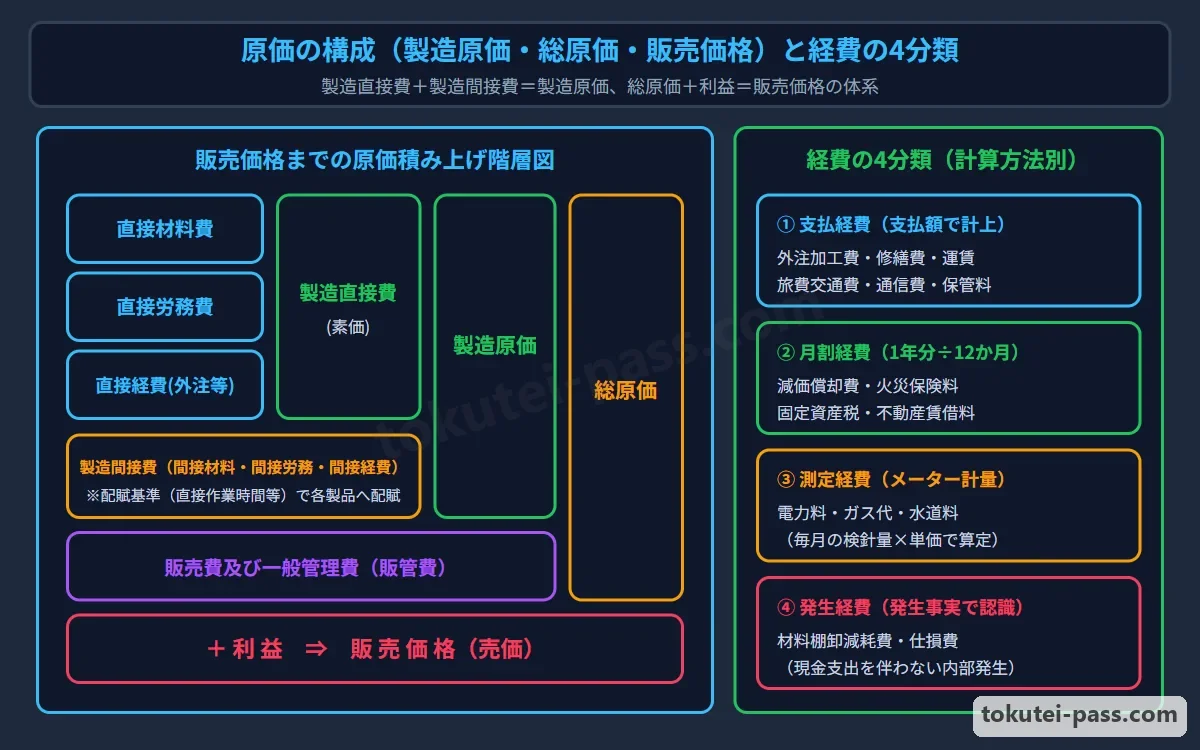
プランニング3級では「経費の4分類」が頻出です。①支払額で計上する「支払経費(外注加工費・修繕費・運賃・旅費交通費)」、②1年分を12か月に割り振る「月割経費(減価償却費・保険料・租税公課・賃借料)」、③メーター計量の「測定経費(電力料・ガス・水道料)」、④発生事実で認識する「発生経費(材料棚卸減耗費・仕損費)」です。
In the Grade 3 Planning exam, the "Four Categories of Expenses (Keihi)" by calculation method are frequently tested: ① "Payment Expenses (subcontract processing fees, repair expenses, freight, travel expenses)" recorded based on cash payment amounts; ② "Monthly Apportioned Expenses (depreciation, fire insurance premiums, property taxes, rent)" where annual amounts are divided across 12 months; ③ "Measured Expenses (electricity, gas, and water charges)" metered by gauges; and ④ "Accrued / Incurred Expenses (material inventory shrinkage, spoilage costs)" recognized upon occurrence.
特定の製品との関連では「直接費」と「間接費」に分けられます。特定製品への消費額が明確な費用は「直接費」として製品へ直接集計(「直課(賦課)」)し、複数製品に共通して発生する「間接費」は直接作業時間などの「配賦基準」によって各製品へ按分(「配賦」)します。
By traceability to specific products, costs are divided into "Direct Costs" and "Indirect Costs." Costs whose consumption amount for a specific product is clear are "Direct Costs" charged directly to that product ("Direct Assignment / Chokka / Fuka"), whereas "Indirect Costs (Overhead)" incurred in common across multiple products are distributed using "Allocation Bases" such as direct labor hours ("Allocation / Haifu").
さらに操業度(生産量)の増減との関連では、生産量に比例して増減する「変動費(直接材料費・外注加工費など)」と、生産量の増減にかかわらず一定額が発生する「固定費(定額法の減価償却費・固定給・火災保険料・固定資産税など)」に分けられます。
By behavior relative to operating volume (production quantity), costs are divided into "Variable Costs (direct material costs, subcontract processing fees, etc.)," which change in proportion to production volume, and "Fixed Costs (straight-line depreciation, fixed salaries, fire insurance, property taxes, etc.)," which remain constant regardless of production volume changes.
Key points
- 形態別3要素=材料費・労務費・経費(外注加工費や減価償却費・光熱費は「経費」に分類される)。
Three cost elements by form = Material Cost, Labor Cost, and Expenses (subcontract processing fees, depreciation, and utilities are classified under "Expenses"). - 経費の4分類:支払経費(外注加工費・修繕費・運賃)、月割経費(減価償却費・保険料・租税公課・賃借料)、測定経費(電力・ガス・水道)、発生経費(棚卸減耗費・仕損費)。
Four Expense categories: Payment Expenses (subcontracting, repairs, freight), Monthly Apportioned Expenses (depreciation, insurance, taxes, rent), Measured Expenses (electricity, gas, water), and Incurred Expenses (inventory shrinkage, spoilage). - 直接費は特定製品へ「直課(賦課)」し、間接費は配賦基準で各製品へ「配賦」する/変動費は生産量に比例し、固定費は生産量に関わらず一定。
Direct Costs are directly assigned ("Chokka") to products and Indirect Costs are allocated ("Haifu") / Variable Costs change proportionally with volume while Fixed Costs remain constant.
| Word | Meaning |
|---|---|
| 材料費・労務費・経費(原価の3要素) | Material Cost, Labor Cost, and Expenses (the 3 cost elements) |
| 支払経費・月割経費・測定経費・発生経費 | Payment Expenses, Monthly Apportioned Expenses, Measured Expenses, and Incurred Expenses |
| 直接費(直課・賦課)と間接費(配賦) | Direct Costs (direct assignment) and Indirect Costs (allocation) |
| 変動費と固定費 | Variable Costs and Fixed Costs |
3. 原価の構成体系(製造直接費・製造間接費・製造原価・総原価・販売価格)
3. Cost Structure Hierarchy (Direct Manufacturing Cost, Manufacturing Overhead, Manufacturing Cost, Total Cost, Selling Price)
形態別の3要素と直接・間接を組み合わせると、原価の階層構造が明確になります。まず「直接材料費(主要材料費・買入部品費)+直接労務費(直接工の加工賃金)+直接経費(外注加工費・専用金型費・特許権使用料など)」の合計が「製造直接費」です。
Combining the three cost elements with direct and indirect classifications clarifies the cost hierarchy. First, the sum of "Direct Material Cost (main materials, purchased parts) + Direct Labor Cost (direct workers' processing wages) + Direct Expenses (subcontract processing fees, dedicated die/mold costs, patent royalties, etc.)" equals "Direct Manufacturing Cost (Prime Cost)."
一方、「間接材料費(補助材料費・工場消耗品費)+間接労務費(間接工賃金・手待ち賃金・工場事務員給料)+間接経費(工場の減価償却費・電力料・保険料など)」の合計が「製造間接費」です。
Meanwhile, the sum of "Indirect Material Cost (auxiliary materials, factory consumables) + Indirect Labor Cost (indirect workers' wages, idle-time wages, factory office salaries) + Indirect Expenses (factory depreciation, electricity, insurance, etc.)" equals "Manufacturing Indirect Cost (Manufacturing Overhead)."
そして「製造直接費+製造間接費」が、工場で製品を造るためにかかった「製造原価(工場原価)」となります。なお、直接材料費以外の原価要素をまとめて「加工費」と呼ぶこともあります。
The sum of "Direct Manufacturing Cost + Manufacturing Overhead" is the "Manufacturing Cost (Factory Cost)" incurred to make the product in the factory. Note that cost elements other than direct material cost are often collectively called "Conversion Cost (Processing Cost)."
さらに「製造原価」に「販売費及び一般管理費(営業社員の給料・広告宣伝費・発送配達費・本社役員報酬など)」を加えたものが「総原価」であり、「総原価+利益」が「販売価格(売価)」となります。
Adding "Selling, General and Administrative Expenses (SG&A: sales staff salaries, advertising expenses, shipping/delivery costs, head-office executive compensation, etc.)" to "Manufacturing Cost" gives "Total Cost," and "Total Cost + Profit" equals the "Selling Price."
Key points
- 製造直接費=直接材料費+直接労務費+直接経費(外注加工費・特許権使用料など)。
Direct Manufacturing Cost = Direct Material Cost + Direct Labor Cost + Direct Expenses (subcontract processing fees, patent royalties, etc.). - 製造原価=製造直接費+製造間接費(工場内で発生するすべての原価)。
Manufacturing Cost = Direct Manufacturing Cost + Manufacturing Overhead (total costs incurred within the factory). - 総原価=製造原価+販売費及び一般管理費/販売価格=総原価+利益(広告宣伝費は販管費であり製造原価ではない!)。
Total Cost = Manufacturing Cost + Selling, General & Administrative Expenses (SG&A) / Selling Price = Total Cost + Profit (advertising is SG&A, NOT manufacturing cost!). - 【例】直接材料費500円・直接労務費300円・直接経費100円・製造間接費200円・販管費150円・利益250円 → 製造直接費=900円、製造原価=1,100円、総原価=1,250円、販売価格=1,500円
Example: Direct materials 500 yen, direct labor 300 yen, direct expenses 100 yen, manufacturing overhead 200 yen, SG&A 150 yen, profit 250 yen → Direct manufacturing cost = 900 yen, Manufacturing cost = 1,100 yen, Total cost = 1,250 yen, Selling price = 1,500 yen
| Word | Meaning |
|---|---|
| 製造直接費と製造間接費 | Direct Manufacturing Cost and Manufacturing Overhead (Indirect Cost) |
| 製造原価(工場原価) | Manufacturing Cost (Factory Cost) |
| 販売費及び一般管理費(販管費) | Selling, General and Administrative Expenses (SG&A) |
| 総原価と販売価格 | Total Cost and Selling Price |
4. 原価計算の手順(費目別→部門別→製品別計算と補助部門費の直接配賦法)
4. Cost Accounting Procedure (By Element → By Department → By Product and the Direct Allocation Method)
原価計算は3つのステップで進めます。第1ステップは「費目別計算(第1次集計)」で、一定期間に発生した原価を直接材料費・直接労務費・製造間接費などの費目ごとに分類・集計します。
Cost accounting proceeds in three steps. Step 1 is "Cost Calculation by Element (First-Stage Accumulation)," which classifies and totals costs incurred during a period by item—such as direct material cost, direct labor cost, and manufacturing overhead.
第2ステップは「部門別計算(第2次集計)」で、製造間接費を発生した場所(原価部門)ごとに集計します。原価部門は、直接製造作業を行う「製造部門(機械加工・組立・塗装など)」と、それを支える「補助部門(動力・修繕・運搬・検査・工場事務など)」に分かれます。
Step 2 is "Departmental Cost Calculation (Second-Stage Accumulation)," which gathers manufacturing overhead by the place (cost department) where it occurred. Cost departments are divided into "Production Departments (machining, assembly, painting, etc.)" that directly perform manufacturing work, and "Auxiliary (Service) Departments (power, maintenance/repair, transport, inspection, factory administration, etc.)" that support them.
補助部門に集計された費用は、最終的に製造部門へ配賦します。このとき、補助部門相互間のサービスのやり取りを無視して、補助部門費を「製造部門だけに直接按分」する方法を「直接配賦法」といい、計算問題で最もよく出題されます。
Costs accumulated in auxiliary departments are ultimately allocated to production departments. The method that ignores mutual service exchanges among auxiliary departments and allocates auxiliary department costs directly "only to production departments" is called the "Direct Allocation Method"—the most frequently tested allocation calculation.
第3ステップは「製品別計算(第3次集計)」で、各製造部門に集まった製造間接費を製品ごとに配賦し、製造直接費と合算して製品単位あたりの製造原価を算定します。
Step 3 is "Product Cost Calculation (Third-Stage Accumulation)," which allocates the manufacturing overhead gathered in each production department to individual products and adds direct manufacturing costs to determine the manufacturing cost per product unit.
Key points
- 原価計算の3ステップ:①費目別計算(要素別集計)→②部門別計算(製造間接費の部門集計)→③製品別計算。
Three steps of cost accounting: ① By Cost Element → ② By Department (accumulating manufacturing overhead by department) → ③ By Product. - 製造部門=製品を直接製造する部門(加工・組立等)/補助部門=製造を支援する部門(動力・修繕・運搬・工場事務等)。
Production Departments = departments directly making products (machining, assembly) / Auxiliary Departments = departments supporting production (power, repair, transport, factory office). - 補助部門費の「直接配賦法」=補助部門どうしの配賦は行わず、製造部門の配賦基準の比率だけで直接製造部門へ配賦する。
Direct Allocation Method for auxiliary department costs = ignores inter-auxiliary-department services and allocates auxiliary costs directly to production departments based solely on production department ratios. - 【例】動力部門費90万円(製造1:4,000kWh、製造2:2,000kWh、修繕補助部門:1,000kWh)を直接配賦法で配賦 → 製造部門合計6,000kWhで按分し、製造1=60万円・製造2=30万円
Example: Allocating power department cost of 900,000 yen (Mfg 1: 4,000 kWh, Mfg 2: 2,000 kWh, Repair support dept: 1,000 kWh) via direct allocation method → Prorated over 6,000 kWh total for manufacturing depts: Mfg 1 = 600,000 yen, Mfg 2 = 300,000 yen
| Word | Meaning |
|---|---|
| 費目別計算・部門別計算・製品別計算 | calculation by cost element, by department, and by product |
| 製造部門と補助部門 | Production Departments and Auxiliary (Service) Departments |
| 直接配賦法(補助部門費の配賦) | Direct Allocation Method (allocating auxiliary department costs) |
5. 個別原価計算と総合原価計算の5分類(月末仕掛品の完成品換算量)
5. Job-Order Costing and the 5 Types of Process Costing (Equivalent Units of Ending WIP)
製品別計算は生産形態により2つに分かれます。多品種少量の「受注個別生産(造船・特注機械・金型など)」では、注文ごとの「製造指図書」別に原価を集計する「個別原価計算」を用います。一方、少品種多量の「見込連続生産」では、1か月などの期間の総製造費用を完成品数量で割る「総合原価計算」を用います。
Product cost calculation is divided into two methods according to production type. High-mix low-volume "make-to-order individual production (shipbuilding, custom machinery, dies/molds, etc.)" uses "Job-Order Costing," which accumulates costs separately for each "Production Order." Conversely, low-mix high-volume "make-to-stock continuous production" uses "Process Costing," dividing total period manufacturing costs (e.g., 1 month) by finished output.
「総合原価計算」は5つに分かれます。①単一製品を量産する「単純」、②同一製品のサイズ・規格違いを等価係数で按分する「等級別」、③異種製品を組ごとに連続生産する「組別」、④複数工程ごとに計算する「工程別」、⑤原料がすべて第1工程始点で投入される際に加工費のみ工程別に計算する「加工費工程別総合原価計算」です。
"Process Costing" is subdivided into five types based on product and process structure: ① "Simple Process Costing" for mass-producing a single product in one process; ② "Grade Process Costing" using equivalence coefficients when the same product has different sizes/grades; ③ "Lot (Class) Process Costing" when different products are continuously produced in lots/groups; ④ "Multi-Process Costing" calculated separately across two or more sequential processes; and ⑤ "Conversion-Cost-Only Multi-Process Costing" where all raw materials are input at the start of Process 1 and only conversion costs are calculated by process.
総合原価計算において月末に未完成の「月末仕掛品」が残っている場合、工程の始点ですべて投入される「直接材料費」は、完成品数量と月末仕掛品数量の「そのままの個数比」で按分します。
In process costing, when unfinished "Ending Work-in-Process (WIP)" remains at month-end, "Direct Material Cost"—where all material is input at the start of the process—is apportioned using the "raw physical quantity ratio" between finished goods quantity and ending WIP quantity.
これに対し、工程の進行に応じて消費される「加工費(労務費+経費)」は、月末仕掛品数量に「加工進捗度(%)」を掛けた「月末仕掛品の完成品換算量=月末仕掛品数量×加工進捗度」を用いて按分します。
In contrast, "Conversion Cost (processing cost = labor + overhead)," which is expended progressively as the process advances, uses the "Equivalent Units of Ending WIP = Ending WIP Quantity × Degree of Completion (%)" and apportions conversion cost according to the ratio between finished goods quantity and ending WIP equivalent units.
Key points
- 個別原価計算=受注生産・個別生産向き(製造指図書ごとに集計)/総合原価計算=見込・連続大量生産向き(1か月の期間原価を完成品と月末仕掛品に按分)。
Job-Order Costing = suited for make-to-order production (by production order) / Process Costing = suited for continuous mass production (apportioning monthly period costs between finished goods and ending WIP). - 総合原価計算の5分類:単純(単一製品)・等級別(同種製品のサイズ違い)・組別(異種製品のロット生産)・工程別・加工費工程別。
Five types of Process Costing: Simple (single product), Grade (same product, different sizes), Lot/Class (different products in lots), Multi-Process, and Conversion-Cost Multi-Process. - 総合原価計算の加工費は「月末仕掛品の完成品換算量=月末仕掛品数×進捗度(%)」で按分する。
Conversion cost in process costing is apportioned using "Equivalent Units of Ending WIP = Ending WIP Quantity × Degree of Completion (%)." - 【例】完成品400個・月末仕掛品200個(始点投入の直接材料費60万円) → 月末仕掛品材料費=60万×200÷(400+200)=20万円(完成品分40万円)
Example: 400 finished units, 200 month-end WIP units (direct material cost added at start: 600,000 yen) → Month-end WIP material cost = 600,000 × 200 ÷ (400 + 200) = 200,000 yen (finished goods portion: 400,000 yen) - 【例】完成品400個・月末仕掛品200個(加工進捗度50%)・当月加工費50万円 → 完成品換算量=200×0.5=100個、月末仕掛品加工費=50万×100÷(400+100)=10万円(完成品分40万円)
Example: 400 finished units, 200 month-end WIP units (50% conversion completion), monthly conversion cost 500,000 yen → Equivalent finished units = 200 × 0.5 = 100 units, month-end WIP conversion cost = 500,000 × 100 ÷ (400 + 100) = 100,000 yen (finished goods portion: 400,000 yen)
| Word | Meaning |
|---|---|
| 個別原価計算(受注生産・製造指図書) | Job-Order Costing (make-to-order and production orders) |
| 単純・等級別・組別・工程別総合原価計算 | Simple, Grade, Lot (Class), and Multi-Process Costing |
| 月末仕掛品と加工進捗度 | Ending Work-in-Process (WIP) and Degree of Completion |
| 完成品換算量 | Equivalent Units of production |
6. 標準原価計算と原価差異分析(直接材料費差異と直接労務費差異)
6. Standard Costing and Cost Variance Analysis (Material Cost Variances and Labor Cost Variances)
科学的・統計的調査に基づいて製品1個あたりの「標準単価×標準消費量」から算定した目標原価を「標準原価」といい、実際にかかった「実際原価」との差額である「原価差異(標準原価-実際原価)」を原因別に分析します(実際の方が大きい場合は「不利差異=マイナス」となります)。
A target cost calculated from "Standard Unit Price × Standard Quantity Consumed" per product based on scientific and statistical study is called "Standard Cost"; the difference between standard cost and actual cost incurred—the "Cost Variance (Standard Cost - Actual Cost)"—is analyzed by cause (when actual cost exceeds standard cost, it is an "Unfavorable Variance = negative").
「直接材料費差異」は2つの原因に分けて計算します。1つ目は購入価格の高騰などによる「価格差異=(標準単価-実際単価)×実際消費量」です。
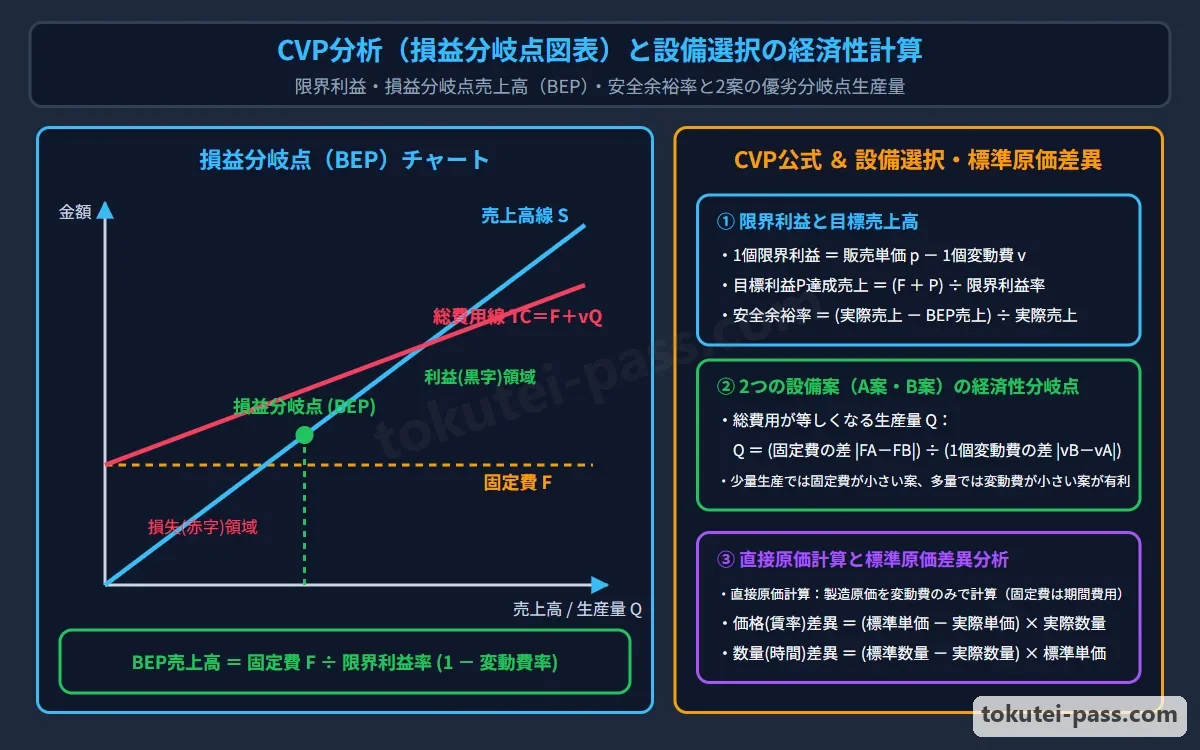
"Direct Material Cost Variance" is broken down into two causes. First is the "Price Variance = (Standard Unit Price - Actual Unit Price) × Actual Quantity Consumed," caused by fluctuations in purchase prices.
2つ目は現場での歩留まり悪化やムダ遣いによる「数量差異=(標準消費量-実際消費量)×標準単価」です。
Second is the "Quantity (Usage) Variance = (Standard Quantity Consumed - Actual Quantity Consumed) × Standard Unit Price," caused by poor material yield or overuse on the shop floor.
同様に「直接労務費差異」も、「賃率差異=(標準賃率-実際賃率)×実際作業時間」と、「作業時間差異(能率差異)=(標準作業時間-実際作業時間)×標準賃率」の2つに分解して管理責任を明確にします。
Similarly, "Direct Labor Cost Variance" is separated into two components to clarify management responsibility: the "Wage Rate Variance = (Standard Wage Rate - Actual Wage Rate) × Actual Direct Labor Hours" and the "Labor Efficiency (Time) Variance = (Standard Direct Labor Hours - Actual Direct Labor Hours) × Standard Wage Rate."
Key points
- 実際原価が標準原価を上回った(コスト超過した)場合は「不利差異(マイナス)」、下回った場合は「有利差異(プラス)」。
When actual cost exceeds standard cost (cost overrun), it is an "Unfavorable Variance (negative)"; when actual cost is lower than standard, it is a "Favorable Variance (positive)." - 直接材料費:価格差異=(標準単価-実際単価)×実際数量/数量差異=(標準数量-実際数量)×標準単価。
Direct Material Cost: Price Variance = (Standard Price - Actual Price) × Actual Quantity / Quantity Variance = (Standard Quantity - Actual Quantity) × Standard Price. - 直接労務費:賃率差異=(標準賃率-実際賃率)×実際時間/時間差異=(標準時間-実際時間)×標準賃率。
Direct Labor Cost: Rate Variance = (Standard Rate - Actual Rate) × Actual Hours / Time (Efficiency) Variance = (Standard Hours - Actual Hours) × Standard Rate. - 【例】直接材料費(標準単価400円/kg・実際単価420円/kg、標準消費量500kg・実際消費量480kg) → 価格差異=(400-420)×480=-9,600円(不利)、数量差異=(500-480)×400=+8,000円(有利)
Example: Direct materials (standard price 400 yen/kg, actual price 420 yen/kg; standard quantity 500 kg, actual quantity 480 kg) → Price variance = (400 − 420) × 480 = −9,600 yen (unfavorable), Quantity variance = (500 − 480) × 400 = +8,000 yen (favorable) - 【例】直接労務費(標準賃率1,500円/時・実際賃率1,600円/時、標準時間200時間・実際時間210時間) → 賃率差異=(1,500-1,600)×210=-21,000円(不利)、作業時間差異=(200-210)×1,500=-15,000円(不利)
Example: Direct labor (standard wage rate 1,500 yen/h, actual rate 1,600 yen/h; standard hours 200 h, actual hours 210 h) → Wage rate variance = (1,500 − 1,600) × 210 = −21,000 yen (unfavorable), Labor efficiency variance = (200 − 210) × 1,500 = −15,000 yen (unfavorable)
| Word | Meaning |
|---|---|
| 標準原価計算と原価差異(有利差異・不利差異) | Standard Costing and Cost Variance (favorable vs. unfavorable variance) |
| 価格差異と数量差異(直接材料費) | Price Variance and Quantity Variance (direct material cost) |
| 賃率差異と作業時間差異(直接労務費) | Wage Rate Variance and Labor Efficiency / Time Variance (direct labor cost) |
7. CVP分析(損益分岐点・限界利益)と損益計算書の5段階利益
7. CVP Analysis (Break-Even Point, Contribution Margin) and the 5 Profit Stages of the Income Statement
原価(Cost)・販売量(Volume)・利益(Profit)の関係を分析する手法を「CVP分析(損益分岐点分析)」といいます。まず売上高から変動費だけを差し引いた「限界利益=売上高-変動費(=固定費+利益)」と、「限界利益率=限界利益÷売上高=1-変動費率(変動費÷売上高)」を求めます。
The technique analyzing the relationship among Cost, Volume, and Profit is called "CVP Analysis (Break-Even Analysis)." First, we find the "Contribution Margin (Marginal Profit) = Sales - Variable Costs (= Fixed Costs + Profit)" and the "Contribution Margin Ratio = Contribution Margin ÷ Sales = 1 - Variable Cost Ratio (Variable Costs ÷ Sales)."
利益がちょうどゼロになる(売上高=総費用、すなわち限界利益=固定費となる)売上高を「損益分岐点売上高」といい、「損益分岐点売上高=固定費÷限界利益率=固定費÷(1-変動費率)」で計算します。また「目標利益達成売上高=(固定費+目標利益)÷限界利益率」となります。
The sales volume at which profit is exactly zero (Sales = Total Costs, meaning Contribution Margin = Fixed Costs) is "Break-Even Sales = Fixed Costs ÷ Contribution Margin Ratio = Fixed Costs ÷ (1 - Variable Cost Ratio)." Furthermore, "Sales Required for Target Profit = (Fixed Costs + Target Profit) ÷ Contribution Margin Ratio."
一方、財務会計の「損益計算書(P/L)」における5段階の利益は、①「売上総利益(粗利益)=売上高-売上原価」、②本業の儲けである「営業利益=売上総利益-販売費及び一般管理費」、③財務収支を加減した「経常利益=営業利益+営業外収益-営業外費用」と続きます。
Meanwhile, in financial accounting's "Income Statement (P/L)," the five profit stages begin with: ① "Gross Profit = Sales - Cost of Goods Sold," ② core business profit "Operating Profit = Gross Profit - Selling, General & Administrative Expenses (SG&A)," and ③ "Ordinary Profit = Operating Profit + Non-Operating Income - Non-Operating Expenses."
さらにプランニング3級では、④臨時の損益を加減した「税引前当期純利益=経常利益+特別利益(固定資産売却益など)-特別損失(災害損失など)」、および⑤最終利益である「当期純利益=税引前当期純利益-法人税・住民税及び事業税(法人税等)」まで5段階すべてが計算問題として出題されます。
In the Grade 3 Planning exam, all five stages are tested, continuing to: ④ "Income Before Income Taxes = Ordinary Profit + Extraordinary Income (gains on sale of fixed assets, etc.) - Extraordinary Losses (disaster losses, etc.)," and ⑤ the final bottom line "Net Income (Profit Attributable to Owners) = Income Before Income Taxes - Corporate, Inhabitant, and Enterprise Taxes."
Key points
- 限界利益=売上高-変動費/損益分岐点売上高=固定費÷限界利益率/目標利益達成売上高=(固定費+目標利益)÷限界利益率。
Contribution Margin = Sales - Variable Costs / Break-Even Sales = Fixed Costs ÷ Contribution Margin Ratio / Target Profit Sales = (Fixed Costs + Target Profit) ÷ Contribution Margin Ratio. - 損益計算書の5段階利益:①売上総利益→②営業利益→③経常利益→④税引前当期純利益(経常利益+特別利益-特別損失)→⑤当期純利益(税引前当期純利益-法人税等)。
Five Profit Stages on the Income Statement: ① Gross Profit → ② Operating Profit → ③ Ordinary Profit → ④ Income Before Taxes (adding/subtracting extraordinary gains/losses) → ⑤ Net Income (after corporate taxes). - 損益分岐点比率=損益分岐点売上高÷実際売上高(低いほど経営が安全で、安全余裕率=1-損益分岐点比率)。
Break-Even Point Ratio = Break-Even Sales ÷ Actual Sales (lower is safer; Margin of Safety Ratio = 1 - Break-Even Point Ratio). - 【例】売上高5,000万円・変動費3,000万円・固定費1,200万円・目標利益400万円 → 限界利益=5,000-3,000=2,000万円(限界利益率=2,000÷5,000=40%)、損益分岐点売上高=1,200÷0.4=3,000万円、目標利益達成売上高=(1,200+400)÷0.4=4,000万円
Example: Sales 50M yen, variable costs 30M yen, fixed costs 12M yen, target profit 4M yen → Marginal profit = 50 − 30 = 20M yen (marginal profit ratio = 20 ÷ 50 = 40%), Break-even sales = 12 ÷ 0.4 = 30M yen, Sales for target profit = (12 + 4) ÷ 0.4 = 40M yen - 【例】売上高4,000万円・売上原価2,500万円・販管費800万円・営業外収益50万円・営業外費用150万円・特別損失100万円・法人税等200万円 → 売上総利益1,500万円、営業利益700万円、経常利益600万円、税引前当期純利益500万円、当期純利益300万円
Example: Sales 40M yen, COGS 25M yen, SG&A 8M yen, non-operating income 0.5M yen, non-operating expenses 1.5M yen, extraordinary loss 1M yen, corporate taxes 2M yen → Gross profit 15M, Operating profit 7M, Ordinary profit 6M, Income before taxes 5M, Net income 3M yen
| Word | Meaning |
|---|---|
| 限界利益と限界利益率 | Contribution Margin (marginal profit) and Contribution Margin Ratio |
| 損益分岐点売上高(CVP分析) | Break-Even Sales (CVP Analysis) |
| 売上総利益・営業利益・経常利益 | Gross Profit, Operating Profit, and Ordinary Profit |
| 税引前当期純利益と当期純利益 | Income Before Income Taxes and Net Income |
8. 原価企画(控除法・積上法)・VA/VEと設備選択の経済性計算
8. Target Costing (Subtraction vs. Addition Methods), VA/VE, and Engineering Economy for Equipment Selection
新製品開発の「原価企画」における目標原価の設定方法には、①予想販売価格から目標利益を差し引いてトップダウンで「許容原価=予想販売価格-目標利益」を求める「控除法(割付法)」、②現状の設計・製造技術からボトムアップで「成行原価(見積原価)」を求める「積上法」、③両者をすり合わせる「折衷法(統合法)」があります。
In "Target Costing" for new product development, target cost is set by three methods: ① the "Subtraction Method (Deductive Method)," a top-down approach subtracting target profit from expected selling price to find "Allowable Cost = Expected Selling Price - Target Profit"; ② the "Addition Method (Accumulation Method)," a bottom-up approach summing current design/manufacturing costs to find "Drifting (Estimated) Cost"; and ③ the "Compromise (Integrated) Method" reconciling both.
目標原価を達成する原価低減手法が「VA(価値分析:既存製品対象)/VE(価値工学:設計開発段階対象)」です。製品の「価値(V)=機能(F:果たすべき働き)÷コスト(C)」と定義し、不必要な過剰機能を削ったり、より安価な代替材料で同じ機能を実現したりして価値Vを高めます。
The cost-reduction methodology for achieving target cost is "VA (Value Analysis: for existing products) / VE (Value Engineering: for the design stage)." Defining "Value (V) = Function (F: required role) ÷ Cost (C)," VA/VE increases Value V by eliminating unnecessary excess functions or achieving the same function with cheaper alternative materials.
さらにプランニング3級では、複数の生産設備(または内外製案)のうち最も経済的(総原価が最小)な案を選ぶ「経済性工学(採算計算)」が出題されます。各設備の年間総原価は「総原価=固定費+(製品1個あたり変動費×生産量Q)」で表されます。
Furthermore, the Grade 3 Planning exam tests "Engineering Economy (Economic Comparison)" for choosing the most economical production equipment (or make-vs.-buy option) that minimizes total cost. The annual total cost for each machine is expressed as "Total Cost = Fixed Cost + (Unit Variable Cost × Production Quantity Q)."
2つの設備A・Bの総原価が等しくなる「分岐点生産量Q」は、「Q=固定費の差額÷1個あたり変動費の差額」で求められます。生産量がこの分岐点Qより少なければ「固定費が安い設備」が有利であり、分岐点Qより多ければ「1個あたり変動費が安い(高性能な)設備」が有利となります。
The "Break-Even (Indifference) Production Volume Q" at which two machines A and B have equal total costs is found by "Q = Difference in Fixed Costs ÷ Difference in Unit Variable Costs." For production volumes below Q, the "machine with lower Fixed Cost" is advantageous; for volumes above Q, the "machine with lower Unit Variable Cost (higher-performance machine)" is advantageous.
Key points
- 控除法(割付法)=「許容原価=予想売価-目標利益」/積上法=現状技術から積み上げる「成行原価」/VA・VE=「価値V=機能F÷コストC」。
Subtraction Method = "Allowable Cost = Expected Selling Price - Target Profit" / Addition Method = bottom-up "Drifting Cost" / VA・VE = "Value V = Function F ÷ Cost C." - 設備選択の分岐点生産量Q=固定費の差÷1個あたり変動費の差(少量生産では固定費が小さい設備、大量生産では変動費が小さい設備が有利)。
Equipment selection break-even volume Q = Fixed Cost Difference ÷ Unit Variable Cost Difference (low volume favors low-fixed-cost equipment; high volume favors low-variable-cost equipment). - 【例】予想販売価格3,000円・目標利益600円・成行原価2,650円 → 許容原価=3,000-600=2,400円(原価低減目標額=2,650-2,400=250円)
Example: Expected selling price 3,000 yen, target profit 600 yen, drifting cost 2,650 yen → Allowable cost = 3,000 − 600 = 2,400 yen (cost reduction target = 2,650 − 2,400 = 250 yen) - 【例】設備X(固定費200万円・変動費500円/個)と設備Y(固定費500万円・変動費200円/個) → 分岐点生産量Q=(500万-200万)÷(500-200)=10,000個(1万個未満はX、1万個超はYが有利)
Example: Equipment X (fixed cost 2M yen, variable cost 500 yen/unit) vs. Equipment Y (fixed cost 5M yen, variable cost 200 yen/unit) → Break-even volume Q = (5M − 2M) ÷ (500 − 200) = 10,000 units (choose X below 10,000 units, choose Y above 10,000 units)
| Word | Meaning |
|---|---|
| 控除法(許容原価)と積上法(成行原価) | Subtraction Method (Allowable Cost) and Addition Method (Drifting Cost) |
| VA(価値分析)とVE(価値工学:V=F÷C) | VA (Value Analysis) and VE (Value Engineering: V = F ÷ C) |
| 経済性計算(設備選択の分岐点生産量) | Engineering Economy (break-even production volume for equipment selection) |
試験によく出るポイントと覚え方
High-Frequency Exam Points and Memory Aids
原価管理は計算と分類の宝庫です。①「製造原価=製造直接費+製造間接費」では、広告宣伝費や販売員給与(これらは販管費!)を絶対に製造原価に入れないこと、逆に外注加工費は「直接経費(支払経費)」として製造原価に含めることが鉄則です。
Cost Management is packed with calculation and classification questions. ① In "Manufacturing Cost = Direct Manufacturing Cost + Manufacturing Overhead," never include advertising or sales staff salaries (those are SG&A!) in manufacturing cost; conversely, always include subcontract processing fees in manufacturing cost as a "Direct Expense (Payment Expense)."
②プランニング特有の分類として、「経費の4分類(支払経費=外注費・修繕費、月割経費=減価償却費・保険料・税金、測定経費=電気・ガス・水道、発生経費=棚卸減耗費・仕損費)」と「総合原価計算の5分類(単純・等級別・組別・工程別・加工費工程別)」を確実に区別しましょう。
② For Planning-specific classifications, clearly distinguish the "4 Categories of Expenses (Payment = subcontracting/repairs, Monthly Apportioned = depreciation/insurance/taxes, Measured = electricity/gas/water, Incurred = inventory shrinkage/spoilage)" and the "5 Types of Process Costing (Simple, Grade, Lot/Class, Multi-Process, Conversion-Cost Multi-Process)."
③「補助部門費の直接配賦法」では他の補助部門への提供分を無視して製造部門の比率だけで按分し、④「総合原価計算」では加工費を月末仕掛品の完成品換算量(数量に加工進捗度を乗じた数)で按分します。
③ In the "Direct Allocation Method for Auxiliary Department Costs," ignore services provided to other auxiliary departments and prorate solely by production department ratios; ④ In "Process Costing," always apportion conversion cost using the Equivalent Units of ending WIP (multiplying ending WIP quantity by the percentage of completion).
⑤「損益計算書の5段階利益(売上総利益→営業利益→経常利益→税引前当期純利益→当期純利益)」、⑥「損益分岐点売上高(固定費を限界利益率で割る)」、⑦「設備選択の分岐点生産量(固定費の差を変動費単価の差で割る)」を押さえれば満点が狙えます。
⑤ Master the "5 Profit Stages on the Income Statement (Gross Profit → Operating Profit → Ordinary Profit → Income Before Taxes → Net Income)," ⑥ "Break-Even Sales (dividing Fixed Costs by the Contribution Margin Ratio)," and ⑦ "Equipment Selection Break-Even Volume (dividing the Fixed Cost difference by the Unit Variable Cost difference)" to aim for a full score.
Key points
- 経費の4分類:支払(外注・修繕)・月割(減価償却・保険・税金)・測定(電力・ガス・水道)・発生(棚卸減耗・仕損)。
4 Expense Categories: Payment (subcontracting, repairs), Monthly Apportioned (depreciation, insurance, taxes), Measured (power, gas, water), Incurred (inventory shrinkage, spoilage). - 損益計算書:売上総利益→営業利益→経常利益→税引前当期純利益(特別損益を加減)→当期純利益(法人税等を控除)。
Income Statement: Gross Profit → Operating Profit → Ordinary Profit → Income Before Taxes (plus/minus extraordinary items) → Net Income (minus corporate taxes). - 損益分岐点売上高=固定費÷限界利益率/設備の分岐点生産量=固定費の差÷1個あたり変動費の差。
Break-Even Sales = Fixed Costs ÷ Contribution Margin Ratio / Equipment Break-Even Volume = Fixed Cost Difference ÷ Unit Variable Cost Difference.
| Word | Meaning |
|---|---|
| 経費の4分類と総合原価計算の5分類 | 4 Expense Categories and 5 Types of Process Costing |
| 製造原価と総原価・5段階利益 | Manufacturing Cost, Total Cost, and 5 Profit Stages |
| 完成品換算量による加工費按分 | apportioning conversion cost using Equivalent Units |
| 損益分岐点と設備選択の経済性計算 | Break-Even Point and Engineering Economy for equipment selection |
Cost Management
Practice this chapter in the appOfficial references
- 中央職業能力開発協会(JAVADA) ビジネス・キャリア検定試験 3級 生産管理プランニング 試験範囲 — https://www.javada.or.jp/jigyou/gino/business/subject.html
- 中央職業能力開発協会 編『ビジネス・キャリア検定試験 標準テキスト【専門知識】生産管理プランニング 3級』 — https://www.javada.or.jp/jigyou/gino/business/text.html